
Walk into a store in a state where marijuana isn't legal for recreation, and you might see a can of THC-infused seltzer. It feels a bit like a glitch in the system, but it’s not. The secret behind how these drinks are legal boils down to one landmark piece of legislation: the 2018 Farm Bill.
This federal law drew a sharp, clear line in the sand between hemp and marijuana, and it all came down to a simple chemical measurement. If a product comes from hemp and contains no more than 0.3% Delta-9 THC by dry weight, it's federally legal. Simple as that.
The Surprising Legality of THC Drinks Explained
So, how does that translate into a drink that actually gives you a buzz? The magic is in the math and that specific phrase—"by dry weight."
When you apply the 0.3% THC limit to the total weight of a beverage, which is mostly water, you have a surprising amount of room to work with. A standard 12-ounce can has enough mass to legally contain a noticeable dose, like 5mg of THC, without ever crossing that federal threshold. It’s a precise formulation, not a legal loophole.
The 2018 Farm Bill didn't just decriminalize hemp; it reclassified it as a standard agricultural commodity. This shift unlocked a national market for hemp-derived products, creating a distinct and legal pathway for beverages that exist completely outside of state-run marijuana programs.
Core Pillars of Legality
The entire industry for these drinks is built on a few core principles. Getting a handle on them shows you exactly how brands can produce and sell these beverages with confidence, all while staying on the right side of federal law.
Think of it this way: the law created a specific, narrow category for a product. It's less about finding a clever workaround and more about formulating a product to fit perfectly within the precise definition laid out by federal law.
This legal foundation is also why you can often buy these drinks online and have them shipped across state lines. But—and this is a big but—the rules aren't the same everywhere. The regulatory world is a patchwork, and states can, and do, create their own rules. For a deeper dive into how complex it can get, exploring the different Delta-8 vs Delta-9 THC shipping restrictions shows just how much the details matter.
To really clarify how this all works, it helps to see the foundational rules side-by-side.
Key Pillars of THC Drink Legality at a Glance
This table breaks down the fundamental legal and regulatory points that make hemp-derived THC beverages possible.
| Pillar | What It Means | Why It Matters for Legality |
|---|---|---|
| Federal Law | The 2018 Farm Bill officially legalized industrial hemp and its natural extracts nationwide. | It created the overarching legal authority for these products, setting them apart from state marijuana laws. |
| Hemp-Derived | The THC in the beverage must be sourced exclusively from legally cultivated hemp plants. | This is the crucial distinction that separates these drinks from marijuana, which is still a federally controlled substance. |
| 0.3% THC Limit | By law, the final product cannot contain more than 0.3% Delta-9 THC when measured by its dry weight. | This is the hard-and-fast scientific rule that determines if a beverage is a compliant hemp product or illegal marijuana. |
| State Oversight | Even with federal legality, individual states have the power to regulate or outright ban these products. | Federal approval is just the first step. Local state laws ultimately decide if these drinks can be sold in your area. |
Understanding these pillars is key to navigating the world of THC beverages, whether you're a consumer curious about what's on the shelf or a brand looking to create a compliant product.
The 2018 Farm Bill: The Law That Changed Everything
To really wrap your head around how THC drinks are legal, we have to go back to one pivotal piece of legislation. The Agriculture Improvement Act of 2018, known to everyone in the industry as the 2018 Farm Bill, completely redrew the map for cannabis in America. It didn't legalize all cannabis—not by a long shot. Instead, it drew a very specific line in the sand.
Before this bill, the federal government lumped all cannabis plants together as "marijuana," a Schedule I controlled substance. The 2018 Farm Bill blew that up by creating an entirely new, federally legal category: "hemp."
What separates illegal marijuana from legal hemp isn't how the plant looks or its genetic makeup. It all boils down to a single chemical measurement: its concentration of Delta-9 THC, the compound that creates the "high."
The Critical 0.3% THC Threshold
The law was crystal clear. It defined hemp as any part of the cannabis sativa plant that contains no more than 0.3% Delta-9 THC on a dry weight basis. If a plant or anything made from it crosses that line, it's legally considered marijuana and remains federally illegal.
Think of it like the difference between decaf and regular coffee. Both drinks come from the same bean, but the amount of a specific chemical—caffeine—changes how we classify them. The 0.3% THC limit works the same way, acting as the sole legal distinction between federally legal hemp and its controlled cousin.
By removing hemp from the Controlled Substances Act, the 2018 Farm Bill effectively turned it into a regular agricultural commodity. This was the moment that cracked the door open for a national market of hemp-derived products, including the very THC beverages we see on shelves today.
This simple reclassification sent major shockwaves through the market, creating immediate new realities for both businesses and consumers.
- Interstate Commerce: For the first time, compliant hemp products could be shipped and sold across state lines, something that was unthinkable before.
- Wider Accessibility: These products could now be sold outside of state-licensed marijuana dispensaries, popping up in regular retail stores and online shops.
- Product Innovation: It gave brands the green light to create sophisticated new products, like precisely dosed seltzers and sparkling waters.
Paving the Way for Modern Beverages
This new legal landscape was the spark that ignited the THC beverage boom. The bill was signed into law on December 20, 2018, and smart entrepreneurs immediately saw an opportunity. They could create drinks that delivered a mild, enjoyable buzz while staying perfectly within the new federal guidelines.
Innovators started developing beverages aimed at health-conscious consumers searching for alternatives to alcohol—often creating low-calorie, zero-sugar options with broad appeal. If you're interested in the numbers, you can explore projections on the growth of cannabis-based beverages to see just how big this market has become.
But this federal law is just the first piece of the puzzle. It set the baseline for legality but also gave states the power to write their own, often stricter, rules. So while the Farm Bill explains how THC drinks are legal nationally, the story gets a lot more complex when you start looking at state and local laws. Even so, it all starts here.
Decoding the Crucial Dry Weight Calculation
The secret to a federally legal THC beverage isn't just about where the THC comes from; it's about simple but powerful math. The entire industry hinges on one key phrase from the 2018 Farm Bill: 0.3% by dry weight. At first glance, applying a "dry weight" rule to a liquid seems confusing, but it’s actually the very thing that makes these drinks possible.
Think of it this way: imagine you have a huge, heavy pitcher of lemonade. Now, you stir in a single grain of sugar. That one grain is the THC, and the lemonade is the rest of the beverage. Because the liquid is so much heavier and makes up virtually all of the product's total weight, the sugar's weight becomes an incredibly tiny fraction of the whole.
This is exactly how a standard 12-ounce can of seltzer can contain a noticeable amount of THC—say, 5mg or 10mg—while staying well under that 0.3% federal threshold. The total weight of the liquid dilutes the THC to a compliant level, even though the dose is enough to feel.
Understanding the Math in Practice
So how does this work in the real world? Let’s break down the numbers.
A typical 12-ounce beverage weighs around 355 grams, which is a whopping 355,000 milligrams. To figure out the maximum legal amount of THC, you just multiply that total weight by the legal limit (0.3%, or 0.003).
- Total Beverage Weight: 355,000 mg
- Legal THC Limit: 0.3% (or 0.003)
- The Math: 355,000 mg x 0.003 = 1,065 mg of THC
That’s right—a single 12-ounce drink could theoretically hold up to 1,065 milligrams of Delta-9 THC and still be a federally compliant hemp product. This is a massive amount, far more than anyone would ever want in a single serving.
This is why most brands, including our Day Dreamer seltzers, stick to much lower, more enjoyable doses like 5mg or 10mg. It keeps the experience pleasant and ensures the products are safely and comfortably within legal limits.
It's important to realize this isn't some shady loophole. It's a direct and intended application of the law, and it's what allows brands to create effective, enjoyable products that can be sold far beyond states with recreational marijuana programs.
This legal framework draws a very clear line in the sand between federally compliant hemp beverages and the traditional marijuana edibles you'd find in a state-licensed dispensary. They might both contain THC, but their sourcing, legal status, and how you can buy them are worlds apart.
Hemp Drinks Versus Marijuana Edibles
For consumers, the difference is huge. One is an agricultural product, legal at the federal level and available in many mainstream stores. The other is a state-regulated product you can only buy in licensed dispensaries. Understanding this distinction is key to knowing why you can find a THC seltzer at your local bottle shop but need to visit a special dispensary for a THC gummy.
To make this crystal clear, let's compare the two side-by-side.
Hemp-Derived THC Drinks vs. Marijuana Edibles
This table breaks down the core differences between Farm Bill-compliant drinks and edibles from state-legal marijuana markets.
| Feature | Hemp-Derived THC Drinks | State-Legal Marijuana Edibles |
|---|---|---|
| Legal Basis | 2018 Federal Farm Bill | State-specific cannabis laws |
| THC Source | Exclusively from legal hemp plants | From marijuana plants |
| THC Limit | Capped at 0.3% Delta-9 THC by dry weight | Varies by state; often capped per serving and package (e.g., 10mg per serving, 100mg per package) |
| Accessibility | Can be sold online and in general retail stores in permissive states | Restricted to sale in licensed dispensaries to adults (21+) |
| Federal Status | Legal as an agricultural commodity | Federally illegal (classified as a Schedule I substance) |
As you can see, the dry weight calculation is the engine driving the entire legal hemp beverage industry. It’s the mechanism that created a unique and accessible market that operates completely separately from state-run marijuana systems.
Navigating the Complex Patchwork of State Laws
While the 2018 Farm Bill opened the door for legal THC drinks on a federal level, the real story unfolds state by state. Think of the federal law as setting a baseline—a foundation to build upon. But from there, each state gets to be its own architect, deciding exactly what’s allowed within its borders. This has created a confusing and often contradictory patchwork of rules that both brands and buyers need to understand.
It's a bit like the relationship between federal and state speed limits. The federal government might provide guidance for interstate highways, but the moment you cross a state line, the actual number on the sign can change. What's a perfectly legal 75 mph in one state could get you a hefty ticket in the next. The same logic applies here; a THC beverage that's 100% legal in one state could be completely banned just one town over.
This is the most critical piece of the puzzle when asking how are THC drinks legal. Their legality is always a two-part equation: they must be compliant with federal law and accepted by state law.
The Three Tiers of State Regulation
To get a handle on this messy landscape, it helps to think of states as falling into one of three general buckets. This isn't a definitive legal list—laws change fast—but it’s a great framework for understanding what you're dealing with.
- Permissive States: These states are pretty much in lockstep with the 2018 Farm Bill. As long as a product is derived from hemp and contains less than 0.3% Delta-9 THC by dry weight, it’s good to go. Some states, like Minnesota, have gone even further, building specific regulatory systems just for these beverages, treating them like any other legitimate product on the shelf.
- Restrictive States: On the other end of the spectrum, these states have put up major roadblocks. Some have banned all forms of THC flat out, regardless of where it comes from. Others have set extremely low milligram caps on THC per serving or package, essentially making most popular drinks illegal by default.
- Ambiguous States: This is where things get really murky. In these states, the laws are either outdated, unclear, or directly conflict with each other. This legal gray area is frustrating for everyone, leaving businesses and consumers guessing about what’s actually compliant.
The bottom line is this: Never assume a federally legal product is automatically legal where you live. The local laws are the only ones that truly matter.
Real-World Examples of State Differences
Let's see how this plays out on the ground. Take Minnesota, which has fully embraced THC seltzers. You can find them sold in liquor stores and breweries, creating a regulated, mainstream market. It became such a normal part of the commerce landscape that even major retailers like Target started testing sales in some stores.
Now, contrast that with Idaho, which has some of the toughest anti-THC laws in the nation. There, any detectable amount of THC is a problem. The exact same drink you bought legally in Minneapolis could land you in serious trouble in Boise. This is precisely why responsible brands are so meticulous about where they ship. Companies like Day Dreamer put compliance first, refusing to sell to states where the legal ground is shaky.
Why You Must Check Local Laws
The legal status of hemp products is anything but static. States are constantly tweaking, rewriting, and updating their laws as they get a better feel for this new market.
So, what does this all mean for you?
- Do Your Homework: Before you click "buy" on a THC drink online, do a quick search for your state’s current laws on hemp-derived cannabinoids.
- Buy from Reputable Brands: Legitimate companies are transparent about their shipping policies. They won't send products to states where they're illegal. If a website claims it will ship anywhere, no questions asked, that's a huge red flag.
- Understand the Risks of Travel: Just because you bought a THC beverage legally doesn’t mean it's legal to possess everywhere. Crossing state lines with these products is a gamble and generally not a good idea.
Ultimately, navigating this legal maze comes down to being a smart, informed consumer. By understanding the tug-of-war between federal and state laws and sticking with brands that play by the rules, you can enjoy these products safely and with peace of mind.
How Responsible Brands Ensure Compliance and Safety
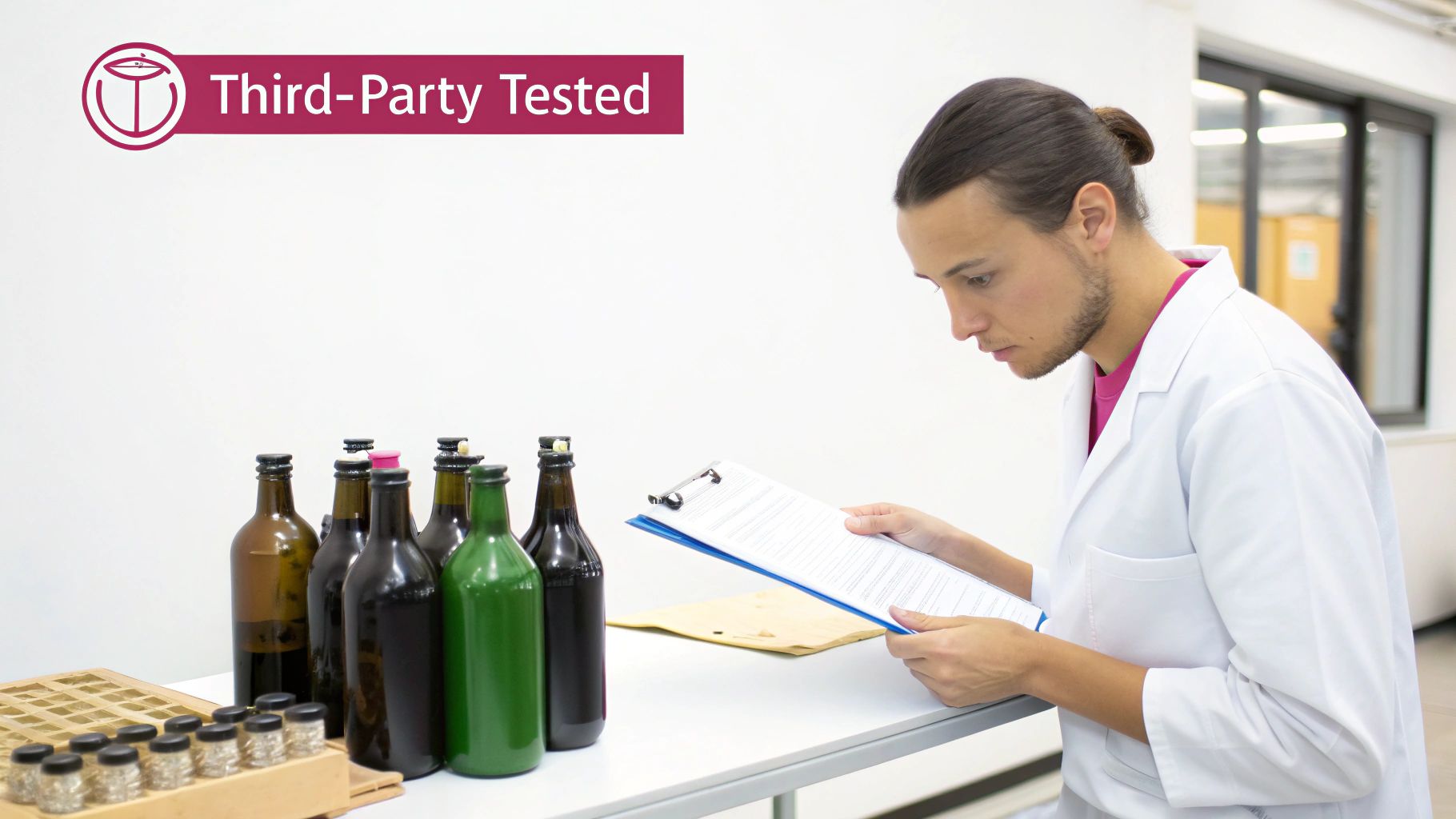
True legality for THC drinks is about more than just hitting a specific THC percentage. For the brands doing things right, it’s a deep-seated commitment to transparency, quality, and your safety. This is what separates a trustworthy company from a risky gamble in this booming market.
The absolute bedrock of this commitment is rigorous third-party lab testing. Reputable brands don’t just tell you their products are compliant; they show you. They send samples from every single batch to independent, accredited labs for a full chemical breakdown.
This process gives us a crucial document called a Certificate of Analysis, or COA. Think of it as a product’s report card. It’s an unbiased, scientific look at exactly what’s inside the can, giving you total transparency and peace of mind.
What to Look for on a Certificate of Analysis
A COA is packed with information that confirms a product is both legal and safe. Smart consumers know what to look for to verify a brand’s claims. When you pull up a COA, here’s what you should zero in on.
-
THC Potency: This is the big one for legal compliance. The COA will list the exact concentration of Delta-9 THC, confirming it’s at or below the federal 0.3% by dry weight limit. It also proves the milligrams on the label match what’s actually in the drink.
-
Cannabinoid Profile: Beyond just Delta-9 THC, the test shows you everything else in there, like CBD, CBG, or CBN. This gives you the complete picture of the active ingredients you're consuming.
-
Contaminant Screening: This part is all about safety. The lab checks for nasty stuff you don’t want, like heavy metals (lead, arsenic), pesticides, leftover solvents from extraction, and microbes like mold or bacteria. A clean report here is non-negotiable.
A readily accessible and easy-to-read COA is the clearest signal a brand has your best interests at heart. If a company makes you hunt for their lab results, that’s a major red flag.
Building Trust Through Transparency
By consistently testing their products and making those results public, brands build a solid foundation of trust. It shows they have nothing to hide and are confident in their ingredients and their process. It proves their products are consistent, can after can.
On top of that, putting safety first helps brands manage the very real legal risks of product liability, which is a huge deal in the consumables space. This focus on verifiable quality, honest labeling, and responsible marketing is how legitimate companies prove they truly understand how THC drinks are legal and safe.
The market for these drinks is exploding—the global cannabis beverage sector is projected to jump from $2.04 billion in 2023 to a staggering $117.05 billion by 2032. This wild growth just highlights why it's so important for brands to self-regulate and for consumers to do their homework. When you choose brands that are transparent, you’re helping build a safer and more reliable industry for everyone.
What's Next for THC Drinks?
The legal tightrope that THC beverages walk is actually pretty straightforward. It all boils down to the 2018 Farm Bill, a landmark piece of legislation that drew a legal line in the sand between hemp and marijuana. From there, it's a simple matter of math—the dry weight calculation—that allows a drink to deliver a satisfying buzz while staying perfectly within the 0.3% Delta-9 THC federal limit. This isn't some shady loophole; it's just how the law is written.
With that legal foundation firmly in place, the THC beverage scene isn't just growing; it's blowing up. This surge is fueled by a massive cultural shift away from alcohol and toward something new. People are looking for sophisticated, adult drinks that offer a clean, controlled experience without the morning-after regrets, and these products fit the bill perfectly.
A Market on the Rise
The numbers tell a compelling story. The global market for cannabis-infused drinks is on track to jump from $1.05 billion in 2025 to a staggering $4.3 billion by 2035. Here in the U.S., we're looking at an expected compound annual growth rate of 17.8% over that same decade. You can dive deeper into these market projections and industry growth to see just how big this wave is getting.
This explosive growth is launching THC drinks into the mainstream. What was once a niche item for cannabis enthusiasts is now popping up on shelves in liquor stores, specialty shops, and even some larger retailers in states with friendly laws. This shift signals a new chapter for cannabis—one where low-dose, socially acceptable products are becoming the new normal for a whole new generation.
The Regulatory Road Ahead
Of course, rapid growth always attracts attention. The legal landscape for THC drinks is bound to evolve as lawmakers take a closer look. Future versions of the Farm Bill could easily bring changes, like tighter testing protocols or more specific labeling rules to ensure everyone knows exactly what they're getting.
The industry is clearly heading toward a more mature, regulated future where safety, transparency, and consistency are the top priorities. Ultimately, this is great news for consumers, as it means safer, more reliable products on the shelf.
For now, though, the future looks bright. As long as brands stick to the rules and consumers know what to look for, THC beverages are poised to become an exciting and permanent fixture in our modern drink culture. You now have a solid grasp of the laws driving this industry, giving you the confidence to explore legal THC drinks safely and responsibly.
Got Questions About Legal THC Drinks? We've Got Answers.
Even after getting the rundown on federal laws and state-by-state rules, you probably still have a few questions about how these legal THC drinks actually work. Let's tackle the most common ones head-on, so you can navigate this exciting new world like a pro.
Think of this as the practical advice you need to feel confident about what you're buying and drinking.
Are Hemp-Derived THC Drinks as Potent as Dispensary Ones?
Here’s the thing: your body doesn’t care where the THC came from. The effect of a THC drink all boils down to the total milligrams (mg) in the can. A 5mg drink made from federally legal hemp has the exact same psychoactive potential as a 5mg drink you’d buy from a state-licensed marijuana dispensary.
The legal magic is all in the THC concentration by weight—keeping it under that 0.3% mark. It's not about a weaker dose. That’s why you always, always need to read the label to check the total milligrams and start slow with any new product to see how it hits you.
Can I Take These Drinks Across State Lines?
In a word: don't. While these seltzers and sodas are federally legal thanks to the 2018 Farm Bill, state laws are a messy patchwork. Driving a THC beverage into a state where it’s banned could land you in serious legal trouble.
Flying with them is a gamble, too. TSA policies can be confusing and often defer to local law enforcement wherever you land. The smartest and safest move is to always buy and enjoy these drinks in the same state.
The Bottom Line: Federal legality isn't a free pass to carry THC products everywhere. Play it safe and respect local laws to avoid a massive headache.
Will I Fail a Drug Test After Drinking a Legal THC Seltzer?
Yes, almost certainly. Standard drug tests are built to find THC metabolites in your system, and they make zero distinction between THC from legal hemp and THC from marijuana.
If you drink anything with THC, no matter its legal status, you're rolling the dice on a drug test. If your job or any other part of your life depends on passing a screening, you should steer clear of these products completely.
What's the Real Difference Between Delta-8 and Delta-9 in These Drinks?
When people talk about THC, they're usually talking about Delta-9 THC. It's the main psychoactive compound in cannabis and the one that the Farm Bill regulates with its 0.3% by dry weight rule. This is what gives hemp-derived drinks their clear (if complicated) legal standing.
Delta-8 THC is a different beast. It's another cannabinoid, but it's usually less potent and is often created in a lab from hemp-derived CBD. Its legal status is much shakier, with many states specifically banning Delta-8 products. The federal path for hemp-derived Delta-9, on the other hand, is far more established and clearly defined.
Ready to explore the refined side of cannabis? Day Dreamer offers a curated line of clean, hemp-derived Delta-9 THC and CBD sparkling waters crafted for a sophisticated experience. Discover your new favorite way to unwind.
The statements made regarding these products have not been evaluated by the Food and Drug Administration. The efficacy of these products has not been confirmed by FDA-approved research. These products are not intended to diagnose, treat, cure, or prevent any disease. All information presented here is not meant as a substitute for, or alternative to, information from healthcare practitioners. Please consult your healthcare professional about potential interactions or other possible complications before using any product. The Federal Food, Drug, and Cosmetic Act requires this notice. All products on this website contain 0.3% THC or less.


