

So, how long does THC actually stay in your system? If you're looking for one simple number, you won't find it. The real answer is a pretty wide range—anywhere from a few days to well over a month. It all comes down to the kind of test you’re taking, how often you use cannabis, and your own unique body.
Your Quick Guide to THC Detection Times
Facing a potential drug test can be incredibly stressful. The big question—“Am I in the clear?”—is simple, but the science behind the answer is anything but. This section is designed to give you a quick, straightforward overview of THC detection windows. Think of it as your starting point before we dive deeper into the nuts and bolts.
Understanding Detection Windows
The length of time THC can be detected really boils down to two main things: the type of test being used and your personal consumption habits. Each testing method has a different sensitivity and is looking for different things—some look for active THC, while others hunt for the metabolites it leaves behind.
Your frequency of use is, without a doubt, the single biggest factor. For someone who only partakes occasionally, a standard urine test can typically detect THC for up to 3 days.
But if you’re a more moderate user, enjoying cannabis a few times a week, that window can easily stretch to 5-7 days. For daily, heavy users, you're looking at a much longer timeframe—often 10-15 days, and sometimes 30 days or even more. The more you consume, the more THC metabolites build up in your body's fat cells, and the longer it takes to clear them out.
Just to give these timelines some perspective, it can be interesting to see how long other common medical tests take to yield results.
To make this even clearer, here’s a quick summary table that lays out what to expect from the most common types of tests.
THC Detection Window by Test Type at a Glance
This table provides a snapshot of typical detection times based on how frequently you use cannabis. Keep in mind that these are estimates, and your individual results can vary.
| Test Type | Occasional User (1-2 times/week) | Frequent User (3-5 times/week) | Chronic User (Daily) |
|---|---|---|---|
| Urine | 1-3 days | 5-7 days | 10-30+ days |
| Blood | 1-2 days | Up to 7 days | Up to 7 days |
| Saliva | 1-3 days | Up to 3 days | Up to 3 days |
| Hair | Up to 90 days | Up to 90 days | Up to 90 days |
As you can see, the differences are huge, especially when it comes to urine tests. And hair tests? They provide a much, much longer history of use.
Here’s a breakdown of what that means in practice:
- Urine Tests: This is the go-to for most workplace screenings. It’s effective for detecting use from 3 to over 30 days, depending entirely on your habits.
- Blood Tests: These are usually reserved for situations where recent impairment is a concern, like a DUI. They detect active THC for a very short window, typically just hours to a couple of days.
- Saliva Tests: A less invasive option that’s gaining popularity. It can spot THC for up to 24-72 hours after last use.
- Hair Follicle Tests: If you need a long look-back period, this is the one. Hair tests can potentially detect cannabis use for up to 90 days.
This is just the starting line. Remember that personal factors like your metabolism, body fat percentage, and even how hydrated you are can nudge these timelines in either direction. We’ll get into all of that in the sections ahead.
Understanding How THC Interacts With Your Body
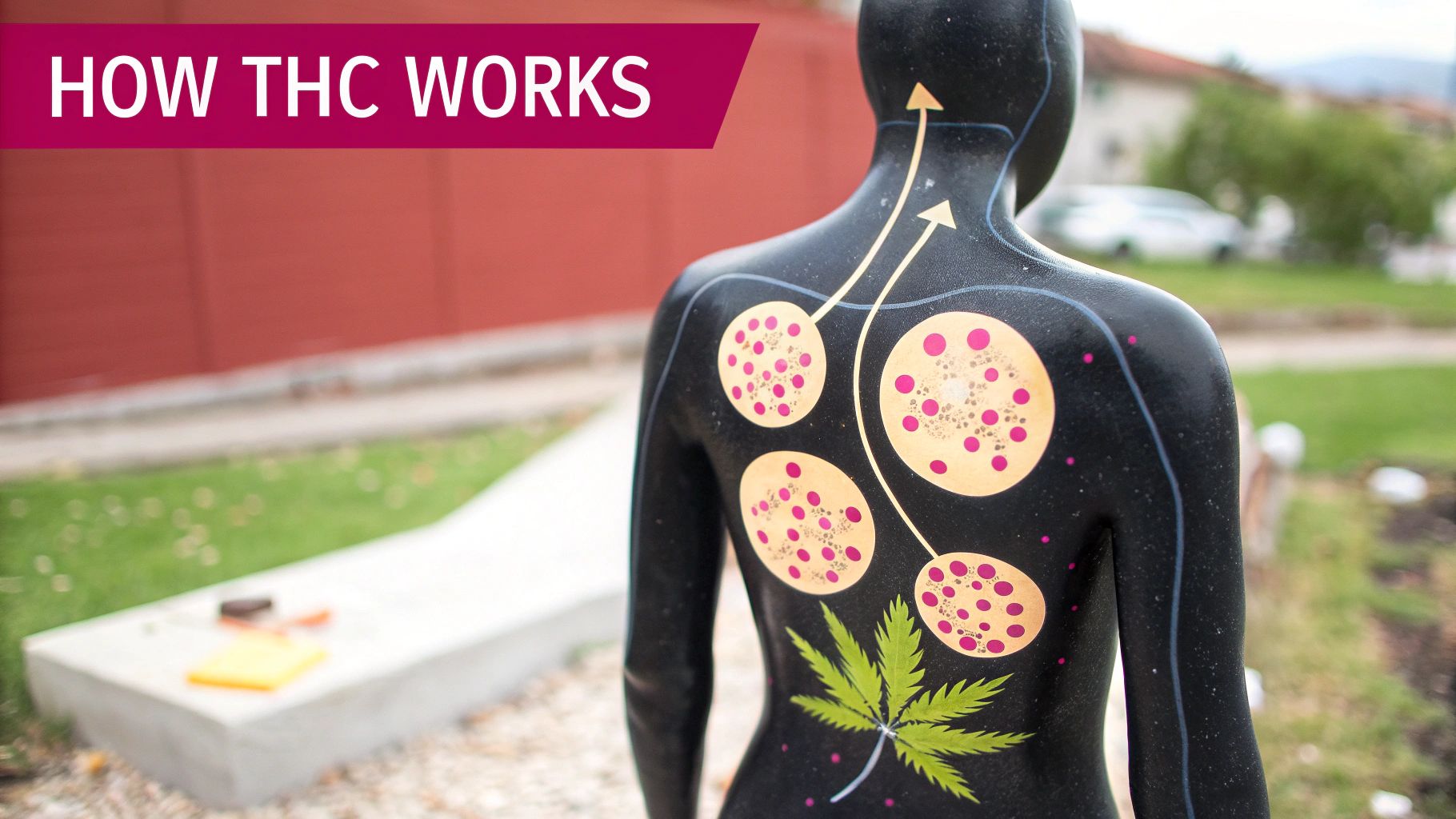
To get a real handle on why THC detection times are all over the map, we need to look at what's happening under the hood from the moment you use it. It's not just about the cannabis itself; it's a story about how your unique body processes, stores, and eventually gets rid of it. This journey is different for everyone, which is why a single, simple answer just isn't realistic.
The second you consume cannabis, tetrahydrocannabinol (THC) makes its way into your bloodstream, but how it gets there matters—a lot. If you smoke or vape, THC zips through your lungs and hits your system in minutes, which is why the effects come on so fast.
On the other hand, if you go with an edible or a THC-infused drink, it's a much slower ride. The THC has to travel through your digestive system and get processed by the liver first, meaning it can take anywhere from 30 minutes to two full hours to really kick in.
Why THC Lingers: It's All About Fat
Here’s the single most important thing to understand about THC: it's lipophilic. That’s just a scientific way of saying it loves fat. Unlike something like alcohol, which is water-soluble and gets flushed out of your system pretty quickly, THC is drawn to your body’s fatty tissues and organs, where it sets up camp.
Think of your fat cells as tiny storage lockers for THC. When you consume more than your body can use right away, the extra molecules get tucked away for later. This is the main reason THC can be detected for so much longer than most other substances.
This also explains why how often you use is the biggest factor in detection times.
- Occasional Users: If you only use once in a while, there isn't much THC to store, and your body can clear it out relatively quickly.
- Chronic Users: If you use daily, you’re constantly topping up those fat stores, adding THC faster than your body can get rid of it. This creates a significant backlog.
Because it’s stored in fat, THC is slowly re-released back into your bloodstream over days or even weeks. For heavy, long-term users, this slow trickle is what allows metabolites to be detected long after the high has worn off.
What Drug Tests Are Really Looking For
When people ask, "how long does THC stay in your system," they're almost always worried about a drug test. It’s crucial to know that most tests, especially for urine, aren't actually looking for the THC compound that gets you high. They're designed to find its leftovers, or metabolites.
After THC does its job, your liver breaks it down. The main byproduct created in this process is a metabolite called THC-COOH (11-nor-9-carboxy-THC). This is the specific compound that nearly all urine tests are calibrated to detect.
The key thing about THC-COOH is that it's inactive—it doesn't have any psychoactive effects. Its only purpose is to stick around until your body can excrete it. And just like THC, it gets stored in fat, making its presence a clear sign of past cannabis use.
The more you use, the more THC-COOH you have stored away. A daily user has a much higher baseline level of this metabolite than someone who partakes just once a month. This accumulated reserve is exactly why a chronic user can test positive for 30 days or more, while a one-time user is often in the clear within a few days.
This entire chain of events—from consumption and storage to the eventual elimination of metabolites—is also shaped by personal factors like your metabolism, body fat percentage, and even how much water you drink. We'll dive into those details next.
A Detailed Look at Each Type of THC Test
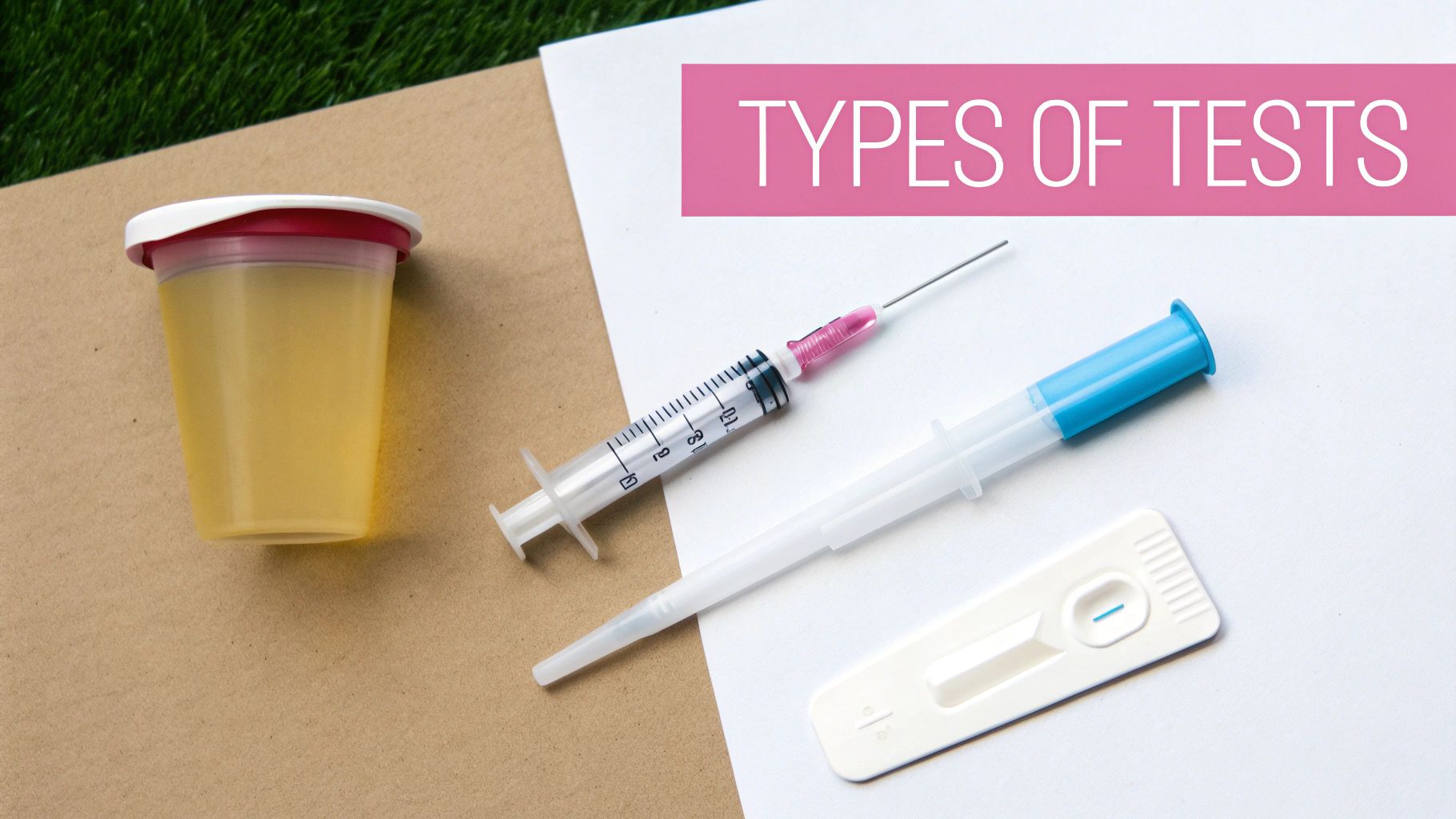
When you ask, "how long does THC stay in your system?", the answer really boils down to one thing: which test are we talking about? Each type of drug test is designed for a specific purpose, looking for different compounds over a unique timeframe.
Think of it like this: some tests are like detectives catching someone in the act, while others are more like historians digging through archives to build a long-term profile. They all look for evidence of cannabis use, but the story they tell is completely different. Let's break down the four main methods you're likely to encounter.
Urine Tests: The Workplace Standard
Urinalysis is, without a doubt, the most common method used for drug screening. It's the go-to for pre-employment checks and routine workplace testing, largely because it’s affordable, non-invasive, and gives a detection window that suits most employers' policies.
What's interesting is that a urine test isn't actually looking for active THC. It’s searching for an inactive metabolite called THC-COOH, which your liver produces as it breaks down THC. This compound gets stored in your body fat and is released slowly over time, meaning it can be detected long after any high has worn off.
This is why the detection times are so all over the map. A one-time user might be clear in just 1-3 days. But for a heavy, daily consumer, that window can easily stretch to 30 days or even longer. To really get a handle on how this works in regulated industries, it helps to understand the official DOT drug testing requirements.
Blood Tests: A Snapshot of Recent Use
Blood tests tell a completely different story. They don't care about what you did weeks ago; they're designed to find active THC circulating in your bloodstream right now. This makes them the tool of choice for law enforcement in situations like roadside sobriety checks or post-accident investigations where current impairment is the main question.
After smoking or vaping cannabis, THC levels in the blood spike almost instantly and then fall just as quickly. Because of this rapid drop-off, the detection window is incredibly short.
- For occasional users, THC is typically only detectable for a few hours, up to about 12-24 hours at most.
- For chronic users, heavy consumption can lead to THC being found for up to 7 days in some cases, but the peak levels are still very short-lived.
This brief window is exactly why blood tests are almost never used for pre-employment screening. They’re a specialized tool for answering one critical question: was this person under the influence very recently?
Saliva Tests: For Very Recent Consumption
Often called oral fluid tests or mouth swabs, saliva tests are becoming more popular as a less-invasive alternative to blood or urine screens. Just like blood tests, they look for the parent THC compound itself, not its metabolites, making them great for pinpointing very recent consumption.
The detection window here is also quite short, generally falling between 24 to 72 hours after the last use. This makes them a practical option for roadside testing or for workplaces that want to confirm an employee isn't impaired on the job, without digging into their off-duty habits.
Key Takeaway: Saliva tests are excellent at confirming if someone has consumed cannabis within the last day or two. They are simple to administer, difficult to tamper with, and provide quick results, but they cannot show a long-term history of use.
Hair Follicle Tests: The Long-Term Record
If a blood test is a snapshot in time, a hair test is the full-length documentary. This method offers the longest detection window by a landslide, capable of showing a history of cannabis use for up to 90 days.
Here’s how it works: when you consume cannabis, THC metabolites enter your bloodstream and get deposited in your hair follicles. As your hair grows, it traps those metabolites, creating a timeline of use. Since scalp hair grows at a fairly predictable rate, a standard 1.5-inch sample can reveal a three-month consumption history.
Hair tests are most often used in high-stakes situations where establishing a long-term pattern of use (or abstinence) is critical, like in certain legal cases or for high-security clearance jobs.
But they have their limits. It takes about 7-10 days for the affected hair to grow long enough to be cut, so this method won't catch very recent use. It’s also much better at identifying regular users than a one-off instance.
Comparing THC Drug Testing Methods
To make it easier to see how these tests stack up, here's a direct comparison of what each one does, where it's used, and its main strengths and weaknesses.
| Testing Method | What It Detects | Primary Use Case | Key Pros | Key Cons |
|---|---|---|---|---|
| Urine Test | Inactive metabolite (THC-COOH) | Pre-employment & workplace screening | Cost-effective, long detection window, non-invasive | Doesn't show current impairment, window varies widely |
| Blood Test | Active THC | Roadside DUI, post-accident testing | Measures current impairment accurately | Invasive, very short detection window, expensive |
| Saliva Test | Active THC | Roadside testing, post-incident workplace checks | Non-invasive, detects recent use, hard to cheat | Short detection window (1-3 days) |
| Hair Test | Inactive metabolite (THC-COOH) | High-security jobs, legal/court-ordered testing | Extremely long detection window (90+ days) | Cannot detect recent use, expensive, can be biased |
Ultimately, the "best" test depends entirely on the goal. Whether it's to confirm sobriety on the job or to build a long-term history of use, there's a specific tool designed for the task.
Key Factors That Influence Your Detection Window

So, you've seen the general timelines, but you're probably wondering why there's such a huge range—from a couple of days to well over a month. The honest answer is that there’s no single, universal timeline for clearing THC. Your personal detection window is a unique puzzle, shaped by your body, your habits, and even the products you use.
Getting a handle on these variables is how you move from generic estimates to a much clearer picture of your own situation. It's not just about what you consumed, but how your body processes it. Let's dig into the major factors that really move the needle.
Your Consumption Habits: The Biggest Factor of All
Hands down, the most critical factors are how much you consume and how often. These two things work in tandem to dictate how much THC and its byproducts get stored away in your body.
Think of your body's fat cells as a sponge.
- Occasional Use: If you only partake once in a blue moon, the sponge absorbs a tiny bit of THC and can be wrung out pretty quickly. There's just no time for a significant buildup.
- Frequent or Chronic Use: If you're a daily user, you're constantly soaking that sponge, far faster than it can ever dry out. This creates a deep reservoir of stored THC metabolites that takes a very long time to fully clear.
This is exactly why someone who uses cannabis one time might test clean in just 3 days, while a heavy daily user could still pop positive 30 days or more after stopping. The dose is a big deal, too. High-potency products like dabs or strong edibles deposit a lot more THC than a low-dose seltzer, naturally extending that timeline.
Body Fat Percentage and Its Role
We've mentioned that THC is fat-soluble, which is a scientific way of saying it loves to bind to and get stored in your fat tissue (also known as adipose tissue). This simple biological fact makes your body fat percentage a major player in this whole equation.
People with a higher body mass index (BMI) or more body fat essentially have more "storage space" for THC. Their bodies can hang onto those THC metabolites for much longer, releasing them slowly back into the bloodstream over time.
On the flip side, someone with very low body fat has fewer places to stash these compounds, which often leads to a faster elimination process. This is a key reason why two people with identical cannabis habits can have completely different detection windows.
A Quick Word on Exercise: While burning fat is great for clearing out stored THC in the long run, hitting the gym hard right before a test can seriously backfire. A burst of intense exercise can cause a temporary surge of THC in your blood and urine as it gets released from those fat cells.
The Speed of Your Metabolism
Your metabolic rate—how fast your body converts fuel to energy—directly affects how quickly you process and get rid of substances, THC included. A faster metabolism means your body breaks down and excretes THC-COOH more efficiently.
Several things influence your personal metabolic speed:
- Genetics: Some of us are just born with a faster metabolic engine.
- Age: Metabolism naturally tends to slow down as we get older.
- Activity Level: An active lifestyle generally keeps your metabolism running higher.
This explains why a younger, active person might clear THC faster than an older, more sedentary person, even if they use the same amount.
Hydration and Its Limits
Staying well-hydrated is always a smart move for your health, and it definitely plays a part in helping your body flush out waste via urine. Good hydration supports your kidney function, which is critical for getting rid of those THC metabolites.
But here’s a crucial point: chugging gallons of water right before a drug test isn't the magic fix some people think it is. While it can temporarily dilute the concentration of metabolites in a urine sample, it doesn't actually remove them from your body any faster. Plus, labs are wise to this trick. An overly diluted sample is an immediate red flag and will likely lead to a re-test.
The story of THC's journey through your body is also written in your blood, not just your urine. Right after you consume it, THC levels in the bloodstream spike, but they also drop off pretty fast. For most people, THC is undetectable in blood within 12 hours. However, for chronic, heavy users, that story can change dramatically. One NIH study on daily cannabis users found THC was still present in blood for up to a month, with a median last detection of 22 days. You can learn more about these long-term THC findings directly from the study.
Setting the Record Straight: Common THC Detox Myths
If you have a drug test on the horizon, you've probably seen a dozen different "quick fixes" online. The stress of the situation makes miracle cures seem like a lifeline, but let's be clear: most of these popular methods are junk science. Some can even make things worse.
Let’s cut through the noise and look at what the science actually says.
Myth 1: You Can Flush THC Out with Water or Detox Kits
This is probably the most common myth out there. The idea is you can chug gallons of water and simply "flush" the THC metabolites out of your system. While proper hydration helps your body's natural processes, trying to flood your system right before a test is a terrible strategy.
Why? Because you're not actually getting rid of the THC metabolites any faster. You're just diluting your urine. And labs are wise to this trick. A sample that’s too watery will be flagged as "dilute," which almost always means you'll have to re-test, often under much stricter supervision.
Those pricey "detox drinks" and kits you see online? They're usually just a mix of vitamins and diuretics sold at a massive markup. They work on the same dilution principle and are incredibly unreliable. There's no solid scientific proof they work, and some have ingredients that could do more harm than good, all without any guarantee you'll pass.
Myth 2: A Hard Workout Before the Test Will Help
This one sounds like it makes sense on the surface. We know THC is stored in fat cells, so burning fat through exercise should help clear it out, right? Not exactly.
While a consistent exercise routine can help reduce your overall body fat (and thus, your THC storage capacity) over time, a last-minute sweat session is a bad move. In fact, it can completely backfire.
When you exercise intensely, you start burning fat for energy. This process releases the THC that was stored in those fat cells back into your bloodstream, which can cause a temporary spike in the THC metabolite levels in your urine. You could actually end up with a higher concentration than if you had just stayed on the couch.
Let's be blunt: The only surefire way to clear THC metabolites from your body is time and abstinence. There are no proven shortcuts, magic pills, or secret tricks that can outsmart your body's natural timeline.
Ultimately, your body gets rid of THC at its own pace, a pace set by your metabolism, body fat, and how often you use cannabis. Understanding how long THC can stay in your system naturally is far more useful than chasing unproven methods. Stick with the facts, and you'll be able to make a much smarter, safer decision.
Answering Your Top Questions About THC Detection
Even once you get the science, real-world questions always pop up. Let's tackle some of the most common ones I hear, so you can connect the dots between the lab data and everyday life.
Can I Really Test Positive from Secondhand Smoke?
Let's be clear: this is extremely unlikely. To have any chance of failing a test from secondhand smoke, you'd have to be in what researchers call a "hotbox" situation—think a small, totally unventilated room thick with smoke for a long time. This is a far cry from just being at a concert or a party where someone is smoking nearby.
Drug testing cutoff levels are intentionally set high enough to screen out this kind of incidental, passive exposure. So, if you're just around it, you can breathe easy.
Will My CBD Product Make Me Fail a Drug Test?
This is a huge point of confusion, and the answer is a firm it depends. The key is knowing exactly what kind of CBD you’re using, because not all products are created equal.
- Full-Spectrum CBD: This contains everything from the hemp plant, which includes trace amounts of THC—legally, up to 0.3%. It won't get you high, but if you're taking large doses of a full-spectrum product every day, those tiny amounts of THC can accumulate and potentially cause you to test positive.
- Broad-Spectrum CBD: This is a much safer bet. It has all the other good stuff from the plant, but the THC has been specifically removed.
- CBD Isolate: This is the safest option of all. It’s pure CBD, period. No other cannabinoids, and definitely no THC.
Bottom line: If you're subject to drug testing, stick with broad-spectrum or CBD isolate products. It’s the only way to be sure your wellness routine won’t lead to a very awkward conversation.
Does Guzzling Water Actually Help Pass a Urine Test?
This is probably the biggest myth out there. Trying to "flush" your system with gallons of water right before a test doesn't actually speed up the removal of THC metabolites from your fat cells. That’s a slow, metabolic process.
All that water does is dilute your urine. And guess what? Testing labs are wise to this trick. They screen every sample for dilution, and if yours is basically just water, it gets flagged. This almost always leads to a mandatory re-test, which you might have to do under direct observation. Just drink a normal amount of water and let nature take its course.
Elevate your experience with Day Dreamer's line of clean, hemp-derived Delta-9 THC and CBD sparkling waters. Crafted for clarity and good times, our beverages offer a refined alternative with no added sugars and only the freshest ingredients. Discover a tasteful indulgence at https://enjoydaydreamer.com.


