

So, is Delta 9 legal? The short answer is yes, but it comes with a huge asterisk. At the federal level, hemp-derived Delta 9 THC is legal as long as it makes up 0.3% or less of the product's total dry weight. This rule comes from a landmark piece of legislation called the 2018 Farm Bill. The catch? State laws can be wildly different, creating a legal maze for consumers.
Your Quick Guide To Delta 9 Legality

It seems like a straightforward question, but the answer to "is Delta 9 legal?" is anything but simple. To really get it, you have to look at how federal and state laws interact—and they don't always play nicely. The whole story starts with the 2018 Farm Bill.
This law changed everything by drawing a legal line in the sand between two types of cannabis plants: hemp and marijuana. From a botanical standpoint, they're practically twins. Legally, however, they are defined by a single, critical number: their Delta 9 THC concentration.
Hemp Versus Marijuana: The Core Legal Difference
At its heart, the legal system treats these two plants as completely separate things, even though they both come from the Cannabis sativa family. This distinction is the foundation the entire legal hemp industry is built on.
Here’s how it breaks down:
- Hemp: This is any cannabis plant—or product made from it—that contains no more than 0.3% Delta 9 THC on a dry weight basis. Under federal law, hemp is treated like any other agricultural crop, not a controlled substance.
- Marijuana: This refers to any cannabis plant with more than 0.3% Delta 9 THC. Marijuana is still a Schedule I controlled substance federally, meaning it's illegal nationwide, though many states have now legalized it for medical or recreational use on their own terms.
This is the "loophole" that makes products like hemp-derived Delta 9 gummies and drinks possible. Because the law focuses on the concentration of THC, a heavier product like a gummy or a canned beverage can contain a noticeable amount of THC (say, 5mg or 10mg) while still keeping the total THC percentage well below that 0.3% legal limit.
The 2018 Farm Bill didn’t just legalize hemp; it inadvertently created a clear pathway for producing federally compliant THC products by focusing on concentration by weight, not the total dose in a serving.
This table gives a quick snapshot of the key differences.
Hemp-Derived Vs Marijuana-Derived Delta 9 At A Glance
| Attribute | Hemp-Derived Delta 9 | Marijuana-Derived Delta 9 |
|---|---|---|
| Federal Legal Status | Legal under the 2018 Farm Bill | Illegal (Schedule I substance) |
| THC Concentration Limit | ≤ 0.3% by dry weight | > 0.3% by dry weight |
| Source Plant | Legal hemp | Marijuana |
| State Legality | Varies; legal in most states | Legal only in states with specific recreational or medical cannabis laws |
| Primary Sales Channel | Online, smoke shops, grocery stores | State-licensed dispensaries |
| Chemical Structure | Identical to marijuana-derived Delta 9 | Identical to hemp-derived Delta 9 |
As you can see, while the molecule itself is the same, the plant it comes from and its concentration are what determine its legality.
Why State Laws Add Another Layer of Complexity
While the Farm Bill gives a federal thumbs-up, it explicitly allows states to set their own, often stricter, rules. This is where things get really tricky. Think of federal law as the starting line, but state law is the ultimate gatekeeper.
Some states have fully adopted the federal definition of hemp, allowing compliant Delta 9 products to be sold freely. Others have slammed the door shut, passing laws that ban or heavily restrict all forms of THC, no matter where they come from. Then there's a third group of states stuck in a legal gray area, with confusing or conflicting rules that leave everyone guessing.
Because of this patchwork of laws, a product that's perfectly legal in one state could get you into trouble just one town over. This makes it absolutely essential to know not just the federal rules, but the specific laws right where you live.
How the 2018 Farm Bill Changed Everything for Cannabis
Not too long ago, the law treated all cannabis the same. It was simple: if it was cannabis, it was illegal. The federal government lumped every part of the plant into the same Schedule I category as drugs like heroin. This meant a tough, fibrous hemp stalk grown for rope was legally identical to a marijuana plant grown for its potent high.
This one-size-fits-all approach was a major headache. It blocked farmers from growing a valuable crop and prevented people from accessing non-intoxicating compounds like CBD. Everything changed with the 2018 Agriculture Improvement Act, better known as the 2018 Farm Bill. This piece of legislation was the game-changer, fundamentally redrawing the lines of what was legal and what wasn't.
Think of it this way: the law used to see a single "cannabis" team on the field. The Farm Bill blew the whistle and split that team into two separate players: hemp and marijuana. How? By creating a very specific, technical definition.
A New Legal dividing Line
The single most important thing the 2018 Farm Bill did was create a legal distinction between hemp and marijuana based on one specific molecule: Delta-9 THC. It set a crystal-clear boundary that would launch an entire industry.
By federal law, a cannabis plant is legally defined as hemp as long as it contains 0.3% Delta-9 THC or less on a dry weight basis. If it crosses that line—even by a tiny fraction—it's considered marijuana and remains federally illegal.
That one sentence did all the work. It officially pulled hemp off the Controlled Substances Act, transforming it from a "drug" into a regular agricultural commodity, just like corn or soy. Farmers could finally plant it, businesses could process it, and products made from it could be sold across the country.
It's crucial to understand that this is a legal distinction, not a botanical one. You could have two cannabis plants sitting side-by-side that look and smell exactly the same. But if one clocks in at 0.29% Delta-9 THC and the other at 0.31%, the first is federally legal hemp, while the second is illegal marijuana. That razor-thin chemical line is everything.
"Dry Weight": The Two Words That Made Legal Delta-9 Possible
While everyone focuses on the 0.3% number, the real magic is in the phrase that comes right after it: "on a dry weight basis." This is the key that unlocked the door for federally compliant Delta-9 THC products that you can actually feel.
It simply means the THC limit is calculated based on the total weight of the finished product, not the plant it came from. This is where things get interesting for edibles and beverages.
Let’s break it down with a quick example:
- Take a fairly standard gummy that weighs 5 grams, which is the same as 5,000 milligrams.
- To stay legal, its Delta-9 THC content can't exceed 0.3% of that total weight.
- The math is simple: 0.3% of 5,000mg is 15mg.
Just like that, a single 5-gram gummy can legally pack up to 15mg of Delta-9 THC and still be considered a compliant hemp product under federal law. This isn't some sneaky loophole; it's right there in the text of the bill. For heavier products like cannabis-infused drinks, where most of the weight is just water, it becomes even easier to include an effective dose while staying well below the legal threshold.
This landmark bill completely redefined the cannabis landscape. By defining hemp as any Cannabis sativa L. plant with no more than 0.3% Delta-9 THC by dry weight, it created a legal pathway for a whole new market. The industry exploded almost overnight, with experts projecting it to be worth billions by 2025 as companies rolled out compliant gummies, drinks, and more. For anyone curious about how these rules apply to real-world situations like air travel, you can find great info from sources like The Hemp Doctor.
Decoding The 0.3% Dry Weight Concentration Rule
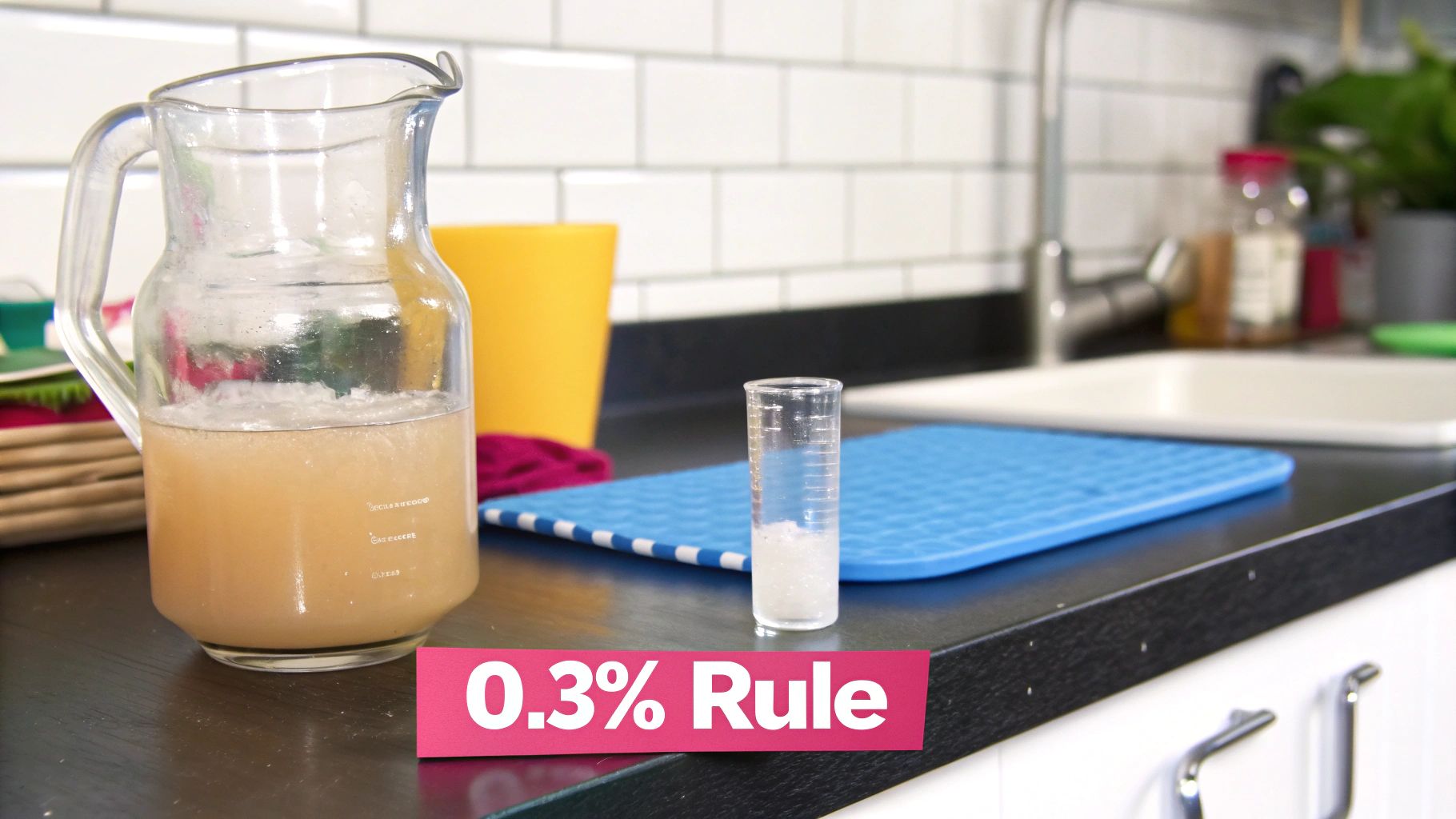
The phrase “0.3% Delta-9 THC by dry weight” is the linchpin of the 2018 Farm Bill. Understanding this rule is the key to seeing how some Delta-9 products are perfectly legal while others remain federally prohibited.
At first glance, it sounds like dense legal jargon. But the concept behind it is actually quite simple and is the very foundation of the modern hemp-derived THC market.
Think of it like making a big pitcher of punch. If you pour a shot of liquor into a tiny glass, it’s going to be very strong. But if you pour that exact same shot into a huge pitcher filled with juice, its concentration plummets. The alcohol is still there, but it’s just a tiny fraction of the total drink.
This is precisely how the dry weight rule works for hemp products. A product’s legality isn't based on the total amount of Delta-9 THC inside, but on its concentration relative to the product's total weight. This clever distinction is what allows brands to create products with noticeable, effective doses of THC that are still fully compliant with federal law.
Putting The Dry Weight Rule Into Practice
Let's swap the punch analogy for a real-world example: a hemp-derived Delta-9 gummy. The math is surprisingly straightforward and shows how a satisfying edible can be totally legal.
A typical gummy might weigh around 4 grams, which is the same as 4,000 milligrams. To be considered legal hemp, its Delta-9 THC content cannot be more than 0.3% of that total weight.
- Total Gummy Weight: 4,000 mg
- Legal THC Limit: 0.3% (or 0.003)
- Calculation: 4,000 mg x 0.003 = 12 mg of Delta-9 THC
This means a single 4-gram gummy can legally hold up to 12 mg of Delta-9 THC and still be sold as a compliant hemp product. For many people, that’s a standard or even strong dose, yet it fits perfectly within the legal framework. This isn't some shady loophole; it's the specific mechanism the law provides.
The "by dry weight" clause is the engine that drives the legal hemp THC market. It shifts the focus from total THC per package to THC concentration, making it possible to produce compliant edibles and beverages with meaningful effects.
How The Rule Applies To THC Beverages
The concept makes even more sense when we look at THC-infused drinks, like Day Dreamer's sparkling waters. Since the overwhelming majority of a beverage's weight is just water, the amount of THC required to hit that 0.3% limit is enormous.
A standard 12-ounce can of liquid weighs about 355 grams (or 355,000 milligrams). If we run the same 0.3% calculation, the legal THC limit for a single can is just massive.
- Total Beverage Weight: 355,000 mg
- Legal THC Limit: 0.3%
- Calculation: 355,000 mg x 0.003 = 1,065 mg of Delta-9 THC
A drink with over 1,000 mg of THC would be unbelievably potent—far beyond what almost any brand would ever produce. This shows how a product like a Day Dreamer beverage, with a carefully measured 5 mg of THC, stays thousands of times below the federal concentration limit. It’s both effective and without question, federally compliant.
To really get a handle on this, you have to appreciate the fundamental legal distinction that separates these products, as explained in the guide on critical shipping law differences between hemp and marijuana products. This core principle is what separates legal commerce from federal offenses.
Navigating The Complex Map Of State Delta 9 Laws
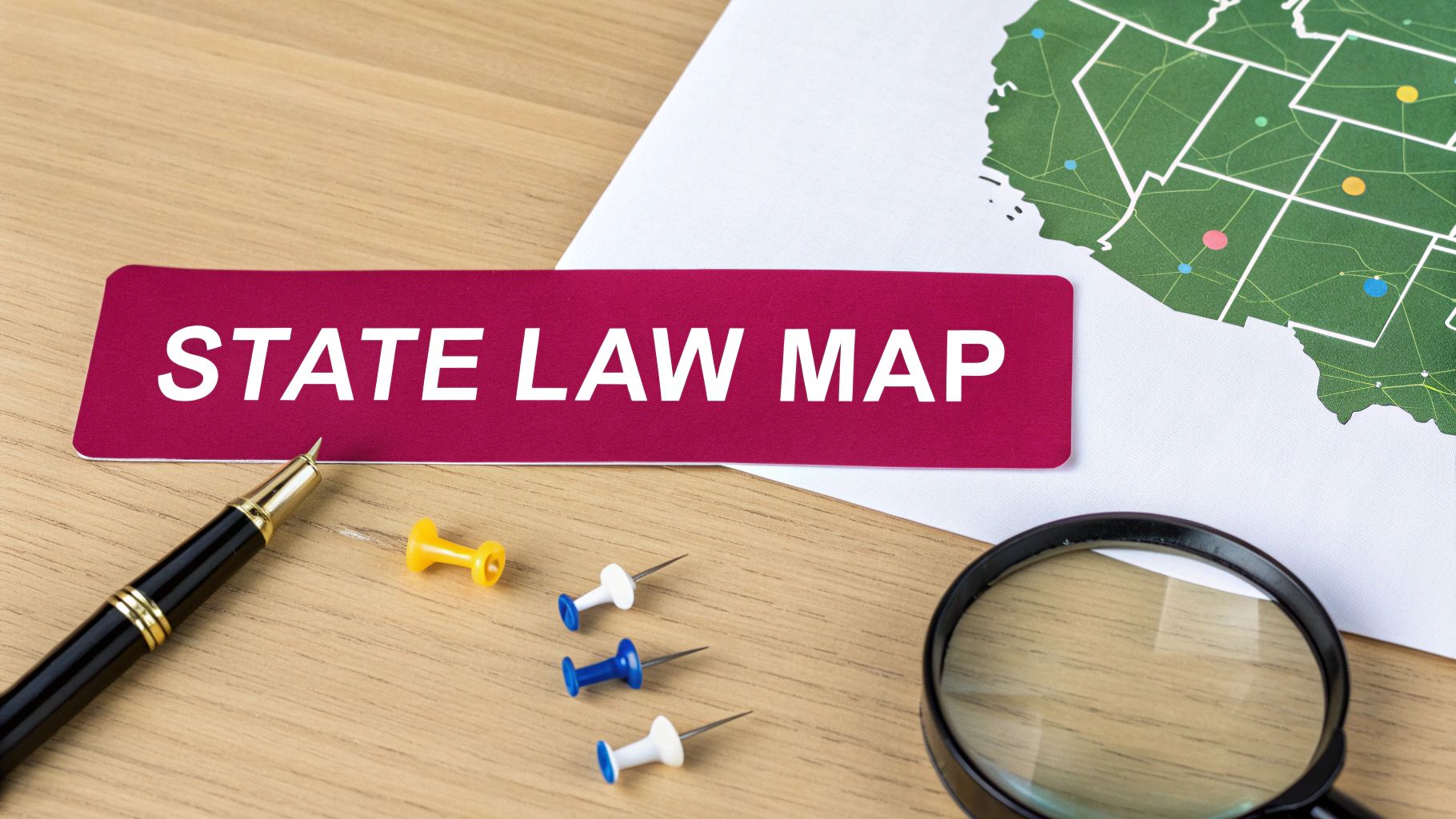
While the 2018 Farm Bill set a clear federal guideline for hemp-derived Delta 9, that's really just the starting point. The bill gave each state the power to write its own rules, and many have chosen to be far stricter. What you end up with is a messy, and sometimes contradictory, legal patchwork where a product can be perfectly legal one moment and illegal the next, just by crossing a state line.
Think of the federal law as setting a baseline—a foundation. From there, states can either build on it or knock it down entirely. Some have fully embraced the federal standard, while others have put up a brick wall, effectively banning these products.
To help you make sense of this puzzle, it's easiest to group states into three general categories based on how they handle hemp-derived THC. This gives you a solid framework for understanding where you can legally and safely enjoy these products.
Permissive States Following Federal Rules
A good number of states decided to keep things simple and just stick with the federal government's rules. In these places, if a Delta 9 product comes from hemp and contains 0.3% or less THC by dry weight, it's legal for adults to buy and use. No strings attached.
These states have basically copied and pasted the 2018 Farm Bill's language into their own local laws, which creates a predictable and stable market for both consumers and businesses. It's why products like hemp-infused seltzers and gummies are easy to find online and in local shops in states like Florida, Ohio, and Pennsylvania.
Just keep in mind that even in these friendly states, some cities or counties might have their own quirky rules, so it never hurts to be aware of what's happening in your specific town.
Restrictive States With Bans Or Strict Limits
Then you have the states on the complete opposite end of the spectrum. These states have passed laws to either ban hemp-derived THC outright or place severe restrictions on it, regardless of its source. They've essentially closed what they see as a "loophole" from the Farm Bill.
Why the hardline stance? It often comes down to concerns about psychoactive products being sold outside of the regulated state-run cannabis systems. To shut it down, these states have taken different approaches:
- Banning any cannabinoid that is synthetically derived.
- Enforcing a “total THC” cap, which includes non-intoxicating precursors like THCA.
- Explicitly outlawing any hemp product that has any detectable amount of THC.
Idaho is a classic example of a zero-tolerance state, banning any product with even a trace of THC. Others, like Colorado and Oregon, have moved to bring these products into their existing dispensary systems. So, if you're wondering "is delta 9 legal" in one of these states, the answer is often a firm "no"—unless you're buying it from a licensed cannabis shop.
Gray Area States With Unclear Laws
Finally, you have a handful of states stuck in a legal fog. Their laws might be outdated, vague, or just plain contradictory, leaving the status of hemp-derived Delta 9 completely up in the air. This creates a huge amount of uncertainty for everyone.
In these states, the laws might not have been touched since before the 2018 Farm Bill was even passed. In other cases, you might have conflicting memos from state health departments and the attorney general's office. This legal murkiness means that while you might see products for sale, their legality could vanish overnight with a new court ruling or a sudden policy change.
Living in one of these states puts the responsibility squarely on your shoulders to stay informed. As the industry grows, most of these states will likely be forced to clarify their positions, but until then, it's a "proceed with caution" situation.
State-By-State Hemp-Derived Delta 9 Legality Snapshot
To give you a clearer picture, it helps to see how the states stack up. This table is a quick reference guide, but remember that laws can and do change quickly. Always double-check your local regulations for the most current information.
| State | Legal Status | Key Notes Or Restrictions |
|---|---|---|
| Alabama | Permissive | Legal, follows federal 0.3% dry-weight rule. |
| Alaska | Gray Area | Regulated under state cannabis laws; complicated. |
| Arizona | Gray Area | Legal status is unclear and debated. |
| Arkansas | Restrictive | Banned; total THC limit of 0.3% is strictly enforced. |
| California | Permissive | Generally legal, but with specific labeling/testing rules. |
| Colorado | Restrictive | Banned outside of licensed dispensaries. |
| Connecticut | Gray Area | Legal, but must be sold by licensed retailers. |
| Delaware | Gray Area | Legal status is currently unclear. |
| Florida | Permissive | Legal, follows federal 0.3% dry-weight rule. |
| Georgia | Permissive | Legal, follows federal 0.3% dry-weight rule. |
| Hawaii | Restrictive | Banned; prohibits all inhalable and edible hemp products. |
| Idaho | Restrictive | Banned; illegal if any THC is present. |
| Illinois | Permissive | Legal, follows federal 0.3% dry-weight rule. |
| Indiana | Permissive | Legal, follows federal 0.3% dry-weight rule. |
| Iowa | Restrictive | Banned; very strict THC limits. |
| Kansas | Permissive | Legal, but must contain 0% Delta 9 THC. |
| Kentucky | Permissive | Legal, follows federal 0.3% dry-weight rule. |
| Louisiana | Permissive | Legal, but with per-serving and per-package limits. |
| Maine | Permissive | Legal, follows federal 0.3% dry-weight rule. |
| Maryland | Gray Area | Legal only for adults 21+ starting in 2023. |
| Massachusetts | Permissive | Legal, but must be produced and sold in-state. |
| Michigan | Gray Area | Regulated under state cannabis laws. |
| Minnesota | Permissive | Legal, but with a 5mg/serving and 50mg/package cap. |
| Mississippi | Restrictive | Banned; total THC is capped at 0.3%. |
| Missouri | Permissive | Legal, follows federal 0.3% dry-weight rule. |
| Montana | Restrictive | Banned; total THC is capped at 0.3%. |
| Nebraska | Permissive | Legal, follows federal 0.3% dry-weight rule. |
| Nevada | Restrictive | Banned; classified as a controlled substance. |
| New Hampshire | Permissive | Legal, follows federal 0.3% dry-weight rule. |
| New Jersey | Permissive | Legal, follows federal 0.3% dry-weight rule. |
| New Mexico | Permissive | Legal, follows federal 0.3% dry-weight rule. |
| New York | Restrictive | Banned; prohibits products with added Delta 9. |
| North Carolina | Permissive | Legal, follows federal 0.3% dry-weight rule. |
| North Dakota | Restrictive | Banned; total THC is capped at 0.3%. |
| Ohio | Permissive | Legal, follows federal 0.3% dry-weight rule. |
| Oklahoma | Permissive | Legal, follows federal 0.3% dry-weight rule. |
| Oregon | Restrictive | Banned outside of licensed dispensaries. |
| Pennsylvania | Permissive | Legal, follows federal 0.3% dry-weight rule. |
| Rhode Island | Restrictive | Banned; classified as a controlled substance. |
| South Carolina | Permissive | Legal, follows federal 0.3% dry-weight rule. |
| South Dakota | Gray Area | Law is ambiguous and unclear. |
| Tennessee | Permissive | Legal, follows federal 0.3% dry-weight rule. |
| Texas | Permissive | Legal, but has faced legal challenges. |
| Utah | Gray Area | Legal only if sold at state-approved pharmacies. |
| Vermont | Restrictive | Banned; prohibits synthetic cannabinoids. |
| Virginia | Permissive | Legal, but with a 2mg/package cap and specific ratios. |
| Washington | Restrictive | Banned; prohibits synthetic and converted THC. |
| West Virginia | Permissive | Legal, follows federal 0.3% dry-weight rule. |
| Wisconsin | Permissive | Legal, follows federal 0.3% dry-weight rule. |
| Wyoming | Permissive | Legal, follows federal 0.3% dry-weight rule. |
Ultimately, this state-by-state approach highlights just how important it is to be an informed consumer. A product that's perfectly legal where you buy it could cause you serious legal headaches just one state over.
How to Check if Your Delta-9 Product is Legal and Safe
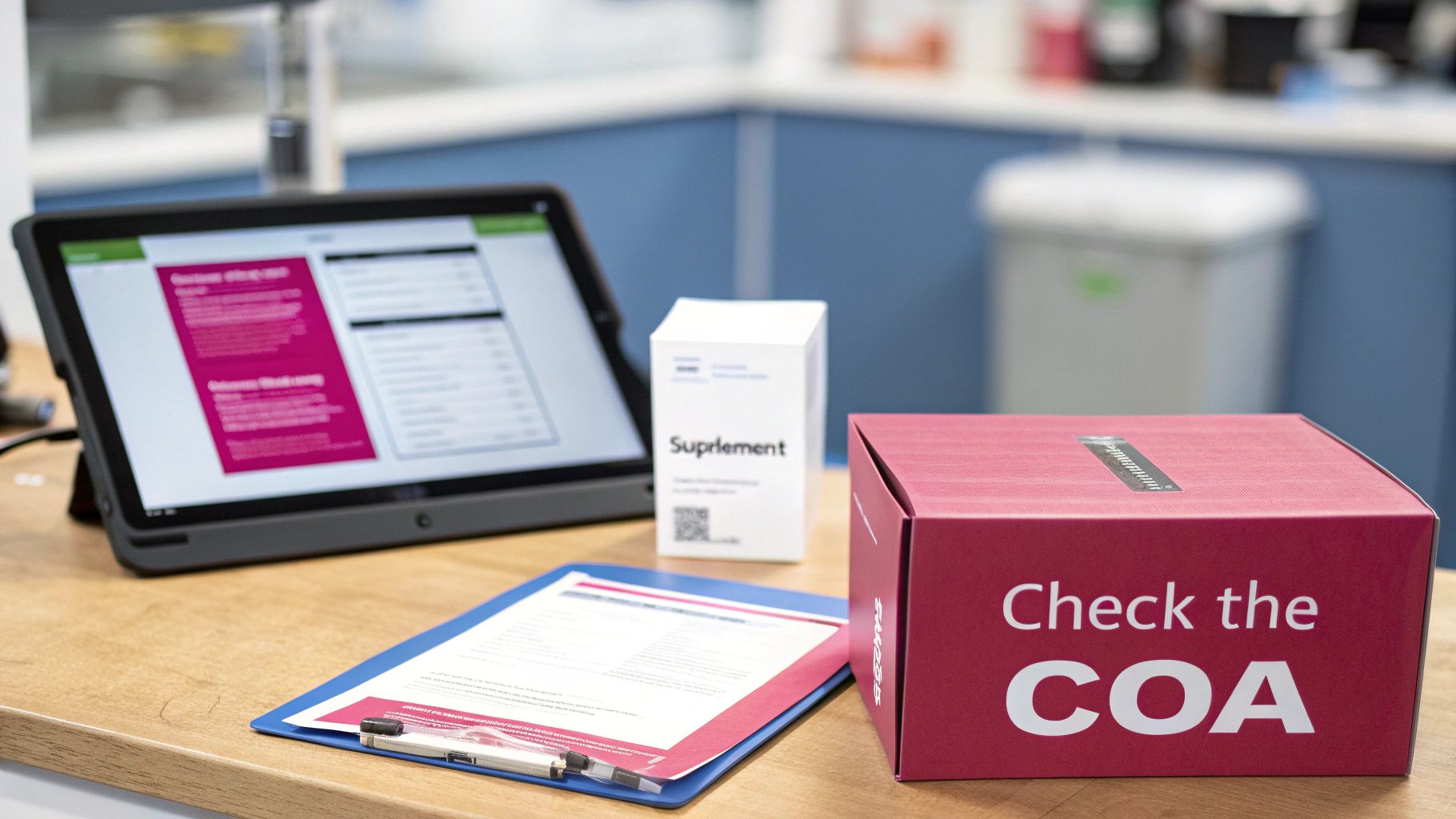
In the world of hemp-derived products, you really have to be your own best advocate. The market isn't tightly regulated by agencies like the FDA, so it's up to responsible brands to prove their products are what they say they are—legal, safe, and accurately labeled.
Your job as a consumer is to know what to look for. And your most powerful tool is the Certificate of Analysis, or COA.
A Certificate of Analysis (COA) is simply a lab report from an independent, third-party laboratory. Think of it as a product's report card. It shows you exactly what’s inside and, just as importantly, what isn't. Any brand worth its salt will make these COAs easy to find for every product batch, usually with a QR code on the package or a dedicated page on their website.
If a company doesn’t provide a COA, or makes it hard to find, that's a massive red flag. Transparency isn't just a nice-to-have; it's essential for confirming a product is both safe and legal.
What to Look For on a COA
Once you’ve got the COA, you need to know how to read it. It can look a little intimidating at first with all the scientific jargon, but you only need to check a few key things to verify a Delta-9 product is legal and clean.
First, make sure the lab’s name is on there and that the report matches the product and batch number you're holding. Then, zero in on these sections:
- Cannabinoid Potency: This is where you confirm legality. Find the line for Delta-9 THC (sometimes listed as Δ9-THC) and look at its concentration. For the product to be federally legal, this number must be at or below 0.3% by dry weight.
- Pesticide Analysis: This part screens for nasty agricultural chemicals. A good report will show "ND" (None Detected) or "Pass" for all the pesticides listed.
- Heavy Metals Testing: Hemp is a bioaccumulator, meaning it can pull things like lead, mercury, and arsenic from the soil. This test ensures those dangerous contaminants didn't make it into the final product.
- Microbial Screening: This confirms the product is free from harmful bacteria, mold, and yeast that could pop up during cultivation or processing.
Think of a COA as a product's detailed background check. It's an unbiased report that proves the brand's claims about potency and purity, giving you the confidence that what's on the label is what's in the product.
Beyond the Lab Report
While the COA is your number one tool, other signs can point to a brand's commitment to quality and transparency. A reputable company works hard to build trust through clear and honest practices.
Look for these other signs of a high-quality, legal product:
- Clear and Accurate Labeling: The package should tell you exactly how much Delta-9 THC is in each serving and in the total package. Vague labels like "hemp extract" without specific cannabinoid amounts are a warning sign.
- Ingredient Sourcing Information: Brands that are proud of their products are usually happy to tell you where their ingredients come from. Look for details on where their hemp is grown and what kind of extraction methods they use.
- Positive Customer Reviews: See what other people are saying. It’s not a scientific measurement, of course, but a consistent stream of positive feedback about product quality and customer service is a pretty good indicator of a trustworthy brand.
Taking a few moments to check these details can make all the difference. It empowers you to pick products that are not only effective but also fully compliant with the law, ensuring you have a safe and positive experience every time.
The Future of Hemp Regulation And Total THC Limits
The legal ground beneath hemp-derived THC is anything but solid. It’s constantly shifting as lawmakers scramble to keep pace with the very market they created with the 2018 Farm Bill. While that bill opened the floodgates for products like Delta 9 beverages, the next big wave of federal regulation is already on its way—and it’s set to change the entire game.
The most critical update on the horizon is the move from today's "Delta 9 THC" limit to a much broader "total THC" standard. This isn't just a minor vocabulary change; it’s a complete overhaul of how we define legal hemp.
The Shift To A Total THC Standard
Right now, a product is considered legal hemp as long as its Delta 9 THC content stays below 0.3% by dry weight. This laser focus on a single cannabinoid created a loophole big enough to drive a truck through, especially for other compounds. Take THCA, for example—it’s a non-intoxicating precursor that cleverly converts into psychoactive Delta 9 when you heat it. This allowed products loaded with THCA to be sold as "legal hemp," even though they delivered a powerful high when smoked or vaped.
The new "total THC" approach is designed specifically to close that loophole. In the near future, a product's legality will be judged by the combined sum of all intoxicating cannabinoids, including Delta 9, its precursors, and its various chemical cousins.
The upcoming "total THC" rule represents a major regulatory tightening. It shifts the legal focus from a single cannabinoid (Delta 9 THC) to the combined psychoactive potential of the entire product, aiming to eliminate high-potency "hemp" that acts like marijuana.
This simple adjustment will make it incredibly difficult for many high-potency products to stay on the right side of the law. Their total intoxicating content will almost certainly blow past the legal limit.
A New Era Of Federal Enforcement
This isn't some far-off hypothetical. The change is coming, and it has a hard deadline. On November 12, 2026, a seismic federal update will officially redefine what counts as legal hemp. The law will ditch the familiar 0.3% Delta-9 rule for a much stricter "total THC" metric, lumping in Delta-9, THCA, Delta-8, and other intoxicating cannabinoids.
As you can read more about how Congress is narrowing the definition of hemp, this will effectively ban most of the consumable hemp products on shelves today. The new law will limit final products to a tiny 0.4mg of total THC per container.
That’s a massive change. This new cap will essentially make the typical 2.5mg to 10mg Delta 9 drinks and edibles illegal overnight, completely reshaping the market. Brands that built their entire business on creatively interpreting the old law will suddenly find themselves in serious trouble.
On the other hand, companies that have always focused on precision, safety, and responsible, low-dose formulas are in a much better position to adapt. Products like Day Dreamer’s carefully measured sparkling waters are built for compliance and consistency. They align perfectly with a future where responsible dosing isn’t just a good idea—it’s the only legal path forward.
Common Questions About Delta 9 Legality
Even with a good grasp of the laws, real-world situations can get tricky. Let's tackle some of the most common questions people have about staying safe and compliant with hemp-derived THC.
Can I Fly With Hemp-Derived Delta 9 Products?
Here’s the deal: federally, you can. The TSA gives the green light to hemp products that stay under the 0.3% Delta 9 THC limit. But—and this is a big but—the real hurdle isn't the TSA, it's the laws at your destination.
Flying with a federally legal product into a state that has banned it can land you in serious hot water. Before you even think about packing that seltzer, you absolutely must:
- Check the laws of the state you're flying to. Is your product welcome there?
- Look up your airline’s policies. Some carriers have their own rules about what you can bring on board.
- Leave products in their original packaging. Make sure the QR code linking to the lab report (COA) is clearly visible.
Will Legal Delta 9 Make Me Fail A Drug Test?
Yes, almost certainly. Standard drug tests don't know the difference between legal hemp and illegal marijuana. All they do is look for THC metabolites in your system.
If you consume any Delta 9 product, you're taking a major risk of testing positive. For anyone facing drug tests for their job or any other reason, the only truly safe bet is to steer clear of all THC products.
It's simple: a product's legal status means nothing to a drug test. A positive result is a positive result, no matter where the THC came from.
How Can A Beverage With 5mg Of THC Be Legal?
This is where the magic of the "0.3% by dry weight" rule really shines. It all comes down to concentration, not the total amount of THC in the can.
Think about it: a 12-ounce can of sparkling water weighs a lot—around 355,000 milligrams. A tiny 5mg dose of THC is just a drop in that bucket, making up a percentage far, far below the 0.3% federal limit. This is how brands can legally create drinks that offer a noticeable, enjoyable effect while staying perfectly compliant.
Ready to see for yourself? Day Dreamer makes clean, low-calorie sparkling waters with a precisely measured dose of Delta-9 for a consistent, uplifting vibe. Check out our flavors and find your new favorite at https://enjoydaydreamer.com.
The statements made regarding these products have not been evaluated by the Food and Drug Administration. The efficacy of these products has not been confirmed by FDA-approved research. These products are not intended to diagnose, treat, cure, or prevent any disease. All information presented here is not meant as a substitute for, or alternative to, information from healthcare practitioners. Please consult your healthcare professional about potential interactions or other possible complications before using any product. The Federal Food, Drug, and Cosmetic Act requires this notice. All products on this website contain 0.3% THC or less.


