

When you're looking for natural ways to manage social anxiety, it's helpful to think of it as a holistic puzzle. You're piecing together lifestyle shifts, new mental habits, and sometimes, gentle support from herbal allies. These elements work in concert to soothe your nervous system, help you question those racing anxious thoughts, and build genuine, lasting resilience. It's a very real, practical path toward feeling more at ease around others.
Finding Calm in a Connected World
Social anxiety often feels like a constant, low-grade stage fright where every conversation or meeting is a high-stakes performance. Have you ever felt your heart pound before walking into a party or mentally rehearsed a simple phone call ten times? If so, you get it. The most important thing to remember is that this isn't a character flaw—it's your nervous system sounding a false alarm.
Your body is essentially reacting to a chat with a coworker as if you were facing a real, physical threat. It’s not a sign of weakness; it’s just your internal security system being a little too vigilant. The great news is you can learn to dial it back down. While professional therapy is often a game-changer, many people also get incredible relief from exploring natural, complementary strategies on their own.
A Toolkit for Your Nervous System
Think of the remedies in this guide as building your own personalized toolkit. There's no single magic cure. Instead, you're gathering a collection of go-to techniques that work for you. This process is empowering because it makes you an expert in what your own mind and body need.
This guide is built around three core pillars:
- Lifestyle Foundations: We'll cover the essentials—breath, movement, and sleep—that create a solid, stable baseline for your mental well-being.
- Mental Reframing: You'll learn practical, science-backed methods for changing how you relate to anxious thoughts so they don't have so much power.
- Supportive Allies: We'll explore well-researched herbs and supplements that can offer your system gentle, steadying support.
The goal isn't to get rid of anxiety completely. After all, it’s a normal human emotion. The aim is to turn down its volume so it no longer runs the show, freeing you up to live the full, connected life you want.
The Growing Interest in Natural Approaches
This shift toward natural methods isn't just a trend; it's a significant movement in how we think about mental wellness. The global market for social anxiety treatments is growing, thanks to greater awareness and better diagnostic tools. A huge driver of this growth is the rise of digital health platforms that make holistic and alternative therapies easier for everyone to access.
As a first step, it helps to explore the different ways of how to calm anxiety naturally. By understanding the options, you can start weaving the strategies that feel right into your daily life, creating a sustainable path toward confidence and calm.
Building Your Foundation with Lifestyle Adjustments
Before we even touch on specific techniques or supplements, let's talk about the absolute bedrock of managing social anxiety. The most powerful changes you can make are the ones that stabilize your nervous system from the ground up, day in and day out.
Think of it like building a house. You wouldn't hang pictures on the walls before you've poured a solid foundation. For your mind and body, that foundation is built on three pillars: your breath, your movement, and your sleep.
Nailing these fundamentals doesn't just chip away at anxiety; it creates a resilient baseline that makes every other strategy far more effective. When your body isn't in a constant state of low-grade alarm, your mind has the space it needs to handle social situations without immediately hitting the panic button.
Let's break down how to shore up each of these crucial areas.
The Power of Your Breath
Your breath is the most direct, real-time remote control you have for your nervous system. It's that simple. When social anxiety spikes, your breathing instinctively gets shallow and quick. This is a primal signal to your brain that something is wrong, flipping the switch on your sympathetic nervous system—your body's "fight-or-flight" mode.
But here’s the amazing part: you can consciously override that signal. By deliberately slowing down and deepening your breath, you activate the parasympathetic nervous system, the "rest-and-digest" state. This sends a powerful, body-wide message that you are safe and the threat has passed.
One of the best ways to do this is with diaphragmatic breathing, or what most people call belly breathing.
- Get Comfortable: Sit or lie down somewhere you can relax. Put one hand on your chest and the other on your stomach.
- Breathe In Slowly: Inhale through your nose for a slow count of four. The whole point is to feel your belly expand like a balloon, pushing your hand up. Your chest should stay relatively still.
- Hold Gently: Pause for just a second or two at the top of the breath.
- Exhale Fully: Breathe out slowly through your mouth for a count of six, feeling your belly deflate.
Just three to five minutes of this a day can start to retrain your body's automatic stress response. It’s an incredibly discreet tool you can pull out anywhere—before a presentation, in a crowded room, or even mid-conversation when you feel that familiar knot of anxiety tightening.
Movement as a Stress Metabolizer
Ever wonder why anxiety makes you feel so jittery and tense? Your body is literally primed for action. It's flooded with cortisol and adrenaline, hormones designed to help you fight a predator or flee from danger. But in the modern world, a social "threat" doesn't require a physical escape, leaving those stress chemicals sloshing around in your system with nowhere to go.
Regular physical activity is the perfect way to burn off that excess anxious energy. It gives your body the physical release it's wired for.
Think of exercise as a way to complete the stress cycle. Your body prepares for a fight, and movement provides that physical release, signaling to your brain that the "danger" has passed and it's safe to relax.
This doesn’t mean you have to start training for a marathon tomorrow. Consistency is a thousand times more important than intensity.
- Brisk Walking: Even a 30-minute walk a day can make a huge difference in cortisol levels while boosting mood-lifting endorphins.
- Yoga or Tai Chi: These are fantastic because they combine gentle movement with the breathwork and mindfulness we're talking about, directly soothing the nervous system.
- Dancing or Team Sports: Finding something fun is the secret sauce. Activities that feel like play can help you re-associate movement with joy instead of it feeling like a chore.
When you find an activity you actually like, you'll stick with it. That consistency helps lower your baseline anxiety, making you far less reactive to social triggers when they do pop up.
Sleep: The Ultimate Emotional Regulator
Let's be clear: sleep isn't a luxury. It's a non-negotiable biological function, especially for mental health. While you sleep, your brain is hard at work processing the day's emotions, filing away memories, and literally cleaning house by clearing out metabolic waste.
When you don't get enough quality sleep, the prefrontal cortex—the logical, rational part of your brain—goes offline. At the same time, the amygdala, your brain's fear center, becomes hyperactive. This is a recipe for anxiety, making you much more likely to perceive neutral social cues as threatening.
Seriously, prioritizing your sleep is one of the most effective natural remedies there is. Getting your sleep hygiene in order can be a game-changer:
- Consistent Schedule: Try to go to bed and wake up around the same time every day, even on weekends. Your body loves a routine.
- Create a Restful Environment: Make your bedroom a sanctuary. It should be dark, cool, and quiet.
- Limit Blue Light: This is a big one. Shut off screens—phones, tablets, TVs—at least an hour before you plan to sleep.
- Mindful Wind-Down: Instead of scrolling, create a relaxing ritual. Read a book, take a warm bath, or listen to some calm music to signal to your brain that it's time to power down.
By building this solid foundation of intentional breathing, consistent movement, and restorative sleep, you create a state of physical calm that dramatically weakens social anxiety's grip on your life.
4. Rewire Your Brain with Mindfulness and Cognitive Tools
While building a strong foundation with things like sleep and exercise is crucial, some of the most profound shifts in social anxiety happen right between your ears. It’s all about changing your relationship with anxious thoughts so they stop calling the shots.
Think of your anxiety as a wild, stormy sea. Trying to fight the waves head-on is not only exhausting but impossible. Mindfulness, on the other hand, teaches you how to become the calm, steady lighthouse on the shore. You learn to observe the storm from a place of safety without getting pulled under.
Let's dive into a few practical mental tools that help you build that lighthouse. We’ll cover simple exercises to anchor you in the present and cognitive techniques to gently question the scary stories anxiety tells you.
Become an Observer with Mindfulness
At its core, mindfulness is just the simple practice of paying attention to the present moment, on purpose and without judgment. For someone struggling with social anxiety, this is a genuine superpower. It yanks you out of the dizzying spiral of future worries ("What if I say something dumb?") and past cringe-fests ("Why did I say that yesterday?").
One of the best ways to get started is with a quick, accessible exercise called the 3-Minute Breathing Space. You can do it anywhere, anytime you feel the anxiety creeping in.
- Acknowledge: For the first minute, just check in with yourself. What’s going on in your mind? What feelings are present? What sensations do you notice in your body? Don't try to change a thing—just notice what's already there.
- Gather: In the second minute, gently bring your full attention to the physical sensation of your breath. Focus on the feeling of the air moving in and out, letting it be an anchor to the here and now.
- Expand: For the final minute, let your awareness expand. Start with the breath and then broaden your focus to include your entire body, the space it takes up, and the sensations throughout.
This simple practice acts like a circuit breaker for the anxious mind. It creates a tiny but powerful pause between an anxious trigger and your usual reaction, giving you a chance to choose a calmer response.
Gently Challenge Anxious Thoughts
Beyond just observing your thoughts, you can also learn to question them. This is a central idea in Cognitive Behavioral Therapy (CBT), one of the most well-researched and effective methods for managing anxiety. The goal isn’t to bully yourself into "thinking positive," but to become a kind and curious detective about your own thought patterns.
Social anxiety loves to use a few tricky thinking patterns, often called cognitive distortions. Learning to spot them is the first step toward taking their power away.
- Mind Reading: This is when you assume you know exactly what other people are thinking, and it’s almost always something negative about you. For instance: "Everyone at this party thinks I'm so awkward."
- Catastrophizing: This is the tendency to jump to the absolute worst-possible conclusion. You might think, "If I stumble over my words during this presentation, I’m definitely going to get fired."
- Personalization: This is the habit of thinking that everything others do or say is a direct, personal reaction to you. If someone glances away while you're talking, you might think, "I must be boring them."
Once you catch yourself in one of these thought loops, you can gently challenge it with a few questions.
Anxious Thought: "Everyone here thinks I'm boring."
Gentle Challenge: "What's the actual evidence for that? Is it a proven fact, or just a feeling? Is there any other possible explanation for how people are acting?"
This process isn't about starting an argument in your head. It’s about planting a small seed of doubt into anxiety's seemingly concrete certainties.
Over time, this practice actually helps rewire the neural pathways in your brain, making you less likely to fall into these negative feedback loops. In fact, studies on Mindfulness-Based Stress Reduction (MBSR) show it can be just as effective as common antidepressants for anxiety and offers lasting benefits in emotional regulation. You can read the full research about these non-drug alternatives to learn more.
Exploring Natural Supplements and Herbal Allies
Once you've started building a solid foundation with lifestyle changes and mental tools, you might wonder what else can help. This is where certain natural supplements and herbal allies can come into the picture, acting as gentle aids that work with your body’s chemistry to help you find your calm.
Think of them less as a magic pill and more as a helpful assistant to the work you're already doing. They can help turn down the volume on your internal alarm system, making it a bit easier to use those mindfulness techniques and step into social situations with more ease. The key is to approach them with a healthy dose of caution, knowledge, and respect.
It’s absolutely critical to talk to your doctor or a qualified healthcare provider before starting anything new. They can help you figure out what’s safe for you, especially if you’re taking other medications, and make sure you’re choosing the right option for your unique health profile.
Adaptogens and Calming Compounds
A handful of natural compounds have been studied for their ability to take the edge off anxiety. They all work a little differently, from helping to balance stress hormones to giving a boost to the calming messengers in our brain.
-
Ashwagandha (Withania somnifera): This is a classic adaptogen, a special class of herbs that helps your body "adapt" to stress. It works by helping to regulate your body's stress response system, primarily by nudging down high levels of the stress hormone cortisol. You can think of it like a thermostat for stress, helping to keep things in a more comfortable range.
-
L-theanine: You'll find this amino acid in green tea, and it's well-known for creating a state of "alert calm." It works by increasing levels of GABA, a neurotransmitter that essentially acts like the brake pedal for your brain. It helps slow down those racing thoughts and promotes relaxation, but without making you feel sleepy. This makes it a popular choice for taking the edge off before a social gathering.
-
Magnesium: This mineral is a true powerhouse for the nervous system. A surprising number of us don't get enough magnesium, which can lead to feeling more on-edge and having a hair-trigger stress response. Supplementing with an easily absorbed form like magnesium glycinate can help relax tense muscles and support that all-important GABA production, helping you feel more emotionally steady.
The most important thing to remember is that supplements are not a replacement for the hard work of changing your lifestyle and reframing your thoughts. They work best when used to support and enhance those efforts, creating a more complete and effective strategy for managing social anxiety.
Responsible Use of Cannabinoids like CBD
Lately, there’s been a lot of talk about cannabinoids—the compounds from the cannabis plant—as potential aids for social anxiety. It’s important to know the difference between the main players, especially CBD and THC, and to approach them with a clear, informed mindset.
Cannabidiol (CBD) is the non-psychoactive compound in the plant, which means it won’t get you "high." Early research suggests it might help ease anxiety by interacting with serotonin receptors in the brain, which are major players in regulating our mood. Many people use it to foster a general sense of calm.
Tetrahydrocannabinol (THC) is the compound that is psychoactive. For some people, very small, controlled doses (often called microdosing) can help lower social inhibitions. But for many others, THC can actually ramp up anxiety and paranoia, particularly in higher doses. The experience can be unpredictable.
If you're considering cannabinoids:
- Start Low, Go Slow: This is the golden rule. Always begin with the smallest possible dose to see how your body responds before even thinking about taking more.
- Source Matters: The market is crowded. Look for brands that provide third-party lab test results to prove what’s in their product. This is how you know you're getting what the label says, without unwanted extras. For example, brands like Day Dreamer focus on clean, tested ingredients in their THC & CBD sparkling waters, offering a transparent option for conscious consumers.
- Legality Varies: Be sure you know the laws regarding CBD and THC where you live.
A wide-ranging meta-analysis of natural compounds has backed up the potential of several of these allies. It found that Ashwagandha had a strong positive effect on reducing anxiety compared to a placebo. Likewise, Cannabidiol (CBD) showed a high probability of easing clinical anxiety in trials, while faster-acting options like L-theanine were noted for their ability to provide quick relief. You can dive deeper into the science in this in-depth review of anxiolytic natural compounds.
The following table offers a quick comparison of some of these popular options to help you see how they stack up at a glance.
Comparing Popular Natural Remedies for Social Anxiety
| Remedy | Primary Benefit | Time to Effect | Key Consideration |
|---|---|---|---|
| Ashwagandha | Reduces overall stress and cortisol | Weeks to build up | Best for long-term, consistent use. |
| L-theanine | Promotes "alert calm," reduces jitters | 30-60 minutes | Great for situational use before an event. |
| Magnesium | Relaxes muscles, supports nervous system | Varies (days to weeks) | Choose a bioavailable form like glycinate. |
| CBD | General sense of calm, reduces anxiety | 30-90 minutes | Sourcing from a reputable brand is crucial. |
Ultimately, choosing to bring herbal allies into your routine is a personal decision that requires careful thought and professional guidance. But when used wisely, they can become a valuable part of your personalized toolkit for finding more comfort and confidence in social settings.
Building Your Personal Social Anxiety Toolkit
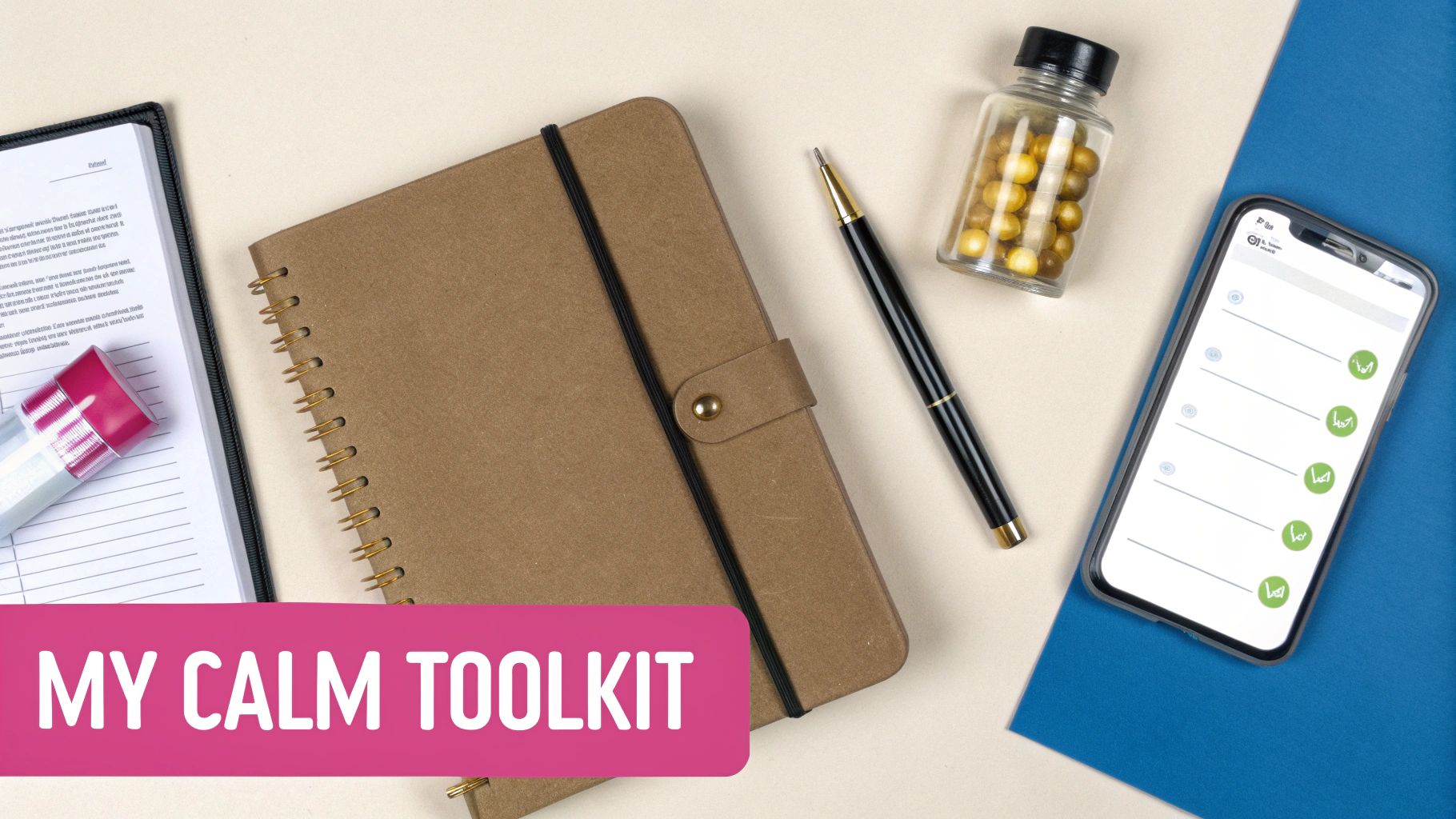
Alright, let's put all the pieces together. Now is the time to assemble your personal strategy, blending breathwork, new thought patterns, and supportive supplements into a plan that actually works for you. Think of it as building your own social anxiety toolkit, stocked with the tools that feel right.
The most important thing to remember here is progress, not perfection. There's no magic bullet or one-size-fits-all solution. Your toolkit will be completely unique to you—your nervous system, your lifestyle, and what triggers your anxiety. The goal is simply to build a reliable system you can lean on when you need it.
Layering Your Tools: Daily, In-the-Moment, and As-Needed
A truly effective toolkit isn't just a random collection of techniques; it's a layered system. You need different tools for different moments. A balanced approach means having daily practices for long-term resilience, quick-acting tools for sudden anxiety spikes, and occasional support for those extra-challenging days.
Here’s how to think about these different layers:
-
Daily Foundations: These are your non-negotiables, the bedrock habits that build a stronger, more resilient baseline over time. A perfect example is starting every morning with five minutes of deep, diaphragmatic breathing to set a calm tone for the day.
-
In-the-Moment Techniques: These are your emergency responders. Think of them as rescue remedies for when you feel that familiar spike of anxiety. You need quick, subtle tools you can use right before walking into a party or during a tough conversation. This is where things like practical grounding techniques for anxiety become lifesavers.
-
As-Needed Support: This layer is for strategic, occasional use. It includes supplements or herbal allies you might turn to before a specific event. For instance, you could take L-theanine about an hour before a big presentation to help quiet the mental chatter.
So, what does a well-rounded toolkit look like in action? It could be a daily morning walk (foundation), using the 5-4-3-2-1 grounding technique right before a phone call (in-the-moment), and taking ashwagandha during a particularly stressful month at work (as-needed support).
Becoming an Expert on Yourself
So, how do you figure out which combination of tools is your winning formula? You become a curious scientist of your own experience. And the single most powerful instrument for this is a simple tracking journal.
You don’t need a fancy app or leather-bound diary. The notes app on your phone or a spare notebook works perfectly. The whole point is to create a feedback loop, connecting what you do with how you feel. By simply noticing the patterns, you become the world’s leading expert on your own nervous system.
Here’s a simple way to start tracking:
The Situation: Write down the social scenario. Be specific (e.g., "Team meeting on Zoom," or "First date").
Anxiety Level (1-10): Give your anxiety a number before the event. This gives you a baseline to measure against.
Tool(s) Used: List what you tried. (e.g., "Did 3 minutes of box breathing," "Took magnesium the night before").
The Outcome: How did it go? Did you feel a difference? "My heart rate stayed pretty steady" is way more useful than "It was okay."
This isn’t about judging yourself—it’s just about gathering data. After a few weeks, you'll start seeing things clearly. You might find that a brisk walk is a better pre-party ritual for you than meditation, or that L-theanine is your go-to for public speaking but doesn't do much for casual get-togethers.
This self-knowledge is the ultimate form of empowerment. It builds real, unshakable confidence in your ability to handle whatever social situation comes your way.
When It’s Time to Call in a Professional
Natural approaches can be fantastic for managing the day-to-day challenges of social anxiety. They build your resilience and give you tools to use in the moment. But it’s crucial to know when you might need to bring in more support.
Think of it like this: if you had a deep cut, you’d clean it and put a bandage on at home, but you’d also go to a doctor to make sure it heals properly. Your mental health deserves the same level of care. Reaching out to a therapist or doctor isn’t a sign of failure—it’s a sign of strength and a smart move for your long-term well-being.
Telltale Signs You Need More Support
It can be tough to know when to make that call, but certain signs are hard to ignore. If any of these feel familiar, it's probably a good time to talk to a professional.
- Your world is shrinking. Is anxiety consistently stopping you from going for a promotion, finishing school, or maintaining important relationships? If you're turning down opportunities or isolating yourself just to avoid social triggers, that’s a major red flag.
- The anxiety feels constant and overwhelming. Despite your best efforts with breathwork, exercise, and other strategies, you feel swamped by anxiety most of the time. The physical feelings—that racing heart, the pit in your stomach—are just too much.
- Other symptoms are showing up. You’re noticing signs of depression, like a persistent feeling of hopelessness, losing interest in things you used to love, or major shifts in your sleep patterns or appetite.
- You're leaning on unhealthy crutches. You find yourself needing a few drinks or using other substances just to get through social events.
A Powerful Partnership for Your Health
Getting professional help doesn't mean you have to ditch the natural strategies that are working for you. Actually, the most powerful approach often combines them.
Therapy and natural remedies aren’t an either/or choice. They’re a powerful team. A therapist can give you proven tools like Cognitive Behavioral Therapy (CBT), while your lifestyle practices build a solid foundation that makes the therapy even more effective.
A good therapist or doctor can help you weave everything together into a plan that makes sense for you. They can help you safely integrate exercise, mindfulness, and even certain supplements into a structured treatment plan.
Taking that step is an investment in yourself and a brighter, more confident future.
Have Questions? We Have Answers.
It's completely normal to have questions when you're looking into natural ways to manage social anxiety. Let's clear up a few common ones so you can move forward with confidence.
How Long Until I Notice a Difference?
This is a great question, and the honest answer is: it depends. Some things offer relief almost instantly, while others are more of a slow burn, building up their benefits over time.
-
For quick relief: Something like a focused breathing exercise can calm you down in the moment, sometimes in just a couple of minutes. Certain supplements, like L-theanine, can also start to work within 30-60 minutes, which is handy if you're heading into a specific situation that makes you nervous.
-
For lasting change: Think of things like exercise, better sleep, or mindfulness as building a stronger foundation. You might not feel a dramatic shift overnight, but after a few weeks of consistency, you'll likely notice your overall anxiety levels are lower. The same goes for adaptogenic herbs like Ashwagandha; they need a little time to help your body get better at handling stress.
Can I Just Use These Instead of Therapy or Medication?
While natural approaches can be incredibly helpful, it's best to think of them as part of a team, not a solo act. They work beautifully alongside professional support but shouldn't be seen as a direct substitute.
Think of it this way: natural remedies can make your day-to-day life much better and can be a fantastic complement to therapy like CBT. But if you're on prescribed medication, it's crucial not to stop or change your dose on your own. Always talk to your doctor before making any adjustments to your treatment plan.
Your healthcare provider is the only one who can see the full picture. They can help you figure out how everything fits together safely and effectively, creating a plan that truly works for you.
Ready to explore a tasteful, modern option for finding your calm? Day Dreamer offers a curated line of clean, hemp-derived Delta-9 THC and CBD sparkling waters, designed for a refined and relaxing experience. Learn more and discover your new favorite way to unwind at https://enjoydaydreamer.com.


