
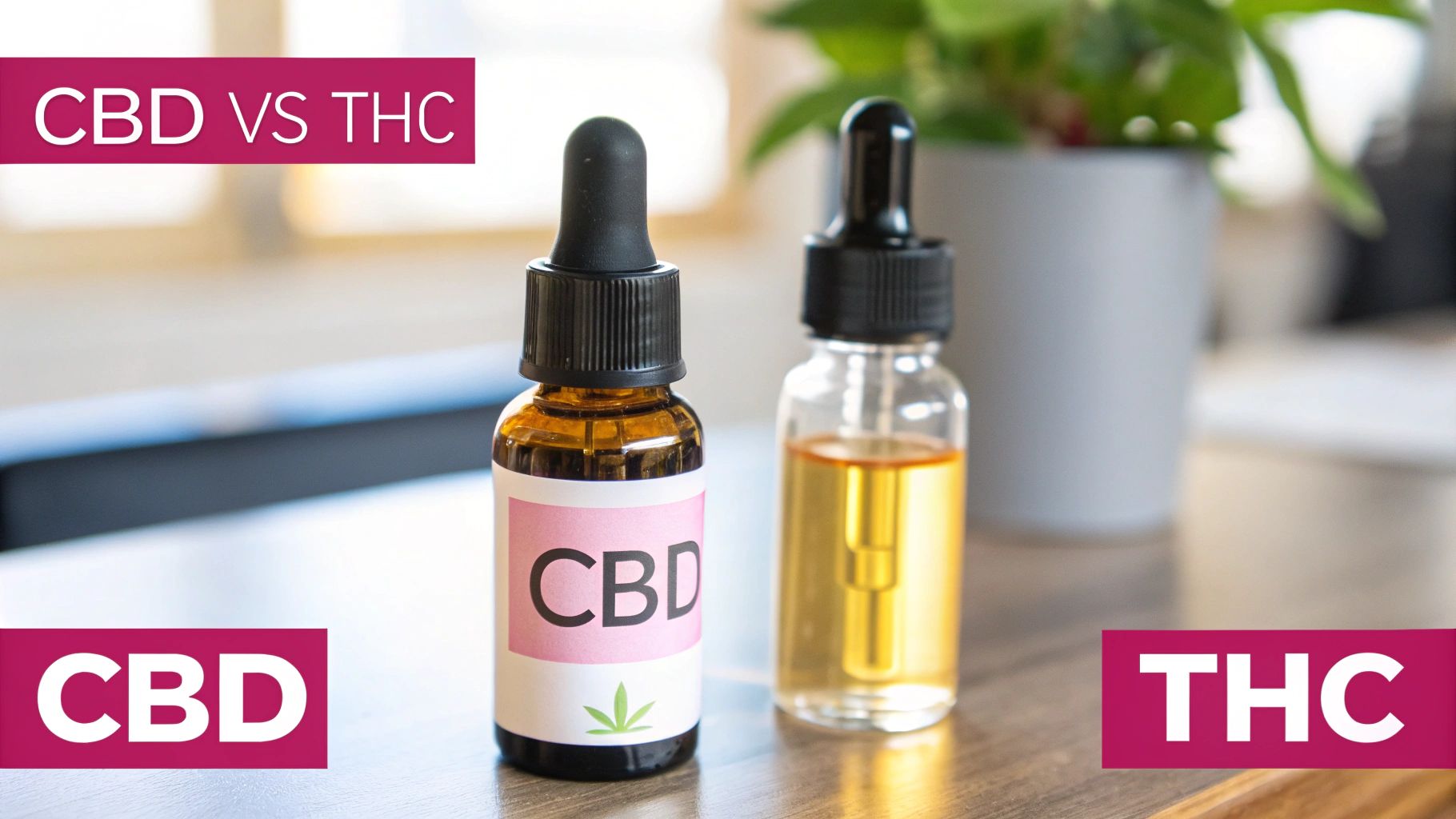
When you boil it down, the core difference between CBD and THC effects is pretty simple: THC gets you high, and CBD doesn't. That's the headline. THC is the compound that creates the classic euphoric, mind-altering experience people associate with cannabis. On the other hand, CBD is entirely non-intoxicating; people seek it out for its therapeutic and calming benefits, completely separate from the "high."
Understanding The Fundamental Differences Between CBD And THC
Even though CBD (cannabidiol) and THC (tetrahydrocannabinol) both come from the cannabis plant, they couldn't be more different in how they affect us. The reason for this divergence comes down to their interaction with our body's endocannabinoid system (ECS), a vital network that helps keep things like mood, sleep, appetite, and pain in balance.
Think of it like a lock and key. THC binds directly and strongly with our cannabinoid 1 (CB1) receptors, which are found all over the brain and central nervous system. This perfect fit is what unlocks the psychoactive effects—the euphoria, the altered perception, the classic "high."
CBD works differently. It takes a much more indirect route and doesn't really bind with those CB1 receptors. Instead, it acts more like a supportive modulator for the entire endocannabinoid system, helping our body's own natural cannabinoids work more effectively. This subtle influence helps promote a sense of calm and well-being without causing any intoxication. This is the critical distinction: one compound changes your perception, while the other helps your body find its own equilibrium.
At-A-Glance Comparison Of CBD vs THC
To make things even clearer, here’s a quick breakdown of the core distinctions between these two cannabinoids. This table should give you a fast, easy way to see the differences in their effects, legality, and common uses.
| Characteristic | CBD (Cannabidiol) | THC (Tetrahydrocannabinol) |
|---|---|---|
| Primary Effect | Non-psychoactive; calming, therapeutic. | Psychoactive; euphoric, mind-altering. |
| Legal Status | Federally legal if derived from hemp. | Federally illegal; legal in some states. |
| Common Uses | Anxiety, inflammation, sleep, pain relief. | Recreation, pain, appetite stimulation, nausea. |
| Drug Test | Typically does not show up on tests. | Will show up on standard drug tests. |
Ultimately, understanding which cannabinoid is right for you comes down to grasping this fundamental split in their effects and purpose.
The simplest way to remember the difference is that THC directly changes your state of mind, while CBD influences your physical and mental state without cognitive impairment. It’s the difference between altering perception and restoring balance.
How CBD And THC Interact With Your Body's Endocannabinoid System
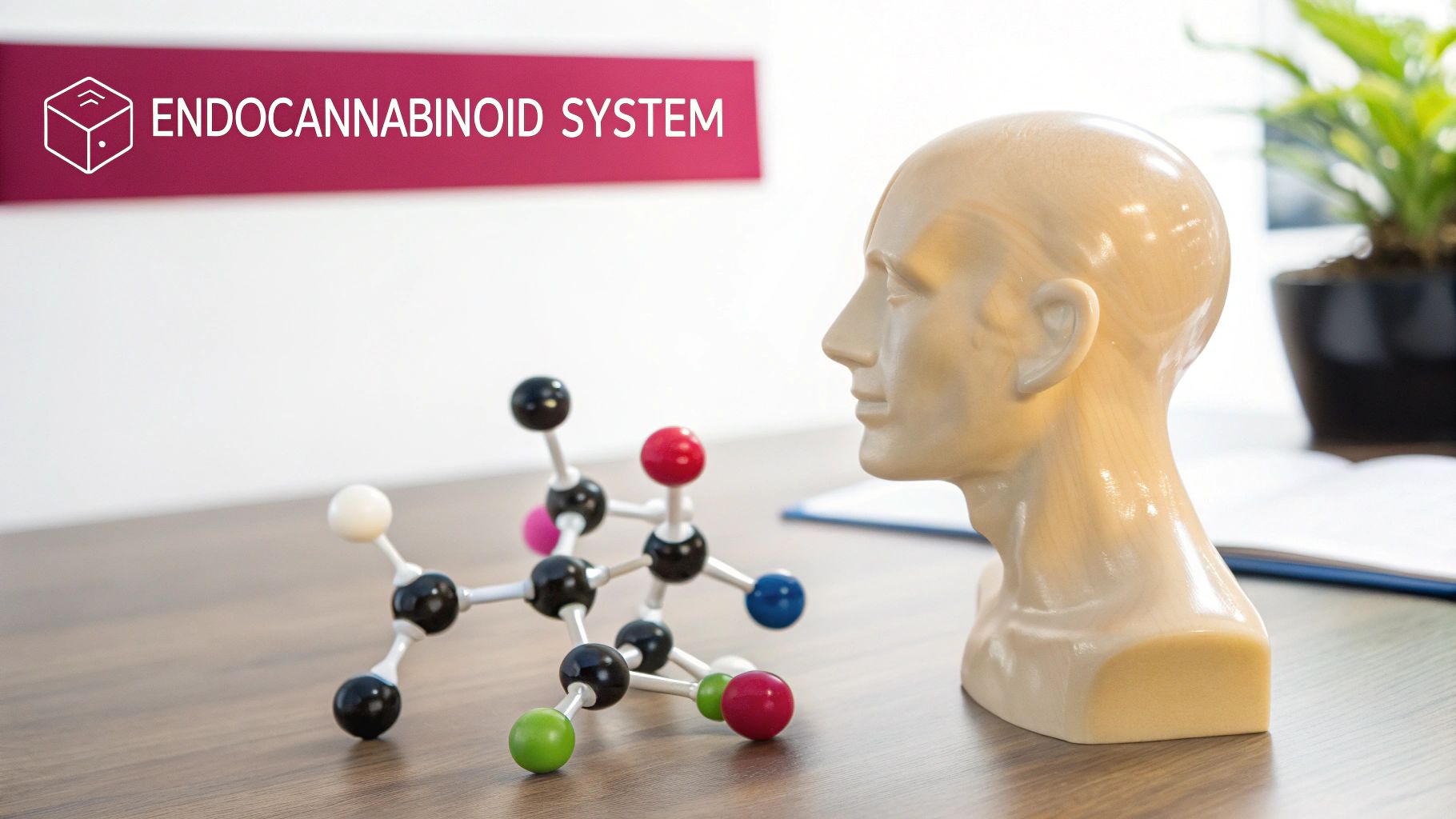
To really get why THC and CBD feel so different, we need to look under the hood at your body's master regulator: the endocannabinoid system (ECS). This incredible network influences just about everything—mood, memory, pain, appetite, you name it. The different effects you feel from CBD vs. THC all come down to how they interact with this system.
Think of your ECS receptors as locks and cannabinoids as keys. THC is a key that fits perfectly into the CB1 receptors, which are packed throughout your brain and central nervous system. This direct connection is what "unlocks" the door to THC's psychoactive effects, kicking off the chain reaction that leads to the classic high.
CBD, on the other hand, works completely differently. It’s less of a key and more of a master locksmith for the entire system.
THC: The Direct Activator
When THC gets into your system, it has one main job: find and fire up those CB1 receptors. It’s a direct and powerful action that changes your perception, mood, and thinking. This is exactly why a THC-dominant edible or drink can deliver such a potent, sometimes overwhelming, euphoric feeling.
That strong bond is both THC’s biggest selling point and its potential pitfall. For someone looking for a powerful buzz or serious relief, it's perfect. But for others, especially at higher doses, that same directness can trigger unwanted side effects like anxiety or paranoia.
CBD: The Indirect Modulator
CBD’s approach is much more subtle. Instead of forcing the CB1 lock open, it influences the ECS in a few clever, indirect ways:
- Enzyme Inhibition: CBD blocks the FAAH enzyme, which breaks down anandamide—your body's own "bliss molecule." By keeping FAAH busy, CBD allows more anandamide to stick around, naturally promoting a feeling of calm and well-being.
- Receptor Modulation: Here’s the really interesting part. CBD can actually change the shape of the CB1 receptor. This makes it harder for THC to bind as strongly, which is why CBD is so effective at "taking the edge off" a THC high.
This balancing act is the secret to creating a more controlled and enjoyable experience, and it's why products like Day Dreamer's sparkling waters intentionally combine both.
The real magic happens when CBD and THC work together. CBD acts as a buffer, smoothing out the sharp edges of THC's high. This synergy allows for a more functional, pleasant uplift without the risk of feeling overwhelmed.
The Entourage Effect In Action
This teamwork between cannabinoids is what we call the entourage effect. The idea is simple: these compounds are better together than they are apart. A beverage with a balanced ratio of THC and CBD, for instance, can provide a gentle lift that’s just right for socializing without sending you to the moon.
Recent neuroimaging studies actually let us see this in action. The data shows that THC alone causes a huge spike in brain activity, but adding CBD brings that activity back down to a more manageable level. This means you get the good stuff from THC—the mood boost and relaxation—while reducing the brain fog that can derail focus in up to 45% of high-THC sessions.
For a student cramming for an exam or a young professional who wants to unwind without a hangover, this science explains everything. It shows how a well-formulated beverage can offer a refined, functional high. You can read the full research on how CBD modulates THC effects for a deeper dive.
What It Actually Feels Like: THC vs. CBD

The science is one thing, but what you really want to know is how each cannabinoid makes you feel. This is where the paths of CBD and THC diverge dramatically. The subjective experience—the actual feeling—is the most important difference between them.
THC is the one that actively changes your consciousness. It's famous for producing a "high," which is just another way of saying it creates a noticeable shift in your perception of the world. But that experience isn't a single, static thing; it's a spectrum that depends on the dose, your personal body chemistry, and even where you are and who you're with.
The THC Experience: A Shift in Perception
At lower doses, THC often feels uplifting and euphoric. You might notice a light wave of happiness wash over you, find things funnier than usual, or discover that music has more depth and food tastes incredible. This sensory enhancement is classic THC, making it a go-to for social events or creative projects.
Think of it this way: sipping a low-dose THC sparkling water from a brand like Day Dreamer at a barbecue can feel like a clean, bright alternative to a beer. It can get conversations flowing and help you feel more connected, but without the sluggishness or next-day hangover that alcohol can bring.
But as you increase the dose, the effects can intensify. For some, a higher dose leads to deep, reflective thoughts or uncontrollable giggles. For others, the cognitive shift can feel a bit overwhelming or disorienting. Too much THC can sometimes trigger anxiety or paranoia, which is why the golden rule is always to start low and go slow.
The CBD Experience: A Return to Center
CBD is completely different. Consuming CBD isn't about creating a new feeling—it’s about dialing in the one you already have. There is no high, no intoxication, and no cognitive impairment. The effect is subtle, best described as a gentle release of built-up mental and physical tension.
Instead of a rush of euphoria, you might just realize that the constant chatter in your mind has quieted. The knot of stress in your shoulders from a long day might start to loosen. It’s more of a return to a balanced, centered state. It’s you, just with less static.
A CBD-infused drink is perfect for unwinding after a stressful workday. It can ease you into your evening, bringing a sense of calm that helps you be more present without feeling sleepy or out of it. It doesn’t add a new layer to your reality; it helps strip away the noise.
The core difference is this: THC directly alters your perception, taking you on a journey. CBD, on the other hand, helps you find your way back to a calmer, more grounded version of yourself.
Let's put this into a couple of real-world scenarios:
- The Social Gathering: You're off to a party and want something to help you loosen up. A low-dose THC beverage can lift your mood and make socializing feel more natural and fun, much like a great cocktail but without the alcohol.
- The Post-Work Wind-Down: It's been a hectic day, and your brain won't shut off. A CBD drink can help soothe your nervous system and quiet those racing thoughts, letting you truly relax and recharge for tomorrow.
Ultimately, your choice depends entirely on what you're looking for. Do you want to enhance an experience and shift your perspective? Or are you trying to restore balance and find a sense of calm? Your answer will point you to the right cannabinoid for that moment.
Therapeutic Benefits And Wellness Applications
When you stack CBD and THC side-by-side, the conversation quickly turns to wellness and finding relief. Both cannabinoids bring some serious, science-backed benefits to the table, but they tackle different problems. Sometimes they work best on their own, and other times, they're a powerhouse duo. Figuring out these differences is the key to making them work for you.
THC is the go-to for more intense situations where you need to interrupt a symptom in its tracks. Because it directly engages with our brain's CB1 receptors, it’s a heavy hitter for things like chronic pain, chemo-related nausea, or boosting appetite. That euphoric feeling it's known for can also be a welcome mental break from severe physical distress.
CBD, on the other hand, is all about bringing your system back into balance. It’s the non-intoxicating counterpart, making it an incredibly versatile tool you can weave into your daily routine.
CBD For Anxiety, Inflammation, And Sleep
One of the main reasons people reach for CBD is to manage anxiety. It works behind the scenes in the endocannabinoid system to help you find a sense of calm and clarity without feeling drowsy, which is why it's great for daytime use. A CBD-rich drink can be a perfect way to ease into a stressful day or unwind at the end of it.
On top of that, CBD is well-known for its powerful anti-inflammatory properties. This has made it a favorite among athletes for post-workout recovery and anyone dealing with inflammatory issues. By soothing discomfort at its source, CBD gives your body's natural healing processes a boost. Of course, cannabinoids aren't the only option; you can explore other effective anti-inflammatory supplements to support your overall well-being, too.
Sleep is another area where CBD really makes a difference. It’s not a knockout sedative like some sleep aids. Instead, it helps quiet the things that often keep us awake, like a racing mind or nagging pain, which paves the way for a more natural, restorative night's rest.
The Power Of Synergy In Pain Management
While both cannabinoids can help with pain, their true strength is often revealed when they work together. This teamwork is called the "entourage effect," and it’s especially noticeable in pain management, where a combo formula often works better than either one alone. Think of it this way: CBD helps mellow out THC's high while simultaneously cranking up its pain-fighting abilities.
The combination of THC and CBD offers a more nuanced approach to relief. THC directly targets pain signals, while CBD works to reduce underlying inflammation and anxiety, creating a comprehensive and more effective treatment.
This isn't just a theory; there's solid research behind it. A landmark 2018 randomized controlled trial with 177 patients suffering from hard-to-treat cancer pain found that a pain reduction of 30% or more was seen in 38% of the group using a THC-CBD combo. For the group using only THC, just 21% hit that same level of relief. This really shows how CBD acts as a modulator, turning up the pain relief while dialing down THC's intensity. You can read the full research on this cannabinoid synergy to dig into the details.
Integrating Cannabinoids Into Modern Wellness
Knowing the unique and overlapping benefits of these compounds lets you be much more intentional with your wellness routine. They've moved beyond just being for severe medical issues and are now sophisticated tools for handling everyday health challenges.
Here are a few modern ways people are using them:
- Post-Workout Recovery: A CBD-dominant beverage can help ease muscle soreness and inflammation after a tough workout, helping you bounce back faster without any mental fog.
- Menstrual Discomfort: A balanced 1:1 ratio of CBD to THC can be a game-changer. THC helps dull the immediate sensation of cramps, while CBD gets to work on the inflammation causing them.
- Stressful Workday: A low-dose CBD drink can quiet a racing mind and ease shoulder tension without making you feel sleepy, letting you stay focused and productive but calm.
- Social Alternative: For a night out, a low-dose THC beverage from a brand like Day Dreamer offers a clean, uplifting buzz without the hangover or empty calories of alcohol. It's a fantastic choice for anyone looking for a healthier social option.
Ultimately, choosing between CBD, THC, or a blend of both really comes down to what you’re trying to achieve. By understanding their individual therapeutic strengths, you can make a smart choice that aligns with your body's specific needs.
Understanding Onset Time, Duration, And Dosing
How you take CBD or THC is just as important as which one you choose. The delivery method dramatically shapes your entire experience—from how quickly the effects kick in to how long they stick around. This is where things get interesting, especially when you compare traditional methods like smoking and edibles to modern cannabis drinks.
If you smoke or vape, you’ll feel it almost instantly. The cannabinoids go straight into your bloodstream through the lungs, so the onset is just a few minutes. The downside? The effects are fleeting, typically lasting only 1-3 hours.
Traditional edibles, like brownies or gummies, are the complete opposite. They have to travel through your digestive system and get processed by your liver, which can take a long and unpredictable 60 to 120 minutes. While the effects last much longer—often 4-8 hours—that long, uncertain wait makes it notoriously difficult to get the dose right.
The Rise Of Cannabis Beverages
This is exactly why cannabis-infused beverages are becoming so popular. They use smart formulation technology like nanoemulsion, which breaks the cannabinoids down into microscopic, water-friendly particles. This clever science allows them to be absorbed directly through the tissues in your mouth and stomach, neatly sidestepping that slow journey through the digestive tract.
The result is a much faster, more reliable experience. With a cannabis beverage, you can expect to feel the effects in as little as 15-30 minutes. That’s a timeframe much closer to sipping a cocktail than waiting for an edible to finally kick in, giving you the control to see how you feel before deciding to have another.
Cannabis beverages bridge the gap between the rapid onset of inhalation and the prolonged duration of edibles. They offer a controlled, sociable, and predictable experience that aligns with the modern consumer's lifestyle.
When it comes to cannabis, the form factor dictates the function. How you consume a cannabinoid directly influences when you'll feel it and for how long. The table below breaks down the typical timelines for different methods.
Cannabis Consumption Method Comparison
| Method | Onset Time | Peak Effects | Total Duration |
|---|---|---|---|
| Inhalation (Smoking/Vaping) | 2–10 minutes | 15–30 minutes | 1–3 hours |
| Traditional Edibles | 60–120 minutes | 2–3 hours | 4–8 hours |
| Cannabis Beverages | 15–30 minutes | 45–60 minutes | 2–4 hours |
| Tinctures (Sublingual) | 15–45 minutes | 60–90 minutes | 4–6 hours |
As you can see, beverages offer a unique middle ground—they're quick to act but don't overstay their welcome, making them ideal for social settings or controlled relaxation.
A Practical Guide To Dosing
With any cannabinoid, the golden rule is to start low and go slow. This is especially true for THC, where taking too much can quickly turn a good time into an uncomfortable one. Precisely dosed drinks, like those from Day Dreamer, take the guesswork out of the equation.
Here are a few real-world examples to help you find your sweet spot:
- The Microdose Experience: A beverage with 2.5mg of THC is a fantastic starting point. It's perfect for a subtle mood lift or a gentle nudge of creativity without any real "high."
- The Balanced Social High: A drink with 5mg of THC and 5mg of CBD hits a beautiful balance. The CBD helps smooth out the THC’s edges, delivering a mellow, happy buzz that's a great alcohol alternative for social events.
- Pure Relaxation: If you want to unwind without any intoxication, a beverage with 20mg of CBD is your ticket. It’s ideal for melting away stress after a long day or prepping for a truly restful night of sleep.
This tailored approach highlights the power of starting small. Research backs this up; one study showed that just a 5 mg oral THC dose reduced nightmare frequency in PTSD patients by 70%. Another found that consistent THC-CBD dosing gave reliable pain control to 38% of patients. For those of us enjoying a precisely dosed beverage, this data is reassuring—it confirms that starting low isn't just safer, it's effective. You can dive deeper into the science behind controlled oral doses by visiting the National Center for Biotechnology Information's website.
How to Pick the Right Cannabinoid for You
Trying to figure out the difference between CBD and THC can feel a bit overwhelming, but it really comes down to one simple question: What are you trying to achieve? Once you know your goal for a particular moment or occasion, you can pick a product that gets you there.
This isn't about deciding which one is "better" overall. It's about what’s better for you, right now. Think of it like choosing the right tool for the job—you wouldn't use a hammer to turn a screw.
Matching the Cannabinoid to Your Goal
Let’s get practical and look at a few real-world situations. Your decision will likely hinge on whether you want to liven up a social event, quiet your mind, or just find a nice middle ground.
For a Vibrant, Social Buzz (Go for THC)
If you're heading to a party or a get-together and want a clean, alcohol-free lift, a low-dose THC beverage is a fantastic option. It can help get conversations flowing, spark a little creativity, and add a happy buzz to the evening, all without the hangover. For most people, a drink with around 5mg of THC is the sweet spot for a fun, manageable experience.
For a Quiet, Calm Mind (Stick with CBD)
When all you want is to decompress after a long day, a CBD-dominant drink is your go-to. It's brilliant for quieting a racing mind and easing physical tension without making you feel "high" or foggy. This makes it perfect for curling up with a book or just easing into a peaceful evening while staying sharp and present.
Your choice is all about context. THC is for actively shifting your mindset to enhance an experience. CBD is more about restoring your natural balance and finding a state of calm. One creates a feeling, while the other helps you get back to center.
The Best of Both Worlds: The 1:1 Ratio
For a lot of people, the magic happens somewhere in the middle. A product with a balanced 1:1 ratio of THC to CBD offers a beautifully harmonious effect, tapping into what's known as the "entourage effect," where the two cannabinoids work together to enhance each other's benefits.
In this kind of blend, the CBD really helps to smooth out the edges of the THC. This can make a huge difference in reducing the chances of feeling anxious or paranoid, which is a common worry for people who are new to THC or just sensitive to its effects.
A 1:1 ratio usually delivers:
- A gentle, mood-lifting buzz from the THC.
- A feeling of physical relaxation and mental calm from the CBD.
- A clear-headed high that feels pleasant and easy to handle.
This balanced profile makes 1:1 products, like the sparkling waters from Day Dreamer, incredibly versatile. They’re perfect for a lazy weekend afternoon, a chill hangout with friends, or any time you want a touch of euphoria grounded by deep relaxation. It’s a fantastic starting point for anyone curious about what both cannabinoids can do together.
Your Top Questions About CBD And THC Answered
It's one thing to understand the science, but it’s another to know how these cannabinoids fit into real life. Questions about drug tests, side effects, and legality always come up, and getting clear answers is essential for using these products confidently. Let's break down some of the most common queries.
Will CBD Make Me Fail A Drug Test?
This is a big one. In theory, pure CBD shouldn't show up on a standard drug test, since those screens are looking for THC. But here’s the catch: it all comes down to the type of CBD product you're using.
Full-spectrum CBD products contain a tiny, legally compliant amount of THC (less than 0.3%). If you take very high doses consistently, it's possible for that THC to build up in your system and trigger a positive test.
If you're subject to drug testing, your safest bet is to stick with CBD isolate or broad-spectrum CBD. These products have had the THC completely removed, so you get the benefits of CBD without the risk.
What Are The Main Side Effects I Should Know About?
Both CBD and THC are generally considered safe, but their side effect profiles are quite different.
- THC side effects are mostly tied to its psychoactive effects and often depend on the dose. You might experience dry mouth, red eyes, a faster heart rate, or some coordination issues. For some people, especially with higher doses, it can also lead to feelings of anxiety or paranoia.
- CBD side effects are far milder and less frequent. The most common ones reported are fatigue, changes in appetite, or an upset stomach.
When comparing CBD vs. THC effects, the side effects tell a clear story. THC’s potential downsides are directly linked to its “high,” while CBD’s are subtler, reinforcing its reputation as the non-intoxicating, gentle cannabinoid.
Is THC From Hemp Really The Same As THC From Marijuana?
Yes, on a molecular level, it's the exact same compound: Delta-9 THC. The difference isn't in the chemical itself but in the plant it comes from and, crucially, its concentration.
The 2018 Farm Bill created a legal distinction. It defined hemp as any cannabis plant with 0.3% THC or less by dry weight, making it federally legal. Marijuana, on the other hand, refers to cannabis plants that exceed this limit.
This is precisely why you can legally buy products like hemp-derived THC sparkling waters. The THC is extracted from legally grown hemp and then infused into beverages in carefully measured doses. It offers a perfectly legal way to enjoy the familiar effects of THC, even in states where recreational marijuana isn't available.
Ready to experience the perfect balance of uplift and relaxation? Day Dreamer crafts clean, precisely dosed, hemp-derived THC and CBD sparkling waters for the modern consumer. Discover your new favorite alcohol alternative and enjoy a refined buzz without compromise by exploring our collection at https://enjoydaydaydreamer.com.
The statements made regarding these products have not been evaluated by the Food and Drug Administration. The efficacy of these products has not been confirmed by FDA-approved research. These products are not intended to diagnose, treat, cure, or prevent any disease. All information presented here is not meant as a substitute for, or alternative to, information from healthcare practitioners. Please consult your healthcare professional about potential interactions or other possible complications before using any product. The Federal Food, Drug, and Cosmetic Act requires this notice. All products on this website contain 0.3% THC or less.


