

When you get down to it, the real difference between Delta 9 and Delta 8 comes down to two things: how strong it is and where it comes from legally. Delta 9 THC is the main psychoactive ingredient in cannabis that gives you that classic, strong high. On the other hand, Delta 8 THC is its milder, less powerful cousin, usually made from legally grown hemp.
Choosing between them is all about what you're looking for. Do you want a more intense, traditional cannabis experience, or are you after something smoother that lets you stay more clear-headed and functional?
A Clear Look at Delta 9 vs Delta 8
As you start exploring the world of cannabinoids, you'll hear "Delta 9" and "Delta 8" thrown around a lot, which can be confusing for just about anyone. Even though they're almost identical chemically, they deliver very different experiences. Figuring out what is delta 9 vs delta 8 is the first step to finding a product that fits your lifestyle and wellness goals.
Delta 9 THC is the celebrity of the cannabis world. It’s the compound behind the quintessential "high" that marijuana is known for. It’s found in large amounts in the plant and has been the star of the show for decades.
In contrast, Delta 8 is more of a background player. It’s a minor cannabinoid, meaning it only appears in tiny trace amounts naturally. To create Delta 8 products, specialists usually convert CBD that’s been extracted from federally legal hemp.
Key Distinctions Explained
That tiny shift in molecular structure might not seem like much, but it changes everything. It dictates how each compound interacts with your body's endocannabinoid system, which is why their effects, potency, and even legal standing are so different.
- Potency and Effects: Delta 9 is the heavy hitter. It’s known for delivering a potent experience that you can feel in both your head and your body. Delta 8 offers a much gentler, clearer-headed buzz. Think relaxation and calm, without the powerful euphoria or mental fog.
- Legal Status: This is where it gets interesting. Thanks to the 2018 Farm Bill, hemp-derived Delta 9 products are federally legal as long as they contain less than 0.3% THC by dry weight. Delta 8, despite also coming from hemp, lives in a much grayer legal space, and some states have banned it outright.
The 2018 Farm Bill really opened the door for smart, compliant products like Day Dreamer's sparkling waters. By staying strictly within that 0.3% Delta 9 THC limit, we can craft a beverage with a precise, enjoyable dose that's both effective and federally legal.
To make things even clearer, here’s a quick rundown of how they stack up.
Delta 9 vs Delta 8 At a Glance
This table offers a snapshot of the core differences between Delta 9 and Delta 8, helping you quickly understand what sets them apart.
| Characteristic | Delta 9 THC | Delta 8 THC |
|---|---|---|
| Potency | High | Mild to Moderate |
| Primary Source | Abundant in Marijuana | Converted from Hemp CBD |
| Common Effects | Strong euphoria, intense | Clear-headed, relaxing |
| Federal Legality | Legal if hemp-derived & <0.3% | Legally complex; state bans exist |
Ultimately, this comparison highlights why one might be a better fit for you than the other, depending entirely on your personal preferences and local laws.
The Molecular Science Behind Each Effect
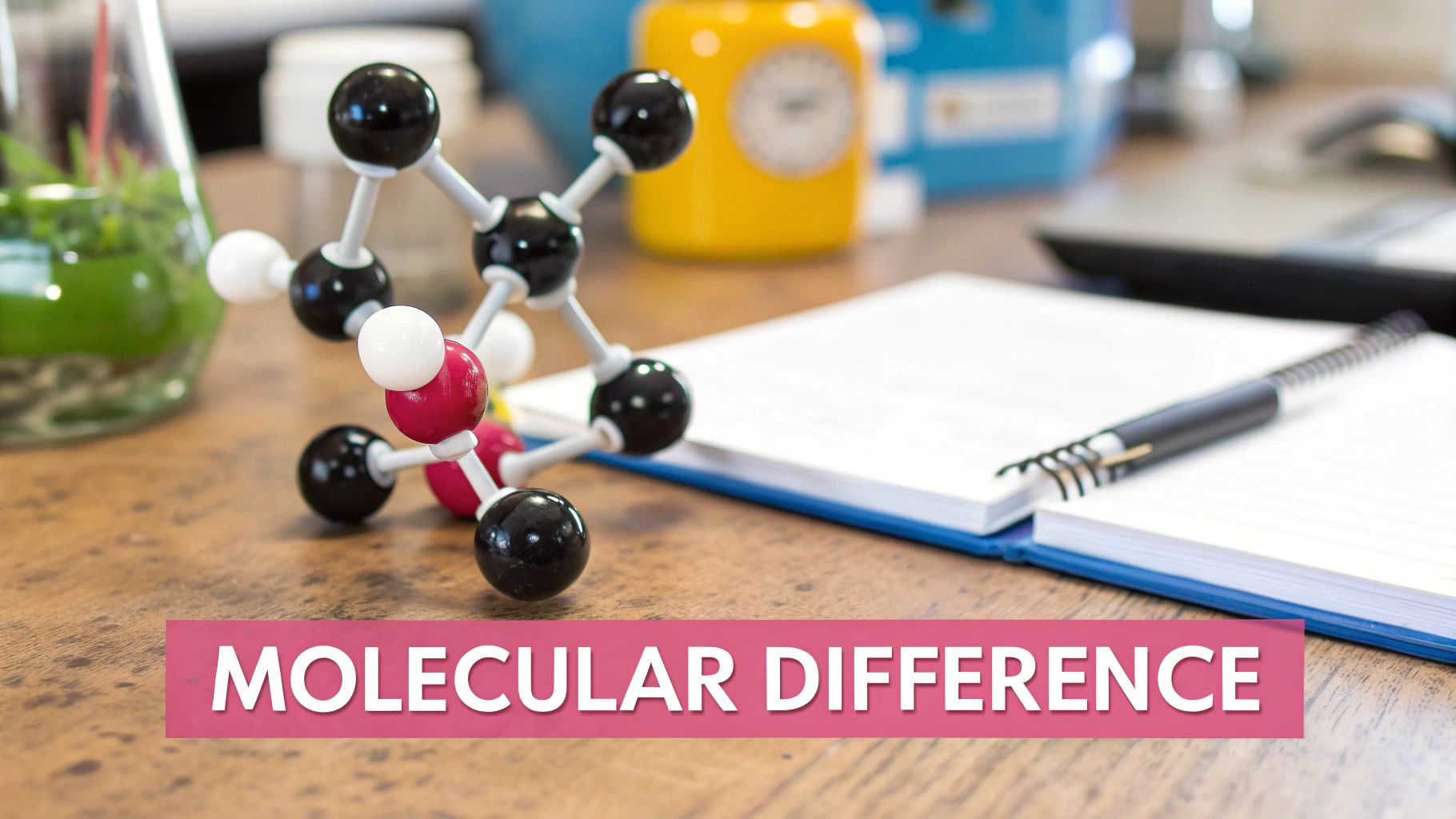
To really get what makes the experiences of Delta-9 and Delta-8 so different, we need to look at their chemical blueprints. At first glance, they look like identical twins. They even share the exact same chemical formula: C₂₁H₃₀O₂. That means they’re built from the same number and types of atoms.
So where does the difference come from? It’s all in the arrangement. The distinction boils down to one incredibly small yet powerful detail: the location of a double bond in their carbon chain. This tiny structural quirk is the very reason they feel so different in the human body.
A Small Shift With Big Consequences
Think of it like two keys that look almost identical, but one has a single groove in a slightly different spot. One key slides into the lock and turns it perfectly, while the other only gets it part of the way. That’s a great way to picture how Delta-9 and Delta-8 interact with your body’s endocannabinoid system (ECS).
The ECS is a complex network of receptors that helps keep things like your mood, appetite, and sleep in balance. For the effects we’re talking about, the most important players are the CB1 receptors, which are found all throughout the brain and central nervous system.
The core difference lies in their atomic structure. This tiny molecular variation dictates how strongly each cannabinoid can connect with your body's CB1 receptors, directly influencing the intensity of your experience.
This difference in potency all comes down to where that double bond sits. For Delta-9, it's on the ninth carbon atom. For Delta-8, it's on the eighth. This subtle shift changes the molecule's overall shape, making it bind a little less snugly to those CB1 receptors. The result is a gentler, less intense psychoactive effect. You can dig deeper into the science behind their receptor affinity and effects.
A Look at Natural Availability
Another crucial piece of the puzzle is how these cannabinoids show up in nature. Their natural abundance has a huge impact on how they’re sourced for products like edibles and the sparkling waters we make at Day Dreamer.
Delta-9 THC is the most famous and plentiful psychoactive compound in the cannabis plant. It develops naturally in large quantities, so it's straightforward to extract directly from both marijuana and hemp. For federally legal products, like our sparkling waters, the Delta-9 is sourced from hemp and carefully kept below the legal 0.3% threshold by dry weight.
Delta-8 THC, however, is what’s known as a minor cannabinoid. It’s only found in trace amounts in the plant—often less than 1%. Trying to extract it directly just isn't practical or cost-effective on a large scale.
The Conversion Process for Delta 8
So, how do we get the Delta-8 products we see everywhere? Producers rely on a chemical conversion process. They start with a much more common, non-psychoactive cannabinoid that’s also found in hemp: cannabidiol (CBD).
In a lab, scientists rearrange the molecular structure of CBD to create Delta-8 THC. This clever conversion is why Delta-8 is so widely available, but it also brings up important questions about purity and safety. Because it’s synthesized, it's absolutely vital to choose brands that provide thorough third-party lab tests. These reports verify that the final product is clean and free from any leftover chemicals or contaminants.
This difference in origin—one being primary and abundant, the other rare and converted—is a fundamental part of what separates these two popular cannabinoids.
Comparing Potency, Effects, and Experience
The real story behind Delta-9 and Delta-8 isn't just about chemistry; it's about the experience. While they both work with your body’s endocannabinoid system, the way they feel creates two very different journeys. Getting a handle on these nuances is the key to picking the right one for the right moment.
Delta-9 THC is the one everyone knows—it’s famous for its powerful and immersive effects. This is the cannabinoid that delivers that classic, strong psychoactive experience people associate with cannabis. You can expect a potent sense of euphoria, noticeable shifts in perception, and a deep body high that can be incredibly relaxing.
On the other hand, Delta-8 THC is often called Delta-9’s more chilled-out cousin. It’s still psychoactive, but the effects are significantly milder. The experience is usually a clear-headed, functional buzz that helps you relax and lifts your mood without the intense mental fog that sometimes comes with Delta-9.
The Nature of the High
When you get down to comparing what is delta 9 vs delta 8, the main event is the quality of the "high." This is where what you want out of the experience really comes into play.
The Delta-9 experience can be intense and all-encompassing, which is great for sparking creativity, deep conversations, or just a good laugh. But for some people, especially newcomers or those sensitive to THC, that same potency can feel overwhelming and might even lead to a bit of anxiety.
Delta-8 offers a much gentler on-ramp. It provides a smooth, manageable lift that many people find perfect for staying focused and productive. Users often say it makes them feel calm and happy, but still totally with it.
"People often call the Delta-8 experience 'functional.' It lets you unwind and de-stress without seriously clouding your thinking. That’s why it’s become a go-to for daytime use or social hangs where you want to stay sharp."
This functional vibe makes Delta-8 a fantastic starting point for anyone curious about THC but wary of a full-blown high. It’s a happy medium that offers noticeable effects without the deep commitment.
Onset Time and Duration of Effects
How fast you feel it and how long it lasts are also major differentiators. While the exact timing depends on how you consume it (sipping a drink versus eating a gummy), some general patterns have become clear.
Onset Time Comparison:
- Delta-9: Tends to kick in faster, especially when inhaled. Edibles and drinks can take anywhere from 30 minutes to two hours, but when they arrive, you'll know it.
- Delta-8: Is often described as having a slower, more gradual build-up. The feeling tends to creep in gently instead of hitting you all at once, which many find more comfortable.
Duration Comparison:
- Delta-9: The peak effects can stick around for several hours, with some residual feelings lasting even longer.
- Delta-8: The experience is generally shorter. It offers a more contained window of effects, which can be a plus for people with packed schedules.
Real-World Scenarios and Use Cases
Let’s translate this into real life. The choice between Delta-9 and Delta-8 really boils down to the situation.
Choose Delta-8 When You Want To:
- Spark Creativity During the Day: Need a little inspiration for a project without losing your edge? Delta-8 can be the perfect creative partner.
- Enhance a Social Gathering: It’s great for easing you into conversations at a party or dinner, helping you relax without feeling spaced out.
- Unwind After Work: Want to take the edge off after a long day? Delta-8 is ideal for chilling out with a movie while keeping a clear head.
Choose Low-Dose Delta-9 When You Want To:
- Achieve Deep Relaxation: For a night dedicated to fully unplugging, a precisely dosed, compliant Delta-9 product like a Day Dreamer sparkling water is perfect for deep rest.
- Immerse Yourself in an Experience: Whether you’re at a concert, exploring a trail, or lost in a film, the heightened sensory experience from Delta-9 can make everything feel more vibrant.
- Address More Significant Discomfort: Because it binds so strongly to our body's receptors, some people find Delta-9 is more effective for easing serious discomfort and encouraging a full night's sleep.
At the end of the day, one isn't "better" than the other. The right choice is all about you—your tolerance, your setting, and what you’re hoping to feel.
Understanding the Modern Legal Landscape
Let's be honest, figuring out the laws around cannabis can feel like navigating a maze. The legal status of Delta-9 versus Delta-8 isn't black and white; it all comes down to where it comes from, what federal law says, and how each state interprets those rules. The single most important piece of legislation to understand is the 2018 Farm Bill—it completely changed the game for cannabinoids in the United States.
This landmark federal law drew a clear line in the sand between hemp and marijuana. It made hemp, along with all its cannabinoids and derivatives, federally legal. But there was one crucial condition: the final product must contain no more than 0.3% Delta-9 THC by dry weight. This one rule is the entire foundation of the modern hemp industry.
You might be wondering how a product can contain a noticeable amount of Delta-9 and still be legal. It's all about that 0.3% threshold, which is based on the product’s total weight. A heavier item, like a gummy or a beverage, can hold a meaningful dose of Delta-9 while staying comfortably within that legal limit.
The Nuances of Hemp-Derived Delta-9
So, what's the key takeaway from the Farm Bill? The source is everything. Delta-9 THC that comes from a marijuana plant is still considered a Schedule I controlled substance on a federal level.
However, Delta-9 THC extracted from a hemp plant is federally legal, as long as it respects that all-important 0.3% dry weight concentration.
This simple distinction has paved the way for a whole new world of accessible, innovative products. For a brand like Day Dreamer, this legal clarity allows us to craft precisely dosed sparkling waters that deliver a consistent, enjoyable experience while being fully compliant with federal law. It means you can now enjoy the familiar effects of Delta-9 in a safe, legal, and regulated format.
The legal magic is in the math. A 355ml beverage weighs about 355,000 milligrams. At the 0.3% limit, that allows for up to 1,065mg of Delta-9 THC per can. This shows how products can offer effective doses while being fully compliant with federal law.
Understanding this framework empowers you to shop with confidence, knowing that high-quality, hemp-derived Delta-9 products have a clear and established legal path.
The Complicated Status of Delta-8
While hemp-derived Delta-9 found its footing with clear federal guidelines, the story for Delta-8 is a lot murkier. Delta-8 THC is almost always made by chemically converting hemp-derived CBD, a process that lands it in a legal gray area.
On one hand, the Farm Bill’s language about "hemp derivatives" seems to give Delta-8 a green light. But on the other hand, some argue that because it's created through a synthetic process, it should be regulated differently. This federal ambiguity has created a chaotic patchwork of state-level laws.
As a result, many states have moved to specifically ban or heavily restrict the sale of Delta-8 products. They often cite concerns over its psychoactive nature and the general lack of regulatory oversight in how it's made. This means you might find Delta-8 freely available in one state, only to find it's completely illegal just across the border.
Before you even think about buying a Delta-8 product, it's absolutely essential to check your current local and state laws. This legal landscape is constantly shifting, which stands in sharp contrast to the much more stable federal legality of compliant, hemp-derived Delta-9.
A Practical Look at Safety and Side Effects
When you're weighing Delta-9 against Delta-8, safety and side effects are probably at the top of your list, especially if you’re a health-conscious person. Let's be clear: both cannabinoids are generally considered safe when used responsibly. The conversation isn't about one being "good" and the other "bad," but about understanding how they work so you can dial in the right experience for you.
Most of the time, any uncomfortable effects from either cannabinoid are simply a matter of taking too much. Common, mild side effects for both can include the usual suspects: dry mouth, red eyes, and a serious case of the munchies. The real differences start to show up when we look at the psychological side of things.
Comparing Mental and Emotional Side Effects
The main distinction in the side effect profiles of Delta-9 and Delta-8 boils down to their psychoactive intensity. Because Delta-9 binds so tightly to the body’s CB1 receptors, it’s more likely to bring on some unwanted mental side effects, particularly if you overdo it.
For some people—especially newcomers to THC or those with a low tolerance—Delta-9 can occasionally trigger anxiety, paranoia, or a racing heart. This is the exact kind of experience most of us want to avoid. It’s also a huge reason why precisely dosed, low-strength products are gaining so much traction; they make it far easier to stay in that comfortable, enjoyable sweet spot.
Delta-8, on the other hand, has a much gentler handshake with those same receptors. As a result, it's widely reported to be far less likely to cause those anxious, uncomfortable feelings, which is a big part of its appeal.
Many people describe the Delta-8 experience as pure relaxation, without the mental fog or the risk of feeling overwhelmed. This makes it a go-to for anyone sensitive to THC or who simply wants to sidestep the potential anxiety that stronger cannabinoids can sometimes bring on.
This milder profile gives you a fantastic option if you're looking for a more predictable and controlled experience.
User-Reported Data and Experiences
It’s not just talk, either. Early research and user surveys are starting to paint a clear picture of their distinct safety profiles. When you look at user experiences, the differences between Delta-8 and Delta-9 THC become pretty stark, with Delta-8 consistently being rated as the milder of the two.
In a 2022 study of more than 500 people, experiences with Delta-8 were significantly calmer; 74% reported no anxiety, and 83% reported no paranoia. These numbers are a world away from the often more intense and unpredictable profile of Delta-9. You can dive into the details yourself in the University at Buffalo study on Delta-8 experiences.
This data really backs up the idea that for many, Delta-8 is a smoother, more forgiving introduction to THC. It offers a pathway to the relaxing and therapeutic benefits of cannabinoids with a much lower risk of the side effects that can make people shy away from THC completely.
The Role of Dosing and Product Quality
At the end of the day, a safe and positive experience with any cannabinoid really comes down to two things: responsible dosing and high-quality products. The old "start low and go slow" mantra is non-negotiable, especially with the more potent Delta-9.
Choosing precisely formulated products, like Day Dreamer’s sparkling waters, takes all the guesswork out of the equation. Each can has a specific, measured amount of hemp-derived Delta-9, which means you get a consistent and manageable experience every single time. This approach is one of the best ways to minimize the risk of accidentally taking too much and running into those unwanted side effects.
And just as important, always stick with brands that provide comprehensive, third-party lab reports. These tests confirm a product's potency and also prove that it's pure and free from nasty stuff like contaminants, solvents, or pesticides. In today's market, this level of transparency isn't just a bonus—it's an absolute must for any reputable brand.
How to Choose the Right Cannabinoid for You
So, Delta-9 or Delta-8? The real question isn't which one is "better," but which one is right for you. Think of it less like a competition and more like choosing the right tool for the job. Your choice should come down to your personal goals, your lifestyle, and the kind of experience you’re looking for.
The best way to figure this out is to think about the situation. Are you hoping to gently unwind and get into a creative flow for a project? Or are you aiming for that classic THC experience to really sink into your couch on a Friday night? Nailing down your intention is the first step to choosing with confidence.
Situational Recommendations
Let's get practical and walk through a few common scenarios. This should help you align your choice with what you want to achieve.
-
For Focused Relaxation and Daytime Use: If you want to take the edge off your stress but still need to stay sharp and productive, Delta-8 is probably your best bet. Its effects are milder, giving you a nice sense of calm without the heavy mental fog. This makes it great for social situations or when you need to tackle a creative task.
-
For a Classic, Immersive Experience: When you really want to unplug and get lost in an album or a movie, a low, compliant dose of Delta-9 is the classic choice. Its potency is known for enhancing sensory perception and delivering a much deeper relaxation. A precisely dosed product, like one of our Day Dreamer sparkling waters, is perfect for this, as it gives you a predictable and enjoyable experience every time.
The most important thing to ask yourself is: what's my desired outcome? Delta-8 offers a functional, clear-headed lift, while a low-dose Delta-9 provides a more profound, classic THC sensation. Neither is superior; they just serve different purposes.
The Importance of Brand Transparency
No matter which cannabinoid you land on, the quality and trustworthiness of the brand you buy from is everything. The market is absolutely flooded with products, and honestly, not all of them are made well. Since the 2018 Farm Bill passed, Delta-8 in particular has exploded in a sort of "gray market" that doesn't have the same state and federal oversight that Delta-9 often does.
This lack of regulation has created real problems with product quality and potency. A survey from the University at Buffalo found that many Delta-8 users are just guessing with their dosage, with a staggering 78% saying they never discussed it with their doctor. You can read more about these consumer experiences and the unregulated market in their findings.
To keep yourself safe and ensure you're getting what you pay for, you have to prioritize brands that are serious about transparency.
What to Look For in a Trustworthy Brand:
- Third-Party Lab Testing: Don't even consider a product unless it has a Certificate of Analysis (COA) from an independent lab. This is your proof that the cannabinoid content is accurate and that it’s free from nasty contaminants.
- Clear Ingredient Lists: Brands like Day Dreamer are built on using clean, high-quality ingredients. You shouldn't see any hidden additives, sugars, or artificial dyes on the label.
- Federal Compliance: Make sure any Delta-9 product is clearly marked as hemp-derived and compliant with that crucial 0.3% THC dry weight limit.
At the end of the day, making an informed choice is what empowers you. It helps you find a product that actually fits into your wellness routine and gives you the exact experience you’re after.
Got Questions? We’ve Got Answers.
Even after a deep dive, you might still be wondering about a few things. Let's clear up some of the most common questions about Delta-9 and Delta-8 to make sure you're feeling confident.
Will Delta 8 or Delta 9 Show Up on a Drug Test?
Yes, they absolutely will. Standard drug tests don't look for specific THC isomers; they're designed to detect the metabolites your body produces after consuming any form of THC.
Because these tests can't tell the difference between Delta-8 and Delta-9, using either one will likely result in a positive test for cannabis. If you're subject to drug screenings for any reason, your safest bet is to steer clear of both products.
How Is Hemp-Derived Delta-9 Even Legal?
This is a great question, and the answer comes down to the 2018 Farm Bill. This landmark federal legislation legalized hemp and all its derivatives, but with one crucial stipulation: the final product can't contain more than 0.3% Delta-9 THC by dry weight.
This distinction is all about concentration, not total dosage. It’s what allows a product like a 12-ounce beverage to contain a noticeable, effective amount of Delta-9 while staying well within the legal limit. This legal framework is what separates compliant, hemp-derived products from marijuana, which remains federally illegal.
The secret is in the math. A refreshing sparkling water can offer a perfect 5mg of Delta-9 and still be federally compliant because its total weight keeps the THC concentration below that 0.3% threshold.
Can You Build a Tolerance to Delta-8 and Delta-9?
You sure can. With regular use, your body's endocannabinoid system adapts, and the cannabinoid receptors can become less responsive. It's a natural process.
If you find that you need more to get the same feeling you once did, that's tolerance at work. Many people find that taking a "tolerance break" — just stepping away from THC products for a little while — can help reset their system, allowing them to enjoy the effects again at lower doses.
Ready to experience a perfectly measured, federally legal Delta-9 beverage? Day Dreamer offers a clean, curated line of hemp-derived sparkling waters crafted for the discerning mind. Find your new favorite way to relax and recharge at https://enjoydaydreamer.com.
The statements made regarding these products have not been evaluated by the Food and Drug Administration. The efficacy of these products has not been confirmed by FDA-approved research. These products are not intended to diagnose, treat, cure, or prevent any disease. All information presented here is not meant as a substitute for, or alternative to, information from healthcare practitioners. Please consult your healthcare professional about potential interactions or other possible complications before using any product. The Federal Food, Drug, and Cosmetic Act requires this notice. All products on this website contain 0.3% THC or less.


