

If you're wondering how long CBD stays in your system, the straight answer is: it depends. There’s no simple, one-size-fits-all timeline. For some, it might be gone in a few days, while for others, it could linger for weeks or even over a month.
Think of it less like a light switch that flips off and more like a dimmer that slowly fades out. The exact timing comes down to your own body, the type of CBD product you use, and how often you're using it.
Understanding the CBD Detection Window
Figuring out your personal detection window isn't about finding a single magic number. It's about understanding the key factors that work together to create a timeline unique to you. This guide will walk you through the "why" behind it all, so you can feel confident and informed.
Whether you enjoy an occasional sparkling water like Day Dreamer or have a daily CBD routine, knowing these variables helps you make the right choices for your situation. To give you a general idea, let’s start with some baseline estimates.
Estimated CBD Detection Windows by User Type
The table below offers a quick reference for how long CBD might stay in your system based on how often you use it.
| User Type | Frequency of Use | Estimated Detection Window |
|---|---|---|
| First-Time User | A single use | Up to 3 days |
| Occasional User | Up to 3 times per week | 3–5 days |
| Moderate User | 4–5 times per week | 5–7 days |
| Heavy/Daily User | Daily use | 15+ days |
Remember, these are just general guidelines. Your actual detection window could be shorter or even much longer depending on the individual factors we’ll break down next.
The Science Behind CBD Clearance
So, what does the research actually tell us? The key concept here is half-life—the time it takes for the concentration of a substance in your body to decrease by half.
Clinical studies have found CBD’s half-life can range from as little as 1 hour to as long as 5 days. This huge variation is mostly due to how you take CBD and how frequently you use it. Because it typically takes 4–5 half-lives for a substance to be fully cleared from the body, this means CBD can take anywhere from 4 hours to 25 days (or more) to leave your system after you stop. You can explore more data on CBD's half-life to see how this works.
This wide range is precisely why a single answer is impossible. Your own metabolism, body fat percentage, and the specific CBD products you use all play a major role in how your body processes cannabinoids. We’ll dive into exactly how each of these variables impacts your personal timeline in the sections ahead.
How Your Body Processes and Eliminates CBD
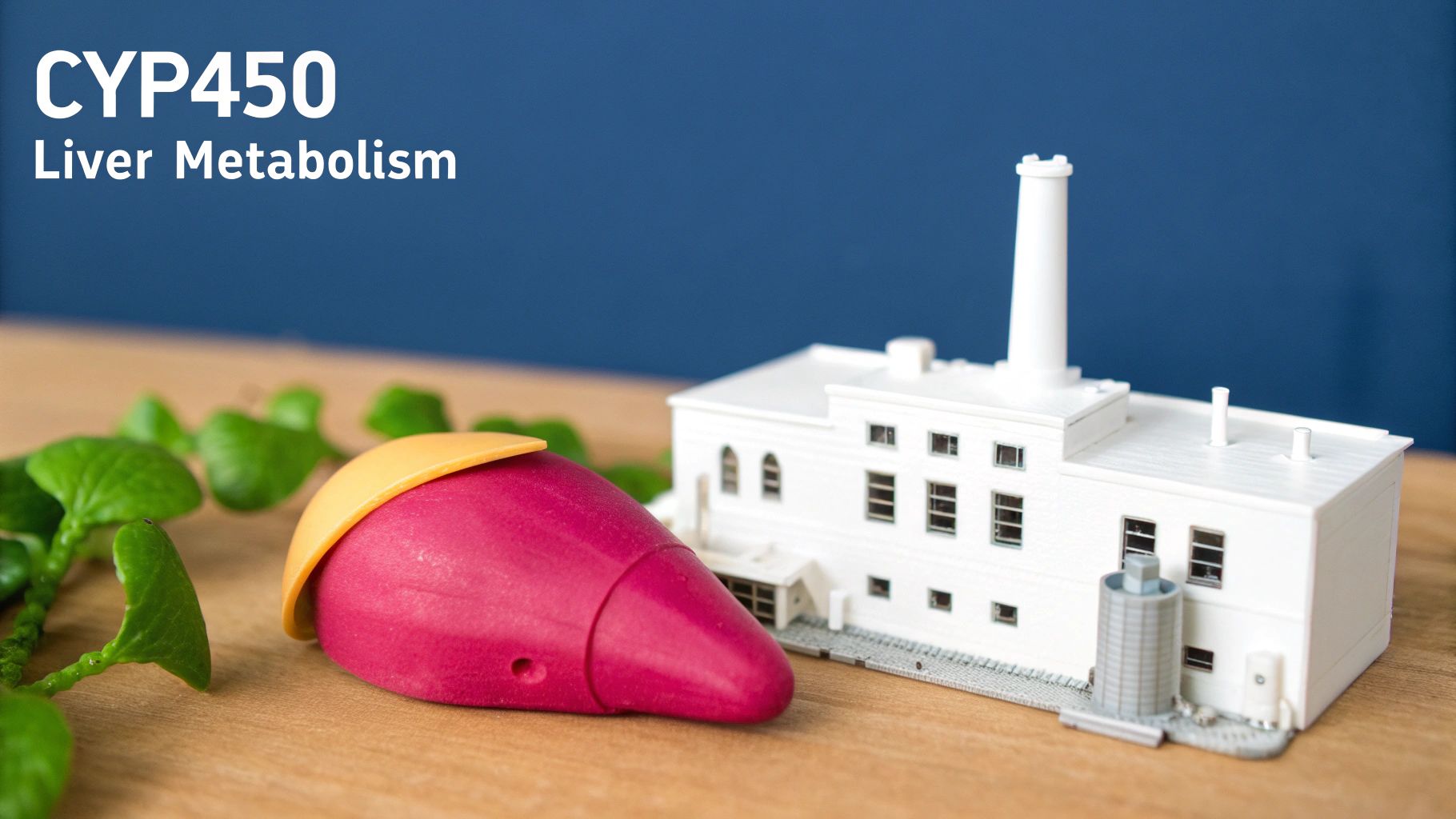
Before we can pin down how long CBD sticks around, we have to look at the journey it takes through your body. It's a four-part trip: absorption, metabolism, storage, and finally, elimination. How efficiently your body handles each step is what really determines the detection window.
Think of it like a package moving through a national shipping network. The route it takes and the stops it makes along the way dictate the final delivery time.
First Stop: The Liver’s Processing Plant
When you eat an edible or drink a CBD beverage, the first major stop is your liver. Picture the liver as a sophisticated sorting and processing facility for everything you consume.
Inside this facility is a team of specialized workers called the cytochrome P450 (CYP450) enzyme system. Their main job is to take foreign substances—from prescription meds to cannabinoids like CBD—and break them down. These enzymes convert CBD into different compounds, called metabolites, which are much easier for your body to get rid of. Without this crucial step, CBD would just hang out in your bloodstream indefinitely.
But here's the catch: not everyone's "processing plant" works at the same speed. Your genetics, overall health, and even other medications you're taking can speed up or slow down the CYP450 system, which is a huge reason why detection times vary so widely from person to person.
The Role of Bioavailability
How you take CBD matters. A lot. The term for this is bioavailability, which is just a technical way of saying how much of the CBD you took actually makes it into your bloodstream to do its job.
- Oral Consumption: When you drink a CBD beverage, it has to pass through your digestive system and liver first. This "first-pass effect" breaks down a good chunk of the CBD before it ever hits your general circulation. That’s why edibles and drinks have a lower bioavailability, typically estimated between 6% and 20%.
- Sublingual Tinctures: Placing CBD oil under your tongue lets it absorb directly into the tiny blood vessels there. This route bypasses the liver, meaning more of it gets into your system.
- Inhalation: Vaping or smoking delivers CBD straight to the lungs, where it's absorbed directly into the bloodstream. This method offers the highest bioavailability because it completely avoids the digestive system.
So, your method of choice directly impacts how much CBD gets to work and how your body begins processing it.
Key Takeaway: Oral products like edibles have lower bioavailability, meaning you might need more to feel an effect. But it also means your liver starts metabolizing it right from the get-go.
Why Being Fat-Soluble Matters
Here’s a crucial piece of the puzzle: CBD is lipophilic, which is a fancy way of saying it’s "fat-soluble." Unlike something water-soluble like Vitamin C that your body flushes out quickly, CBD is drawn to fat cells.
This means that after the liver does its initial work, leftover CBD and its metabolites can be stored in your body’s adipose (fat) tissue. Your fat cells basically act like tiny reservoirs, grabbing onto CBD and then slowly releasing it back into your bloodstream over time.
This slow-release mechanism is the main reason CBD can be detected for days—or even weeks—after you last used it, especially if you're a regular user. The more body fat you have and the more frequently you take CBD, the bigger this reservoir gets, which naturally extends the detection window. It’s why a daily user will test positive for much longer than someone who tried it just once.
Key Factors That Influence How Long CBD Stays in Your System
Ever wondered why CBD clears out of one person's system in a few days but seems to stick around for weeks in another? It’s not just random—it’s a unique combination of personal factors that determines your body's specific timeline.
Think of it this way: your body is a complex filter. The efficiency of that filter depends on four key things: how much CBD you take, how often you use it, your personal body chemistry, and the way you consume it. Let's break down how these pieces fit together.
Dosage and Frequency: How Much and How Often You Use
The biggest and most obvious factor is simply your usage pattern. Both the dosage (how much CBD you take at once) and the frequency (how often you take it) are the main drivers of how long it stays detectable.
If you have a single, low-dose CBD beverage, your body processes it fairly quickly and starts clearing it out without much buildup. But when you get into frequent, high-dose use, CBD begins to accumulate in your fat cells. This creates a reservoir that takes much longer to empty.
Recent modeling really puts this into perspective. A pharmacokinetic analysis of single oral CBD doses found that for every extra 100 mg of CBD someone took, the detection window in their plasma stretched by about 4 days. In that same study, 24 of 54 blood samples still had measurable CBD 7 or more days after just one dose. It's a clear correlation: higher doses stick around longer. You can dig deeper into these CBD dosage findings to see the data for yourself.
Your Individual Body Chemistry
Your body is completely unique, and two aspects of your personal chemistry really dictate how you process CBD: your metabolic rate and your body fat percentage.
- Metabolism: Think of your basal metabolic rate (BMR) as the engine speed of your body when it's at rest. A faster metabolism means your liver's CYP450 enzyme system chews through compounds like CBD more quickly, shortening its stay. A slower metabolism, on the other hand, means CBD hangs around longer before it gets broken down.
- Body Fat Percentage: CBD is fat-soluble, which means it loves to bind to and get stored in your body’s adipose tissue (fat cells). Someone with a higher body fat percentage has more storage space for CBD. This acts like a time-release mechanism, slowly leaking CBD back into the bloodstream long after you've stopped using it, which can significantly extend the detection window.
Analogy: Imagine pouring the same amount of water (CBD) onto two different sponges—one small and one large. The larger sponge (representing higher body fat) will soak up more water and release it much more slowly over time.
This is exactly why a daily user with higher body fat will have a much longer clearance time than an occasional user with lower body fat, even if their dosage is the same.
Method of Consumption
Finally, how you get CBD into your system makes a big difference. The method you choose affects how much CBD your body can actually use (its bioavailability) and how quickly it's processed.
Different methods have entirely different journeys through the body:
- Oral (Beverages, Edibles): When you drink a CBD sparkling water like a Day Dreamer, it has to go through your digestive system and take a "first pass" through the liver. This is a slower route with lower bioavailability, but it also means the effects and the CBD itself can linger as your body processes it over several hours.
- Sublingual (Tinctures): Holding CBD oil under your tongue lets it absorb directly into the bloodstream, bypassing that initial trip to the liver. This gives you a faster onset and higher bioavailability.
- Inhalation (Vaping): This is the fastest method by far. CBD goes straight to the lungs and is absorbed into the bloodstream almost instantly. While you feel the effects quickly, they also tend to fade faster, and the substance is often cleared more rapidly than with oral methods.
So, when you choose a beverage, you're opting for a slower, more gradual absorption and elimination process compared to other popular methods.
How Long Drug Tests Can Detect CBD
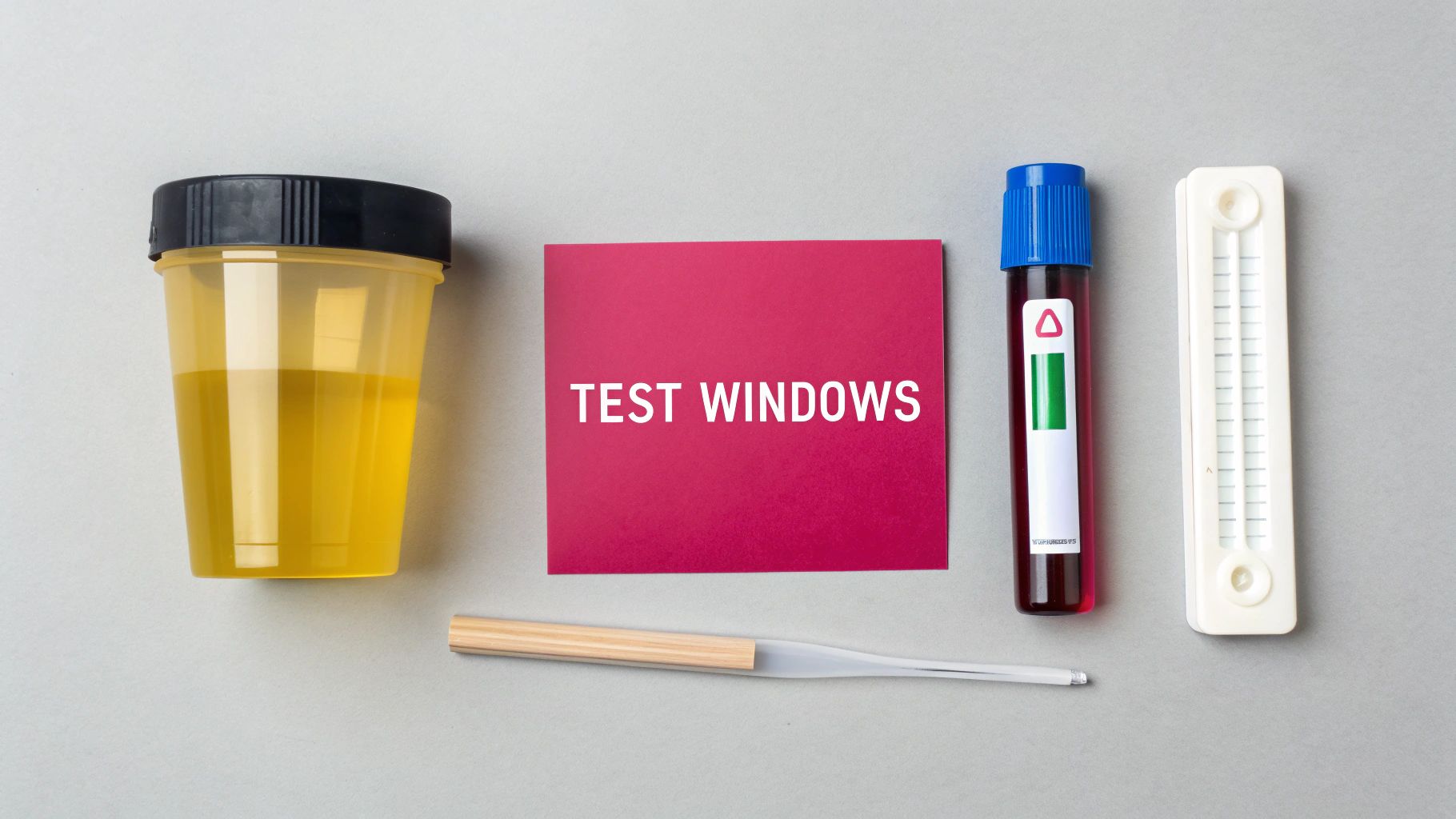
Let's get straight to the point. When most people ask, "How long does CBD stay in your system?" what they're really asking is, "Am I going to pass a drug test?" It's a fair question, and the answer isn't a simple yes or no. It all comes down to the type of test being used, because each one is designed to look for different things over a different period of time.
Think of it this way: a roadside saliva test is looking for what you did in the last day or two, while a pre-employment urine screen wants to know about your habits over the past few weeks. Knowing the difference between them is the key to understanding what you're up against.
Urine Tests: The Workplace Standard
Urine tests are, by far, the most common method for workplace drug screenings. Why? Because they offer a long look-back period, giving employers a bigger picture of a person’s habits. As your body breaks down cannabinoids, the resulting metabolites are slowly filtered out through your urine over days or even weeks.
It's important to remember that standard drug panels are designed to hunt for THC metabolites, not CBD. However, if your CBD product contains trace amounts of THC, those metabolites can absolutely show up.
The detection window here can vary wildly depending on your usage:
- Occasional Users: For someone who uses CBD products once in a while, cannabinoids might be detectable for 3 to 5 days.
- Frequent Users: If you use CBD several times a week, that window can stretch to 15 days or more.
- Chronic, Heavy Users: For daily users, it’s not unheard of for metabolites to be found for over 30 days.
Blood Tests: A Snapshot in Time
Blood tests are a different beast entirely. You won't usually see them in a standard pre-employment screening because their detection window is incredibly short. They're typically reserved for situations where establishing current impairment is critical, like after a car accident.
A blood test looks for active cannabinoids floating around in your bloodstream right now. CBD enters your blood quickly after you take it, but it’s also cleared out just as fast. For most people, CBD is only detectable in blood for a few hours, or at most, a couple of days after a single use.
Key Takeaway: Blood tests show what’s happening in your body at this very moment. Urine tests tell a story about your usage over the past several days or weeks.
Saliva and Hair Tests: The Short and Long of It
Two other common tests, saliva and hair follicle, sit at opposite ends of the detection spectrum. Each one gives a unique glimpse into a person's consumption history by looking for specific diagnostic biomarkers—the unique chemical fingerprints left behind.
Saliva (Oral Fluid) Tests
These are becoming more popular for roadside checks by law enforcement. They are excellent at spotting very recent use, typically identifying cannabinoids for about 24 to 72 hours after consumption. They’re great for determining if someone was using recently, but they can't tell you about long-term patterns.
Hair Follicle Tests
Then there's the hair test, which has the longest memory of all. As your body processes compounds, trace amounts get locked into your growing hair follicles. Since hair grows slowly, a small sample can provide a historical record of use stretching back up to 90 days.
The following table breaks down these detection windows to give you a clearer picture.
Comparison of CBD Drug Test Detection Windows
This table summarizes how long cannabinoid metabolites might be detectable based on the test type and how often you use CBD products.
| Test Type | Typical Detection Window (Occasional User) | Typical Detection Window (Chronic User) | Common Use Case |
|---|---|---|---|
| Urine | 3-5 days | 15-30+ days | Pre-employment and workplace screening |
| Blood | A few hours to 2 days | Up to 7 days | Post-accident, DUI, and clinical impairment testing |
| Saliva (Oral) | 24-72 hours | Up to 72 hours | Roadside testing, post-accident |
| Hair Follicle | Up to 90 days | Up to 90 days | Long-term history screening for certain jobs or legal cases |
Ultimately, where you look for cannabinoids—be it blood, urine, saliva, or hair—determines what you’ll find. This is a critical point for everyone from college students to professionals, especially those using THC or CBD beverages as an alternative to alcohol. Each test tells a different story with a different timeline.
Why Product Purity and THC Content Matter
Here's something that catches a lot of people off guard: standard drug tests aren't looking for CBD at all. They're designed to find one thing and one thing only—THC, the compound in cannabis that gets you high. This simple fact is the biggest source of confusion and worry for people using CBD.
Once you get that, it's easier to understand how someone using a completely legal, hemp-derived CBD product could still fail a drug test. It all boils down to what type of product you’re using and whether it contains even tiny, trace amounts of THC.
Full-Spectrum vs. Broad-Spectrum vs. Isolate
The labels you see on CBD products—full-spectrum, broad-spectrum, and isolate—aren't just marketing fluff. They tell you exactly what’s inside the bottle, which directly affects your risk of testing positive for THC.
-
CBD Isolate: Think of this as the purest form of CBD you can get. The extraction process strips away everything else—other cannabinoids, terpenes, you name it. What’s left is 99%+ pure CBD, which should contain zero THC. For anyone subject to drug testing, this is by far the safest bet.
-
Broad-Spectrum CBD: This is the happy medium. You get CBD plus a range of other beneficial plant compounds, but the THC has been intentionally removed. It’s designed to give you some of the synergistic "entourage effect" without the THC risk.
-
Full-Spectrum CBD: This type includes everything the hemp plant has to offer, including a small, legally allowed amount of THC. According to the 2018 Farm Bill, hemp products can legally contain up to 0.3% THC by dry weight. That’s not nearly enough to make you feel high, but it can be enough to show up on a drug test.
The Accumulation Effect: Taking a single dose of a full-spectrum CBD product probably won't cause any issues. The problem comes with consistent, daily use. That tiny 0.3% THC can slowly build up in your body's fat cells, and over time, it can reach a level high enough to be detected by a sensitive screening.
The Critical Role of Lab Testing and Transparency
The CBD industry isn't tightly regulated, so you can't always trust what a product label says. A bottle might claim to be "THC-free" but could still have trace amounts from poor manufacturing or cross-contamination. This is why checking for independent verification is a must.
Any trustworthy brand will provide a Certificate of Analysis (COA) for every product batch. This is a lab report from an independent source that shows the exact cannabinoid profile, confirming the levels of CBD, THC, and other compounds. Always look for the COA before you buy. To guarantee product integrity, many brands go a step further with comprehensive third-party supplement testing.
This kind of transparency means you know exactly what you’re putting in your body. It's especially crucial for products like Day Dreamer sparkling waters, which are made with hemp-derived Delta-9 THC. While these drinks are fully legal under the 2018 Farm Bill, they are designed to contain THC and will absolutely cause a failed drug test.
Knowing exactly what's in your product gives you the power to make smart choices that fit your life and job, without any nasty surprises down the road.
Navigating CBD Use and Drug Testing
Knowing the science behind how long CBD stays in your system is one thing, but what does it mean for your day-to-day life? This is where the rubber meets the road, especially if you're subject to drug testing for your job or other commitments. The real goal is to make sure your CBD routine fits comfortably within your professional and personal life.
This isn’t about trying to “beat” a test. It's about being a savvy consumer who understands exactly what’s going into your body and how it might show up.
How to Read a Certificate of Analysis (COA)
Your single best tool for this is the Certificate of Analysis, or COA. Any brand worth its salt will provide this third-party lab report for every batch of product they sell. Think of it as a detailed ingredient list that shows the exact cannabinoid profile.
When you pull up a COA, you’re looking for two main things:
- Total CBD: First, does the product actually have the amount of CBD it claims on the label? This confirms you're getting what you paid for.
- Total THC: This is the critical part for drug testing. You want to see "ND" (Non-Detect) or a zero. If it’s a full-spectrum product, it will show a THC value, which should be under the 0.3% legal limit.
A COA is non-negotiable if you're concerned about drug testing. If a company won't show you one, you can't trust what's in their product. It's that simple.
Practical Steps for Smart CBD Use
A little foresight can save you a lot of stress. If you know you're subject to testing, here are a few practical steps to make sure you stay on the right side of any policy.
-
Know Your Workplace Policy: Every company has different rules. Some have a strict zero-tolerance policy for any THC, while others are more relaxed. Find out what the official policy is before you start.
-
Choose the Right Product Type: If you're tested regularly, your safest bet is to stick with CBD Isolate or Broad-Spectrum products. Make sure you check the COA to confirm they have zero detectable THC. It's best to steer clear of full-spectrum products entirely.
-
Watch Out for High-Risk Products: You have to be careful here. Some products that are perfectly legal under federal law are designed to contain THC. For example, hemp-derived Delta-9 THC drinks like Day Dreamer are formulated to be compliant with the 2018 Farm Bill, but they absolutely contain enough THC to make you fail a drug test.
-
Think About Timing and Accumulation: If you do use full-spectrum CBD, don't forget that THC can build up in your system over time. The more often you take it, the longer it’s going to hang around.
At the end of the day, having this knowledge puts you in control. It lets you get the benefits of CBD without putting your career on the line.
Got Questions? We've Got Answers.
Let's tackle a few more of the common questions that pop up when people start thinking about CBD, drug tests, and how it all works in the real world.
Can You Actually Fail a Drug Test from a CBD-Only Product?
Here's the deal: it’s highly unlikely, but not impossible. Standard drug panels aren't even looking for CBD; their target is THC, the compound that gets you high. So, if you're using a product that is a true CBD isolate with absolutely zero THC, you should be in the clear.
The grey area emerges with full-spectrum products or products from brands that aren't meticulous about their purity. Legally, full-spectrum CBD can contain up to 0.3% THC. If you use it every day, that tiny amount can start to accumulate in your body's fat cells. Over time, that buildup could be just enough to cross the threshold on a sensitive drug screening.
The bottom line? If you're subject to testing, stick with broad-spectrum or isolate products. Always, always check the third-party Certificate of Analysis (COA) to confirm it's truly THC-free.
How Long Would a Single 10mg CBD Drink Stick Around?
If you’re new to CBD or just use it once in a blue moon, a single 10mg dose from a drink won't hang around for long. You can expect it to be gone from your bloodstream in a few hours and completely clear of your urine in maybe up to 3 days.
But this is a completely different story for a regular user. Since CBD is fat-soluble, consistent use lets it build up a reserve in your body. For someone who has that same 10mg drink every day, the compound will be detectable for a week or even longer because their body's "reservoir" is constantly being topped off.
Does Vaping vs. Drinking Change How Long CBD Stays in Your System?
Absolutely. The way you take CBD makes a huge difference in how your body processes it.
- Inhaling (Vaping or Smoking): This is the fast lane. It hits your system quickly and with high potency, but your body also gets rid of it much faster.
- Oral (Edibles or Drinks): This is the scenic route. It has to go through your digestive system and liver first, which means it takes longer to kick in and also tends to linger in your system for a longer period.
So yes, how you choose to consume your CBD plays a big role in its detection window.
Here at Day Dreamer, our goal is to be completely transparent so you can make informed choices. Our hemp-derived sparkling waters are designed for a clean, elevated experience, but they do contain THC. They're crafted for those who can enjoy it without worrying about a drug test. If that's you, we invite you to check out our line of curated beverages.
Discover the Day Dreamer experience today!
The statements made regarding these products have not been evaluated by the Food and Drug Administration. The efficacy of these products has not been confirmed by FDA-approved research. These products are not intended to diagnose, treat, cure, or prevent any disease. All information presented here is not meant as a substitute for, or alternative to, information from healthcare practitioners. Please consult your healthcare professional about potential interactions or other possible complications before using any product. The Federal Food, Drug, and Cosmetic Act requires this notice. All products on this website contain 0.3% THC or less.


