

Facing a drug test can feel like a pop quiz you didn't study for. But once you know what kind of test you're up against, you can start building a smart, effective strategy. The most common tests—urine, saliva, hair, and blood—all have different detection windows, and that's the crucial detail. Your game plan depends entirely on which test you're taking and how much time you have to prepare.
Decoding The Different Types Of Drug Tests
When a drug test pops up on your radar, the best thing you can do is get informed. Whether it’s for a new job, a random check at your current one, or after an incident, every situation is different. This isn't a simple pass/fail scenario; the science behind each test varies wildly, which changes everything from how you should prepare to what the results actually mean.
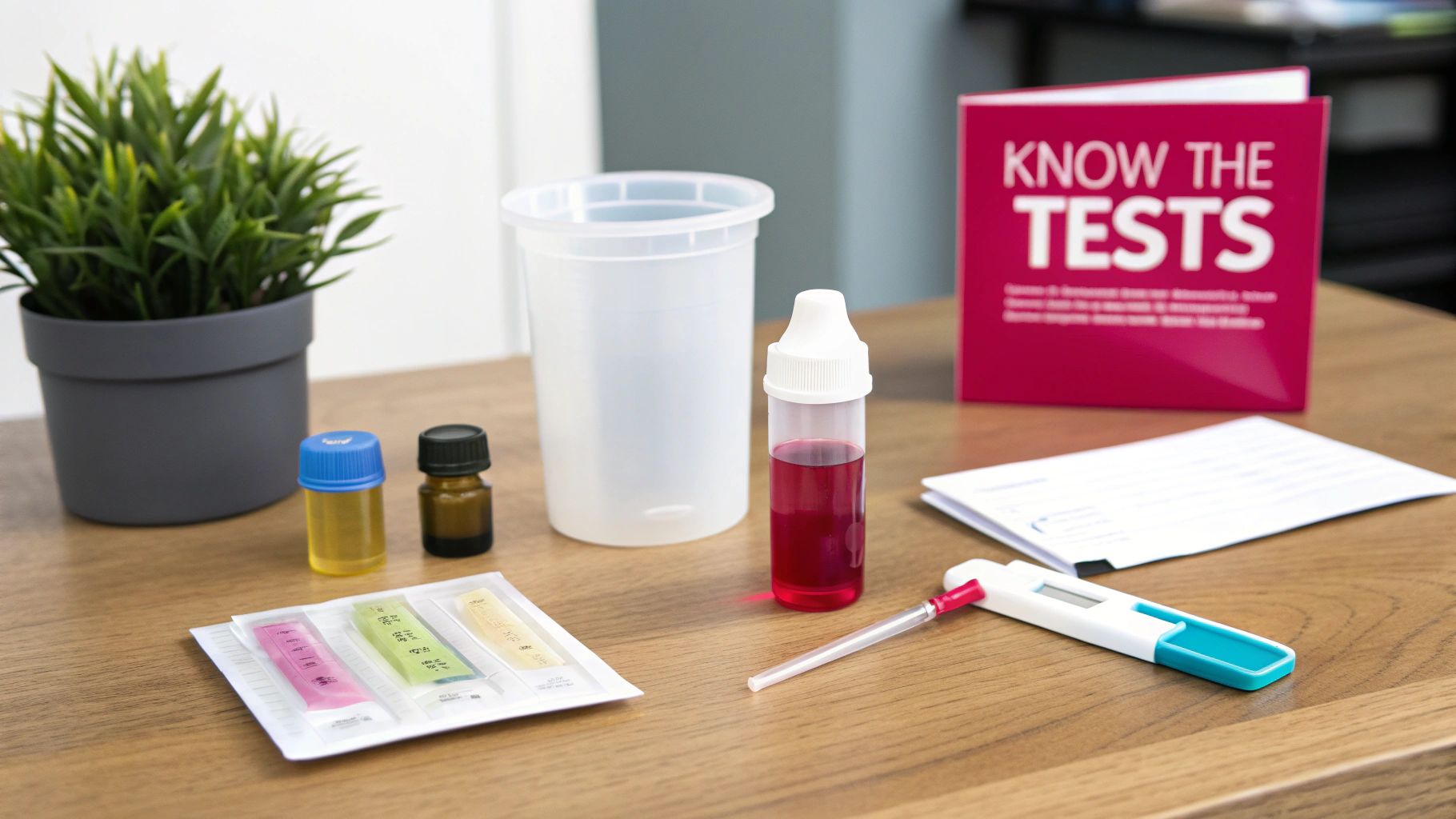
It’s worth noting that workplace testing is more common than ever. One major analysis of 9.5 million samples found that employee drug test positivity rates recently hit a 10-year high. Unsurprisingly, marijuana detections were a big part of that climb, even in states where it’s legal for recreational use.
The Four Main Testing Methods
Each type of test is looking for a different piece of the puzzle. A saliva test, for instance, is all about detecting very recent use—think within the last day or two. A hair follicle test, on the other hand, can create a historical record of use stretching back months. Getting a handle on these key differences is the first real step to figuring out how to pass.
Let's break down the four main methods you're most likely to see:
- Urine Test (Urinalysis): This is the go-to for most employers. It doesn't look for the drug itself but for its metabolites—the leftovers your body creates after processing a substance. These can hang around long after the effects have faded.
- Saliva Test (Oral Fluid Test): These are getting more popular because they're easy to administer and hard to cheat. A saliva test looks for the parent drug, making it great for detecting very recent use and determining potential impairment, like in roadside checks.
- Hair Follicle Test: If an employer wants a long-term history, this is the test they'll use. It can detect drug metabolites that have been embedded in the hair shaft for up to 90 days.
- Blood Test: This one is the most accurate but also the most invasive and expensive. Blood tests have a very short detection window and are usually reserved for specific situations, like post-accident investigations, where they need to confirm active impairment.
For anyone in a federally regulated industry, it’s also smart to be familiar with the comprehensive DOT drug testing requirements that apply to safety-sensitive roles.
Understanding Detection Windows
The "detection window" is simply the length of time a test can find a substance in your system. This isn't a fixed number. It’s a moving target influenced by your metabolism, how often you use, the dosage, and even your body fat percentage.
A common myth is that just a few days of staying clean will get you a negative result on any test. That's a dangerous assumption. For a daily THC user, metabolites can show up in urine for 30 days or more, while a hair test can flag use from three months ago.
To make sense of it all, here's a quick-reference guide. It lays out the four main tests and what you can generally expect for THC detection windows.
Drug Test Types and THC Detection Windows
This table breaks down how long THC is typically detectable in each test, along with where you're most likely to encounter them.
| Test Type | Typical Detection Window (THC) | Common Use Case | What It Detects |
|---|---|---|---|
| Urine | 3-30+ days (depends on use) | Pre-employment, random checks | Drug Metabolites |
| Saliva | 24-72 hours | Roadside, post-accident | Parent Drug |
| Hair Follicle | Up to 90 days | High-security jobs, legal cases | Drug Metabolites |
| Blood | A few hours to 2 days | DUI, post-accident | Parent Drug |
As you can see, the timelines vary dramatically. The bottom line is that knowing which test you're facing is the foundation of your entire approach. Each one poses a unique challenge, and your strategy has to be tailored to match.
The Real Science Behind Clearing THC from Your System
If you’re trying to figure out how to pass a drug test, the first thing you need to understand is your own body. There's no magic number or universal timeline for getting clean; it's a complicated biological process that’s unique to you. The advice that worked for your friend might be completely wrong for your situation.

Here’s the main problem: unlike other substances that are water-soluble and flush out of your system pretty fast, THC is lipophilic. That’s a scientific way of saying it loves fat.
When you consume cannabis, your liver breaks THC down into metabolites. The main one that drug tests look for is called THC-COOH. Instead of being flushed out, these metabolites get stored in your fat cells. From there, they slowly trickle back into your bloodstream to be excreted over time. This fat-storage mechanism is precisely why THC sticks around for so long.
How Often You Use Is Everything
The single biggest factor that dictates your timeline is your consumption habit. Plain and simple. How much and how often you use cannabis directly impacts how long it will take to clear THC-COOH from your system.
Think of it like a rain barrel. An occasional user adds a cup of water every now and then—it evaporates or drains quickly. A heavy, daily user, on the other hand, has the faucet running constantly. The barrel is always full, and it’s going to take a long, long time to empty once you finally turn off the tap.
Let's break down some realistic scenarios:
- Infrequent User: You had a single edible at a party last weekend. You'll likely be in the clear within 3-5 days. Your "barrel" was pretty much empty to start with.
- Moderate User: If you use cannabis a few times a week, you'll probably need 1-2 weeks of total abstinence to test clean.
- Daily User: For anyone who uses daily, especially high-potency products, the timeline gets much longer. Be prepared for it to take 30 days or more. I've seen cases where it takes even longer for very heavy users.
The Potency and Dose Equation
Not all cannabis is created equal. The strength of what you’re consuming plays a massive role in how much THC your body has to deal with. A person using high-THC concentrates every day is loading their system with exponentially more metabolites than someone who has a low-dose sparkling water from a brand like Day Dreamer once in a while.
Modern concentrates can easily top 80-90% THC. That’s a world away from the 10-20% flower that was common just a decade or so ago. Higher potency means more metabolites get packed away into your fat cells, which means a much longer detection window.
Your body doesn't just eliminate THC; it accumulates it. Consistent use of high-strength products saturates your fat cells, creating a reservoir of metabolites that can take weeks or even months to deplete fully.
Your Unique Biology is a Wild Card
Beyond your habits, your personal biology is the other half of the puzzle. Two factors are incredibly important here: your metabolic rate and your body fat percentage. These two things work hand-in-hand to determine how quickly your body can release and get rid of stored THC.
Metabolic Rate
Your metabolism is essentially the engine that runs your body. A faster metabolism burns through everything more quickly, and that includes the THC metabolites stored in your fat. If you're someone who naturally has a high metabolism, you have a head start in clearing THC compared to someone with a slower one, assuming all else is equal.
Body Fat Percentage
This one is crucial. Since THC metabolites are stored in fat (adipose) tissue, the more body fat you have, the more "storage space" you're offering them. Someone with a higher body fat percentage has a much larger capacity to hold onto these compounds.
For example, a person with 30% body fat has far more storage real estate for THC metabolites than a leaner person with 15% body fat. This is why two people with the exact same cannabis habit can have completely different results. The lean, active person with a fast metabolism will almost always clear out faster than the person with a higher body fat percentage and a more sedentary lifestyle.
Real-World Strategies for Passing a Test
When you're facing a drug test, you need practical, effective strategies, not magic pills or risky shortcuts. Forget the myths. The best approach is grounded in biology—helping your body do what it already does naturally.
It's all about giving your system the time and support it needs to clear out any detectable metabolites. This harm-reduction approach focuses on making smart choices based on your own usage, your body, and your timeline. Let’s walk through what actually works.

Informed Abstinence: The Only Sure Thing
Let’s be blunt: the only 100% guaranteed method to pass a drug test is to have nothing in your system to detect. That means the moment you know a test is coming, you stop all consumption. Full stop.
The more time you give your body, the better your odds. Your system needs that time to metabolize the THC-COOH stored in your fat cells and flush it out. A casual user might be in the clear after a week or two. But if you’re a daily consumer, you should realistically plan for 30 days or more to be safe.
Your goal isn't just stopping; it's stopping with a realistic timeline in mind. Match your abstinence period to your personal usage patterns and the detection windows we've discussed.
Smart Hydration (Don't Overdo It)
Hydration is your friend, but you have to be smart about it. The idea is to support your body's natural flushing process, not to drown your system with gallons of water an hour before the test.
Chugging water right before you go in is a classic mistake. It can lead to a "dilute-negative" result. While that’s not technically a fail, it’s a massive red flag for the lab. They’ll see the sample is watered down, get suspicious, and likely make you re-test under much closer supervision.
Instead, just focus on staying consistently hydrated in the days leading up to your appointment. Drink enough fluids to keep your urine a normal, pale yellow. On test day, a glass or two of water an hour beforehand is plenty.
The Exercise Paradox: When to Go Hard and When to Stop
Working out is a powerful tool for speeding up detox, but timing is absolutely critical. THC metabolites love to hang out in your fat cells. When you do cardio, you burn fat, releasing those metabolites into your bloodstream so they can be filtered out.
In the weeks or days before your test, hitting the gym is a great idea. Things like running, HIIT, or swimming can really help clear things out.
But you have to stop all exercise 48-72 hours before the test. This is non-negotiable. If you work out too close to test day, you'll release a fresh wave of THC metabolites into your system, causing a temporary spike in your urine concentration. That's the last thing you want. For the final two or three days, embrace being a couch potato.
How Diet and Fiber Can Help
Your diet plays a surprisingly big role. A large chunk of THC metabolites actually exit the body through your stool, not just your urine. Eating a diet high in soluble fiber helps bind to these metabolites in your gut, making sure they get escorted out of your system efficiently.
Try adding more of these to your meals while you're detoxing:
- Beans and lentils
- Oats and barley
- Apples and citrus fruits
- Broccoli and carrots
A clean diet also keeps your liver happy, which is the command center for your body's entire detoxification process.
Disclosing Your Medications the Right Way
This is a big one. Some perfectly legal prescription and over-the-counter drugs can accidentally trigger a false positive on an initial drug screen.
Common culprits include certain antidepressants, antihistamines, and even high doses of NSAIDs like ibuprofen. This is why you must be ready to tell the Medical Review Officer (MRO) about any medications you're taking. If you have a valid prescription for a substance that flags a positive, the MRO will verify it and overturn the result.
With workplace testing on the rise, this is more important than ever. According to data from Quest Diagnostics, post-accident marijuana positivity in the general U.S. workforce hit 7.5% in 2023, a staggering 114.3% jump over nine years. Not surprisingly, attempts to cheat also rose, with invalid urine specimens increasing by 45.2%. You can dig deeper into these shifting workplace drug testing trends for more context.
Know Your Rights
Finally, knowing your rights is a crucial part of your toolkit. You are entitled to a fair and accurate testing process. If you get a positive result you believe is an error, you have the right to demand a confirmation test.
The initial screening is just that—a screen. The confirmation test uses a much more precise method called Gas Chromatography/Mass Spectrometry (GC-MS), which can definitively rule out any false positives. Knowing this is your right provides critical peace of mind and is your ultimate protection.
What Doesn't Work: Myths and Methods to Avoid at All Costs
When you've got a drug test looming, it's easy to fall down an internet rabbit hole of "quick fixes" and miracle cures. Let's be real, most of it is junk science designed to prey on your anxiety. Before you waste your money or, worse, risk your health, you need to understand what you're up against.
Employers and testing labs are more vigilant than ever. A recent report revealed that marijuana positivity in the general U.S. workforce hit a 25-year high of 4.3% in 2022. Think about that. Another study from DISA showed that 1 out of every 29 corporate employees failed random drug tests in 2021. Labs have seen every trick in the book, and their testing methods have gotten incredibly sophisticated.
The Truth About "Detox" Drinks and Kits
You've seen them in every smoke shop—shelves lined with pricey drinks and kits that promise to flush THC from your system in just a few hours. The reality is, these products are little more than a high-markup blend of vitamins and diuretics.
Their only real function is to dilute your urine. The idea is to make you pee a lot, flushing out your system, while adding back some color and compounds that get stripped out when you're over-hydrated. But here's the catch: modern labs are wise to this game.
Every sample is screened for dilution. They specifically check for:
- Creatinine levels: This is a natural byproduct of muscle metabolism. If your levels are too low, it’s a dead giveaway that your sample is just water.
- Specific gravity: This measures urine density. Again, if it’s too close to water, it raises an immediate red flag.
- Color: The B vitamins in these drinks often turn your urine an unnaturally vibrant, almost neon yellow that experienced lab techs can spot from a mile away.
Don't mistake a "diluted" result for a "pass." It's an invalid test. You'll almost certainly have to re-test, but this time it will likely be under direct observation. Trust me, you want to avoid that scenario.
Why Adulterants and Synthetic Urine Are a Terrible Idea
This is where desperation can lead to some truly bad decisions. Adulterants are chemicals you add directly to your urine sample, hoping to destroy the drug metabolites. This is one of the worst things you can do.
Labs run "specimen validity testing" on every single sample. They are specifically looking for common adulterants like nitrites, bleach, or commercially sold products. If they find anything, it's an automatic fail. It’s not just a failed test—it’s documented proof that you tried to cheat, which can have much more severe consequences.
So, what about synthetic urine? Ten years ago, maybe. Today? Not a chance. Labs now test for uric acid and other biological markers that are always present in real human urine. On top of that, you have the impossible task of keeping the sample at a precise body temperature (between 90-100°F). If the temperature strip on the cup reads too hot or too cold, they'll reject it on the spot.
Dangerous "Home Remedies" You Should Never Try
The most alarming advice comes from online forums and whispered rumors. These so-called home remedies aren't just ineffective; they are downright dangerous.
- Niacin Overdoses: The idea that mega-dosing Niacin (Vitamin B3) will "burn" THC out of your fat cells is a complete myth. What it will do is cause painful skin flushing, extreme nausea, and potentially lead to severe liver damage.
- Bleach or Household Cleaners: This shouldn't need to be said, but never, ever ingest household cleaners. This is poison. It’s a life-threatening myth with zero basis in science.
- Cranberry Juice & Goldenseal: These are often touted as natural cleansers. While they won't hurt you in normal amounts, there is simply no scientific evidence they do anything to speed up THC metabolite elimination for a drug test.
At the end of the day, these shortcuts and miracle cures are a waste of time and money. They offer false hope and can put you in an even worse position. The only responsible path forward is to stick with strategies that are actually based in reality.
What to Do If You Get a Positive Result (And How to Protect Your Rights)
Getting that call about a positive drug test can make your stomach drop. It’s easy to feel like it’s game over, but in reality, this is just the start of a formal review process. Your next moves are incredibly important, and understanding your rights is the best tool you have. The initial screening is far from the final word.

First off, you need to know that the initial test—usually an immunoassay screen—is built for speed and low cost, not pinpoint accuracy. False positives are a known issue. Because of this, you absolutely have the right to request a confirmation test.
This follow-up analysis is almost always a Gas Chromatography/Mass Spectrometry (GC-MS) test. It’s the gold standard for a reason. This method is incredibly precise and can identify the exact substance and its metabolites in your sample, which is key for ruling out any cross-reactions from other legal medications.
The Medical Review Officer Is Your First Call
After a sample flags positive, it doesn't just get sent to your boss. A crucial step comes first: it's reviewed by a Medical Review Officer (MRO), who is a licensed physician. Think of the MRO as an impartial investigator. Their job is to contact you directly and confidentially to discuss the findings.
This phone call is your chance to provide a legitimate medical reason for the result. If you’re taking a prescribed medication that could have triggered the positive screen, now is the time to speak up.
- Have Your Info Ready: Keep your prescription details handy, including the doctor's name and contact information.
- Be Direct and Honest: Clearly explain the medication you're prescribed and the reason for it. The MRO’s job is simply to verify a valid prescription, not to pass judgment on your health.
- Stay Professional: Treat it as a medical verification, not an accusation. Keep the conversation calm and stick to the facts.
If the MRO confirms your prescription is valid, they report the test result to your employer as a negative. Your confidential medical information stays private and is not shared.
A positive drug test isn't officially a failure until the MRO has finished their investigation. How you handle this conversation can change everything.
Know the Rules: State Laws and Company Policies
Your rights in this situation can change dramatically based on your state's laws and your employer's specific drug-testing policy. With cannabis laws evolving so quickly across the country, the landscape is a patchwork of different rules. Some states now have laws protecting employees for off-duty cannabis use, while many others offer no such protections.
For instance, a registered medical marijuana patient in one state might be completely protected from being fired, while an employee in a neighboring state could be terminated for the exact same reason. It's vital to research the laws where you live.
People also frequently ask if you can get drug tested at court, which brings up a whole different set of legal standards and underscores why knowing your rights is so critical in any scenario.
If you feel a result is wrong or that your rights are being ignored, don’t just accept it. Ask HR for a copy of the company's official drug testing policy. If things still don't feel right, consulting with an employment lawyer is a smart next step to explore your options.
Your Drug Test Questions, Answered
When you're facing a drug test, you need straight answers, not guesswork. Let's cut through the myths and tackle some of the most pressing questions people have about the process.
Can I Really Pass a Drug Test in 24 Hours?
Let's be realistic: for most people, especially cannabis users, passing a urine test in just 24 hours is a long shot. The main issue is that THC metabolites love to hang out in your body's fat cells, and they don't leave quickly. It can take days, or even weeks, for them to clear out completely.
You might hear about chugging water to dilute your sample. While this can sometimes work, it's a huge gamble. Labs are wise to this trick and routinely check for creatinine and specific gravity to spot over-diluted samples. If they flag your sample as invalid, you'll likely have to re-test, but this time under much closer observation. A saliva test gives you a slightly better chance since it focuses on very recent use, but it's still no sure thing.
Will CBD Make Me Fail a Drug Test?
This is a common and valid concern. The short answer is, it can. Pure CBD isolate shouldn't pop on a standard drug screen because those tests are looking for THC, not CBD.
The problem is the CBD market is like the Wild West—largely unregulated. Many full-spectrum CBD products legally contain trace amounts of THC. If you're a regular user, these small amounts can build up in your system over time and eventually be enough to trigger a positive test result. I've seen it happen.
Pro Tip: Your best defense is to stick with trusted brands that offer a Certificate of Analysis (COA) from a third-party lab. This report is your proof. Make sure it explicitly states the product contains 0.0% THC.
Can I Fail a Test From Secondhand Smoke?
You can relax on this one. It's incredibly unlikely. To fail a drug test from secondhand cannabis smoke, the conditions would have to be extreme. Think being stuck in a small, unventilated room (a classic "hotbox") with multiple heavy smokers for an extended time.
Testing labs know this, which is why they set the cutoff levels for a positive test high enough to avoid punishing someone for simply being in the wrong place at the wrong time. For typical, everyday exposure, the amount of THC you'd absorb is nowhere near enough to even register, let alone cross the positive threshold.
How Long Does a Single Low-Dose Edible Stay in My System?
If you're not a regular user and have a single, low-dose edible—say, a 5mg gummy—your body will process it much faster than it would with chronic use or higher-potency products. For someone with an average metabolism, the detection window could be as short as 3 to 5 days.
But remember, this is just an estimate. Everyone's body is different. Your metabolism, body fat, and how often you use cannabis products are the real determining factors. A one-time thing is one thing, but if "low-dose" becomes a daily or weekly habit, that THC will start to accumulate, and the detection window will get much longer. And yes, you can even get drug tested at court, so knowing your timeline is crucial.
At Day Dreamer, we believe in transparency and quality. Our line of clean, hemp-derived Delta-9 THC and CBD sparkling waters is crafted for the modern consumer who values a refined experience. Made with no added sugars and only the freshest ingredients, our beverages are designed to fit your lifestyle. Explore our curated selection at https://enjoydaydaydreamer.com.
The statements made regarding these products have not been evaluated by the Food and Drug Administration. The efficacy of these products has not been confirmed by FDA-approved research. These products are not intended to diagnose, treat, cure, or prevent any disease. All information presented here is not meant as a substitute for, or alternative to, information from healthcare practitioners. Please consult your healthcare professional about potential interactions or other possible complications before using any product. The Federal Food, Drug, and Cosmetic Act requires this notice. All products on this website contain 0.3% THC or less.


