
Deciding to quit drinking alcohol is a huge first step, and it all starts with a clear decision backed by a solid plan. It's a journey that involves taking an honest look at your current habits, figuring out a safe way to detox, learning new ways to cope with life's stresses, and finding the right people and tools to support you along the way.
Your Journey to an Alcohol-Free Life Starts Here
You've made the call to stop drinking, and that's a powerful move. This guide is designed to be your companion on this path, breaking down what can feel like a massive undertaking into clear, manageable stages. We're going to skip the vague advice and get straight to real-world strategies that work.
Let's get rid of the overwhelm right now. Think of this as a straightforward roadmap—we’ll cover everything from understanding your own drinking patterns to building a new life you genuinely enjoy, alcohol-free.
This whole process is about empowerment, not deprivation. To give you a bird's-eye view of the road ahead, I've outlined the entire journey into four core phases. Seeing it this way makes it feel much more approachable right from the start.
The Four Core Phases of Quitting Alcohol
This framework summarizes the key stages involved in the journey to stop drinking, providing a clear and simple framework for the process. When you understand these phases, it demystifies how to quit drinking by showing that it's a progression, not a sudden, impossible leap.
| Phase | What It Involves | Key Goal |
|---|---|---|
| Phase 1: Assessment & Planning | Honestly evaluating your drinking habits, understanding personal risks, and setting a clear goal to quit. | To create a safe, personalized, and realistic quitting plan. |
| Phase 2: Detox & Early Sobriety | Safely managing withdrawal symptoms, potentially with medical help, and navigating the first days or weeks without alcohol. | To cleanse the body of alcohol and establish initial stability. |
| Phase 3: Building New Habits | Identifying triggers, developing healthy coping mechanisms, and finding fulfilling alternatives to drinking. | To replace old patterns with positive routines that support long-term sobriety. |
| Phase 4: Long-Term Maintenance | Engaging with support systems, planning for social situations, preventing relapse, and enjoying the benefits of a sober life. | To sustain your progress and build a resilient, fulfilling alcohol-free lifestyle. |
Each of these phases builds directly on the last, creating a strong foundation for a change that sticks. By focusing on one stage at a time, you can turn what feels like a monumental goal into a series of smaller, more achievable wins.
Honestly Assessing Your Relationship with Alcohol

Before you can change your relationship with alcohol, you need to get brutally honest about what that relationship actually looks like. This isn't about shame or labeling yourself. It's about taking a clear-eyed inventory of your habits so you can build a plan that actually works.
A great first step is to become an observer of your own life for a couple of weeks. Grab a notebook or use an app and jot down not just what you drink, but why. Was it a rough meeting at work? A Friday night ritual? Just plain boredom?
Think of it as gathering intel. Without this real-world data, you’re just guessing at what needs to change.
Moving Beyond Simple Drink Counting
Knowing your patterns goes much deeper than counting ounces. You need to understand the role alcohol is playing in your life.
To get a clearer picture, start asking yourself some tough questions:
- Emotional Triggers: Do you pour a drink when you’re feeling angry, lonely, or overwhelmed? Many of us use alcohol to self-medicate, and identifying this is the first step toward finding healthier coping skills.
- Social Context: Is your drinking tied to certain people or places? Maybe it’s that happy hour crew from work or watching the game with a specific group of friends.
- Life Impact: Let's be real—has drinking caused problems? This could be anything from arguments with your partner and missed deadlines to financial strain or a warning from your doctor.
- Loss of Control: Have you ever told yourself, "just one," only to find the bottle empty? Or have you tried to cut back before and found it impossible to stick with?
Answering "yes" to these questions doesn't mean you need a specific diagnosis. It's simply an indication that alcohol might be taking more from you than it's giving. Acknowledging that is a huge step forward.
Key Insight: This process isn't about judging yourself. It's about strategy. Every pattern you uncover is a clue that helps you build a smarter, more targeted plan for quitting.
And you're not alone in this. Globally, an estimated 209 million people met the criteria for alcohol dependence in 2019. That same year, alcohol was responsible for about 2 million deaths among men and 600,000 among women, with a shocking 13% of those deaths happening to people aged 20–39. Understanding the gravity of these global alcohol-related statistics can really cement your "why" for making a change.
Identifying the Risk of Physical Dependence
This part is crucial. You have to figure out if your body has become physically dependent on alcohol. This is entirely different from a psychological habit. Physical dependence means your body has adapted to having alcohol around and will protest—sometimes dangerously—if you stop suddenly.
Quitting "cold turkey" can be life-threatening for someone with significant physical dependence.
Be honest with yourself about these signs:
- Morning Drinking: Do you need a drink when you wake up to "steady your nerves" or stop the shakes?
- Withdrawal Symptoms: When you go too long without a drink, do you get hit with sweating, nausea, intense anxiety, insomnia, or tremors?
- Increased Tolerance: Have you noticed that it takes a lot more alcohol to get the same buzz you used to?
If any of this sounds familiar, it is absolutely critical that you talk to a doctor before you stop drinking. Alcohol withdrawal is one of the few that can be fatal because of risks like seizures and delirium tremens (DTs).
A medically supervised detox isn't a sign of failure. It's the smartest, safest way to start. It gives you a controlled environment to manage the symptoms, making the whole process safer and much more bearable.
Building Your Personal Sobriety Toolkit
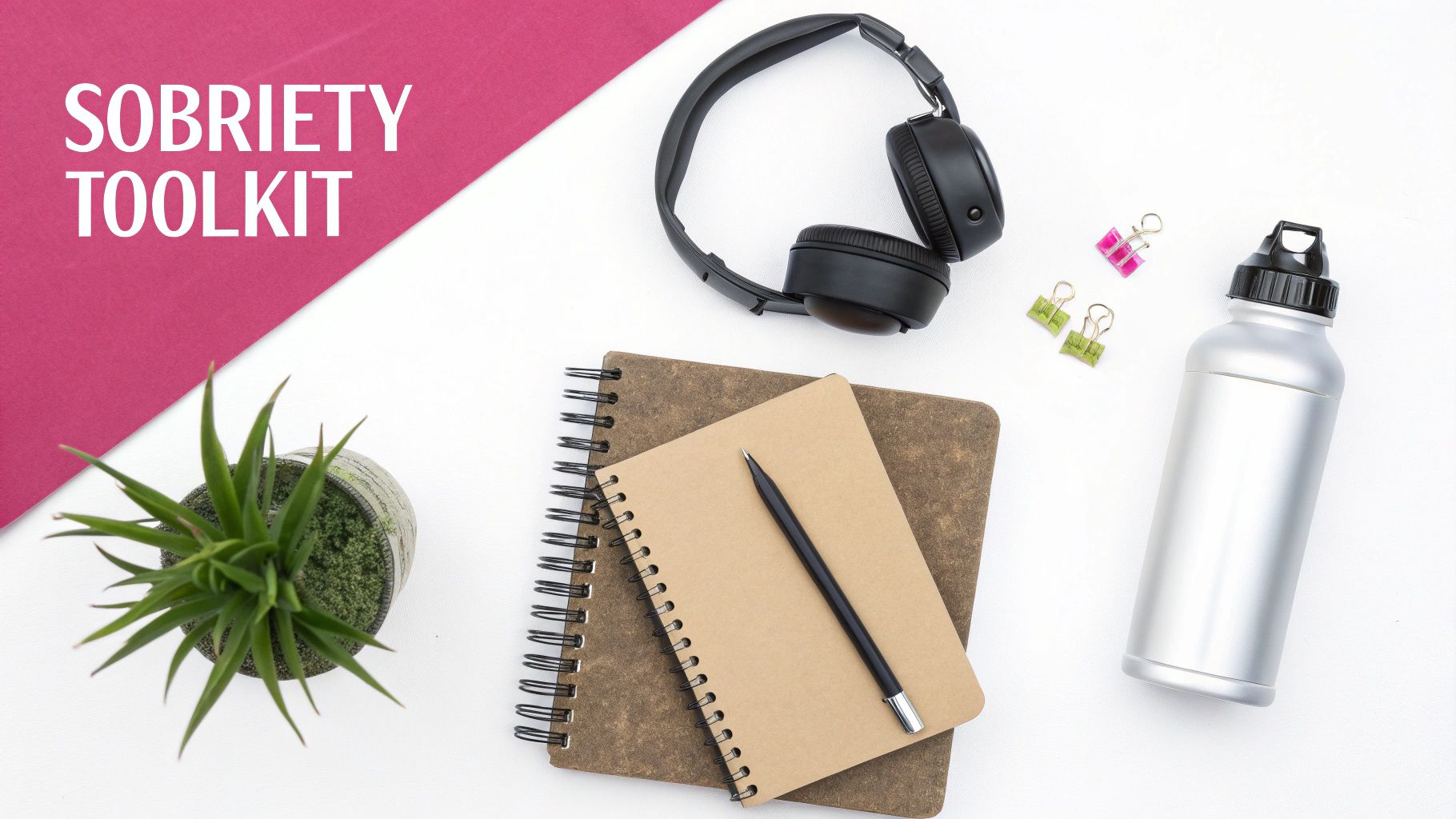
Successfully staying sober for the long haul has less to do with sheer willpower and more to do with having a solid game plan. It’s about moving from the big, abstract decision to quit into the small, practical things you do every single day.
This is where your personal sobriety toolkit comes in. Think of it as your collection of go-to skills, strategies, and routines designed to help you handle whatever life throws at you—without reaching for a drink.
Getting to Know Your Personal Triggers
The first layer of your toolkit is understanding what makes you want to drink in the first place. We call these triggers, and they are deeply personal. A trigger could be anything—a specific person, a stressful feeling, a certain time of day, or even a particular song.
You have to become a detective of your own habits. For a lot of people, the clock hitting 5 PM is a blaring signal for a beer. For others, it's that tense email from the boss that sparks an immediate craving for wine. Spotting these patterns is your first and most powerful line of defense.
Triggers are basically cues your brain has learned to associate with the reward of alcohol. Your job now is to identify them, understand them, and have a plan ready to either avoid them or face them down with a completely new response.
Common triggers usually fall into a few buckets:
- Environmental Triggers: These are the people, places, and things around you. It might be driving past your old favorite bar, seeing alcohol ads pop up during a game, or even just hanging out with certain friends.
- Emotional Triggers: This is your internal world. Stress is a massive one, but don't discount boredom, loneliness, anxiety, or even happiness. So many of us are conditioned to drink to celebrate, forging a powerful link between joy and alcohol.
- Situational Triggers: These are tied to specific events or parts of your routine. Think holidays, Friday nights, backyard barbecues, or the classic after-work happy hour.
Once you start putting a name to these triggers, you strip them of their power. An unidentified urge can feel like a random, overwhelming wave of craving. But a trigger you’ve identified becomes a problem you can actually solve. To build out your toolkit even further, it's worth exploring the various evidence-based addiction treatment options available that can provide more structured guidance.
Developing Real-World Coping Skills
Knowing your triggers is one thing; having the tools to deal with the cravings they cause is another. It's important to remember that a craving is just a thought. You can learn to sit with that feeling without having to act on it.
One of the most effective, in-the-moment tools is the HALT check-in. It’s a simple but powerful acronym that reminds you to pause and ask yourself if you are:
- Hungry
- Angry
- Lonely
- Tired
These four basic human needs are huge drivers of cravings. More often than not, what feels like an intense urge for a drink is actually your body yelling for a sandwich, a nap, or just a quick chat with a friend. Address the root need, and you’ll be amazed at how quickly the craving can fade.
A craving is a signal, not a command. Learning to interpret that signal is a cornerstone of recovery. Often, the craving isn't for alcohol itself, but for relief from an underlying state like hunger or stress.
Beyond HALT, other fantastic techniques include mindfulness practices like deep, slow breathing or the "urge surfing" method. With urge surfing, you visualize the craving as a wave, and your job is to simply stay on your board and ride it until it peaks and naturally fades away.
The Power of Habit Replacement
Your brain is wired for routine. The ritual of drinking—the sound of a can cracking open, the familiar feel of a cold glass—is a deeply ingrained habit loop. Just trying to erase that habit can leave a gaping hole, and your brain will scramble to fill it, often with the old behavior.
The real key isn't just to stop the old habit but to actively replace it with a new one. This gives your brain a new, healthier routine to grab onto.
Think about the time and energy you used to dedicate to drinking. How can you fill that space now? The goal is to find activities that are genuinely rewarding and simply incompatible with drinking.
Here are a few real-world swaps:
- The 5 PM Stress Drink: Instead of heading for the fridge after work, immediately change into workout clothes and go for a brisk walk, hit the gym, or do a quick yoga video online. The endorphin release will give you a natural and much healthier mood boost.
- The Weekend Boredom Drink: Don't leave your weekends empty. Plan ahead. Sign up for a Saturday morning class, join a local hiking group, or finally tackle that home improvement project you've been putting off. A busy, engaged mind has far less room for cravings to creep in.
- The Social Anxiety Drink: Before you go to a party, have a plan. Think of a few easy conversation starters. Most importantly, get a delicious non-alcoholic drink in your hand right away—like a seltzer with lime—so you have something to hold and sip on.
This is about more than just finding distractions. It's about consciously building a life that is more interesting, fulfilling, and engaging than your old one. Every new hobby, every healthy meal, and every good night's sleep adds another essential tool to your sobriety kit, making you stronger for the road ahead.
Finding Support and Redefining Your Social Life

One of the biggest myths about quitting alcohol is that it's a solo mission—a pure test of willpower. In reality, that’s just not how it works. Connection is one of the most powerful tools you have in your corner. You don’t have to go through this alone, and frankly, you shouldn’t.
Building a solid support system isn't about admitting weakness; it’s about playing smart. It’s about intentionally surrounding yourself with people and resources that make your new, sober life not just manageable, but genuinely enjoyable.
This support can look different for everyone. It might be structured therapy, peer groups, or just the simple act of confiding in a trusted friend. The whole point is to build a network that can offer a word of encouragement, share some real-world advice, and hold you accountable on the days when you need it most.
Tapping into Professional and Peer Support
When you're first figuring out how to quit drinking, leaning on the experience of others can be a total game-changer. Formal support gives you a safe, non-judgmental space to dig into your relationship with alcohol and learn from people who are walking the same path.
There are a few great avenues to explore:
- Individual Therapy: Working one-on-one with a therapist or counselor helps you unpack the “why” behind your drinking habits. They can give you personalized strategies for handling triggers and navigating cravings.
- Peer Support Groups: Organizations like Alcoholics Anonymous (AA) and SMART Recovery host community meetings where you can share what’s on your mind and learn from other people's journeys. That sense of shared experience is incredibly validating.
- Digital Communities: Let's be real, sometimes you need support at 2 AM. Apps and online forums offer 24/7 access to a community of people who get exactly what you're going through. It’s perfect for those moments when you need immediate encouragement.
Beyond one-on-one counseling, group therapy for substance use disorders provides a powerful sense of community. Just hearing someone else voice the same struggle you've been having can dissolve those feelings of isolation and give you practical tips for navigating sobriety.
Learning to Socialize Without Alcohol
For many people, the biggest fear isn't just stopping the drinking—it's the social fallout. How do you go to a party, a wedding, or a work happy hour without a drink in your hand? This is where a little prep work goes a very long way.
First, get a few go-to phrases ready for politely declining a drink. The key is to be firm but friendly. You don’t owe anyone a long-winded explanation.
Simple Scripts for Saying 'No'
- "No thanks, I'm good for now."
- "I'm sticking with sparkling water tonight."
- "I'm driving, so I'll just have a soda."
- "Thanks, but I'm taking a break from drinking."
Pro tip: always have a non-alcoholic drink in your hand. It gives you something to hold, stops people from constantly offering you a drink, and helps you feel part of the social ritual. Most bars and restaurants today have an impressive menu of options well beyond a flat Coke.
Exploring Alcohol Alternatives
The good news is that social norms are finally shifting. The market for high-quality, non-alcoholic options has absolutely exploded, giving you more choices than ever to replace old habits with something new.
This opens up a whole new world of beverages that can make socializing feel natural and even exciting again.
Popular Non-Alcoholic Swaps
| Category | Description | Examples |
|---|---|---|
| Craft Mocktails | Complex, flavorful drinks made with quality ingredients like fresh juices, bitters, and botanicals. | Virgin mojitos, spicy ginger mules, fruit-infused sparkling water. |
| Non-Alcoholic Beers | Today's NA beers have come a long way, offering the taste of traditional craft brews without the booze. | Athletic Brewing Co., Heineken 0.0, Clausthaler. |
| Sparkling Teas & Kombucha | These bring a sophisticated, bubbly experience with unique flavors, perfect for celebratory moments. | Guayaki Yerba Mate, Health-Ade Kombucha. |
For some people, another category of alternatives has emerged as a way to unwind in social settings: hemp-derived THC and CBD beverages. Options like low-calorie, sugar-free sparkling waters can offer a way to relax and socialize without the negative health impacts of alcohol.
These drinks can provide a mild buzz and a sense of calm, which might mimic some of the social effects people look for in alcohol. However, it's absolutely essential to be honest with yourself about your recovery goals, local laws, and personal health. For some, any mind-altering substance can be a slippery slope. For others, it's a useful tool for harm reduction. This is a personal decision that should be made carefully and with full awareness of your own journey.
So, You Slipped. Here’s What Really Matters.
First, let's get one thing straight: if you have a drink after deciding to quit, you have not failed. This isn't a pass/fail test. The road to a life without alcohol is almost never a perfectly straight line, and hitting a bump doesn't mean you're back at square one.
A slip-up isn't a moral failing; it’s a data point. It’s a moment that can teach you something powerful about your triggers and help you shore up your defenses. Think of it less like a total collapse and more like an unexpected detour. What you do right now is what truly shapes your journey forward.
Shame and guilt are your worst enemies here. They'll tell you to give up. Don't listen. Instead, meet this moment with a clear head and some self-compassion. This is far from over.
The First 24 Hours: Your Action Plan
When you have a drink, the immediate goal is damage control. You need to stop one drink from turning into a full-blown relapse. The first few hours are absolutely critical.
Here’s exactly what to do to get back in the driver's seat:
- Stop. Now. Don’t fall into the trap of “I’ll just finish this one” or “I’ll start again tomorrow.” Pour out whatever is left and get it away from you. This single action is incredibly powerful.
- Phone a Friend. This is precisely why you built a support system. Call your therapist, text that sober friend, or jump into your online support group. Actually saying the words, “I slipped, and I need help,” breaks the secrecy that lets a setback spiral out of control.
- Focus on Physical Safety. If you’ve had more than a little, your priority is keeping yourself safe. Don’t even think about driving. Get some water in you, eat something if you can, and just focus on riding out the immediate physical effects.
This isn’t about punishing yourself. It’s about taking swift, decisive action to regain your footing. You are still the same person who made the courageous choice to change your life; this one event doesn't erase that.
From Setback to Stepping Stone
Okay, the immediate crisis is over. Now it's time to become a detective. A relapse rarely comes out of nowhere. There was a trigger—a person, a feeling, a situation—that pushed past your defenses. Your mission is to figure out what it was so it doesn't happen again.
Get brutally honest with yourself. Ask these questions:
- Where were you and who were you with? Was it a specific bar, a certain group of friends, or a family event that always gets under your skin?
- What were you feeling right before? Were you blindsided by stress? Overwhelmed by boredom? Angry? Maybe even celebrating something and let your guard down?
- What was your plan, and what went wrong? Did you try to use a coping skill you’d learned? If so, why didn't it work? If you didn't, what stopped you?
Answering these questions transforms a moment of regret into a priceless lesson. Maybe you just uncovered a trigger you never even knew you had. Or maybe you realized your plan for handling social events needs a serious upgrade.
A setback doesn't wipe out your progress. All it does is shine a spotlight on the weakest part of your plan so you can make it stronger. This is how you build a sobriety that can actually last.
This isn't a failure; it's research and development. Use what you learned to add a new tool to your kit, set a firmer boundary, or find a better way to spend a Friday night.
Building a Life You Don’t Want to Escape From
Here's the real secret to long-term success: it’s not about deprivation. It’s not about spending the rest of your life gritting your teeth and white-knuckling it through cravings.
True, lasting sobriety comes from building a life that is so full, so interesting, and so genuinely enjoyable that alcohol starts to look boring in comparison.
This is the best part of the whole process—you get to rediscover who you are. What did you love to do before drinking soaked up all your time and energy? What’s that one thing you’ve always wanted to learn? Now’s your chance.
You can finally pour all that money, time, and mental space into things that actually feed your soul.
What this looks like in the real world:
- Creative Outlets: A friend of mine picked up a guitar that had been collecting dust for 15 years. He found that with a clear head, he could focus and create music in a way he never could before.
- Physical Goals: Someone else might start training for a 5k. They quickly realize the endorphin rush from a good run beats the sluggish feeling from a hangover any day of the week.
- Deeper Connections: For many, this is about being truly present. Sobriety allows you to fix strained relationships and connect with your kids, your partner, and your friends on a much deeper, more authentic level.
When this shift happens, it’s profound. You stop thinking of sobriety as something you have to do and start seeing it as something you get to do. It’s the freedom to wake up on a Saturday morning feeling fantastic, the mental clarity to chase a big career goal, and the simple peace that comes from being comfortable in your own skin. The goal isn’t just to stop drinking—it’s to build a life you’re genuinely excited to live.
Got Questions About Quitting Drinking? You're Not Alone.
It’s completely normal to have a ton of questions when you decide to make a big change like quitting alcohol. In fact, getting curious and seeking out answers is one of the smartest things you can do.
Let's walk through some of the most common concerns people have. We'll tackle everything from what to expect in the early days to handling those tricky social moments and what to do if you hit a bump in the road.
How Long Does It Take to Start Feeling Better?
This is usually the first thing people ask, and the honest answer is, it's different for everyone. How you feel and when you start to feel better really depends on your past drinking habits. But there’s a general pattern of recovery that most people experience.
The first week is often the toughest physically, but you might be surprised by how quickly the good stuff starts happening.
A Realistic Recovery Timeline
- The First 24-72 Hours: This is often the peak of physical withdrawal. It can feel rough, but it's a clear sign your body is already working hard to heal itself.
- The First Week: You’ll likely notice you're sleeping more soundly. Better hydration kicks in, and that persistent bloating starts to go down. Toward the end of the week, the mental fog often begins to lift.
- Two Weeks to One Month: This is where many people feel a real shift in their energy and mood. Your skin might look clearer, and you'll probably find yourself thinking with a clarity you haven't had in a long time.
- Three Months and Beyond: The deeper benefits really start to solidify here. Your brain chemistry continues to find its balance, which means more stable moods, less anxiety, and an overall sense of just feeling good.
The Big Picture: The first few days are a hurdle, but positive changes show up faster than you'd expect. Just focus on getting through today. Every single sober day is a win that moves you closer to feeling like yourself again.
How Do I Deal with Friends and Social Pressure?
Figuring out how to navigate your social life without drinking can feel like a huge challenge. The fear of being the odd one out, getting endless questions, or being pressured is very real. The secret is walking into any social situation with a simple, solid plan.
You don't owe anyone a long-winded explanation. A short, confident, and friendly response is all you need. It helps to practice a few lines so they feel natural when you say them.
Here are a few simple go-to responses:
- "I'm good for now, thanks!"
- "Just sticking with sparkling water tonight."
- "I'm taking a break from booze for a bit."
Remember, real friends will have your back. If someone keeps pushing after you've said no, that’s a reflection of their own issues, not yours. It is perfectly okay to set firm boundaries to protect your well-being.
What If I Slip Up? Does That Mean I've Failed?
First things first, let's get rid of the word "fail." If you have a drink after deciding to quit, it's not a failure. It's a setback. It's a piece of information you can learn from. The only real failure is giving up completely.
Almost everyone who successfully quits drinking has to navigate a few bumps in the road. One slip-up doesn't cancel out all the progress you've made. What truly matters is what you do next.
Here’s your immediate action plan:
- Stop it in its tracks. Don't let one drink snowball into a weekend bender. Stop, and if there's any alcohol left, get it out of the house.
- Phone a friend. This is not the time to hide in shame. Call a supportive person, your therapist, or log into a peer support group. Saying it out loud robs it of its power.
- Get curious, not critical. What just happened? Ask yourself if you were hungry, angry, lonely, or tired (HALT). Understanding the trigger is the absolute key to making sure it doesn't happen again.
A setback is a lesson, not a life sentence. Use it to strengthen your plan, lean on your support system, and reconnect with all the powerful reasons you decided to make this change in the first place.
Redefining your social rituals can be a key part of your journey. For those seeking an alternative that offers relaxation without the negative impacts of alcohol, Day Dreamer provides a sophisticated choice. Our clean, hemp-derived Delta-9 THC and CBD sparkling waters are crafted for the modern consumer, offering an elegant, low-calorie option to help you unwind and socialize with clarity. Explore a new way to enjoy your moments at https://enjoydaydreamer.com.


